


The SARS epidemic continues to spread. Over the past few weeks, all our worries about community transmission have been confirmed by the sealing off and disinfection of the Huachang apartment complex. In fact, from the appearance of the epidemic until today, the general direction of the prevention effort has been toward an intense focus on medical treatment and individual patients.
Both governmental and non-governmental organizations have explained the symptoms of SARS through various media. They have also emphasized the importance of wearing face masks and washing your hands. If we want to be able to stop the spread of SARS, however, the discourse and the direction of preventive measures must also take the social aspect into consideration.
Preventive measures based on societal security are built on the concepts that there will be no individual safety without social safety and that helping others means helping oneself. This is a concept that involves not just morals and feelings. All circles of society should display love for our compatriots and care for those infected by SARS or those under home quarantine. The kind of societal security that would prevent the spread of the epidemic would have to be built not only on the individual conduct of each of us, but also on collective action.
Let's use those in home quarantine as an example. Over the past few days, we have seen several examples in the media of people violating their home quarantine. The government can issue steep fines, but if those under home quarantine do not get appropriate assistance and support, it will be difficult to implement these measures successfully.
This isn't a question of whether those under home quarantine are willing to follow regulations, but rather of whether they can be given sufficient support to allow them to sit out their quarantine. Society cannot simply put them under the surveillance of regular or military police and cold electronic monitoring equipment. They need extensive social support as well as a kind and unprejudiced environment. In such a situation, though it is the government's responsibility to allocate resources and build a support system, society's self-organizational abilities are also crucial.
Community epidemic prevention is not only a medical concept. It also means to advocate the necessity of community mobilization for successful epidemic prevention. At the same time, communities are not restricted to traditionally recognized neighborhoods, boroughs or communities. The community is a social network and a psychological concept that includes relatives, friends, charity organizations and community movements and associations.
The main point isn't only that we all should disinfect our home environment, but rather that we should become organizers, mobilizers or participants within our individual social network to participate in the building of societal security. We should be aware of the implication that every time quarantine is successful, fewer people need to be placed under quarantine, and that we will all be safer when the epidemic is under control.
Given these considerations, there are many substantive things that can be done. For example, associations and departments specializing in psychology or social work could set up telephone hot lines providing consultation services. Volunteer associations or retail businesses could provide various services such as purchasing groceries or doing tax declarations.
Education-reform associations could design home education programs, develop games or provide books, videos and VCRs for quarantined children to help them while away the boredom of home quarantine. Companies and different charities could start donation campaigns to subsidize the daily lives of middle- and low-income households under quarantine to increase the resources and incentives for them to complete their quarantine period.
In the SARS epidemic, the societal security concept also includes the consideration of medical resources. These resources are limited and, in addition to differences in the immune systems of individual patients, the question of whether patients will recover is closely connected to the question of whether there are sufficient medical resources. If prevention measures fall short, we will face a problem of too few medical resources.
Here, medical resources do of course not only include hardware resources such as immunoglobulin or the number of isolation wards. They also include the number of medical staff capable of treating SARS patients.
Similarly, if medical staff are not given sufficient support and encouragement, we will soon see the same wave of resignations among doctors and nurses in other areas that we saw in Hoping hospital. This would also contribute to a shortage of medical resources. The SARS threat experienced by society as a whole will increase proportionately to the shortage of medical resources.
The SARS epidemic is still expanding. Regardless of where the responsibility for neglect lies, one obvious fact is that, prior to the mass infection at Hoping Hospital, society as a whole was psychologically and institutionally unprepared for the impact of SARS. Now is the time for each of us to participate in the building of a societal security network.
Huang Chang-ling is an assistant professor in the Graduate School of Political Science at National Taiwan University. Chen Ming-chi is an assistant professor in the department of sociology at National Taipei University.
Translated by Perry Svensson
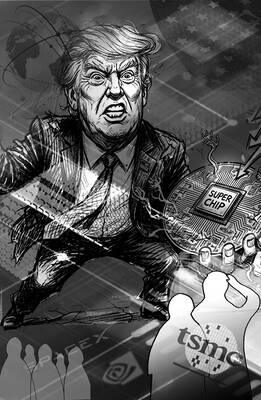
The White House’s decision to take a 9.9 percent stake in Intel Corp is looking like very shrewd business indeed. Since the government bought in at US$20.47 a share last August, the US chipmaker’s surging stock price has delivered the US a US$43 billion return. One of the reasons the investment has so far proved so sound is that the White House has made sure of it. According to The Wall Street Journal, Howard personally pushed deals on Intel’s behalf with some of the most lucrative clients imaginable. They include Nvidia Corp, the company at the heart of the AI
A single photograph can cut through a lot of noise, but it can also be used to misrepresent the truth. At the very least, it can concentrate the mind on something that requires further investigation. On Monday last week, Ma Ying-jeou Foundation CEO Tai Hsia-ling (戴遐齡) and former National Security Council secretary-general King Pu-tsung (金溥聰) held a news conference in which they showed a photograph of former foundation CEO Hsiao Hsu-tsen (蕭旭岑), now Chinese Nationalist Party (KMT) deputy chairman. In the image Hsiao is seated next to Xiamen Taiwan Businessmen Association chairman Han Ying-huan (韓螢煥). The two men were holding
I first met Professor Ray Jiing (井迎瑞) as a film and documentary student at Shih Hsin University’s (SHU) Department of Radio Television and Film in 1988. The following year, he went on to become the director of the Chinese Taipei Film Archive — forerunner of the Taiwan Film and Audiovisual Institute (TFAI). Over his eight-year tenure, Jiing rescued and restored over 200 classic Taiwanese films. In 1997, he established the Graduate Institute of Studies in Documentary and Film Archiving at Tainan National University of the Arts (TNNUA), and I joined the program in his third cohort of students. Beyond a
President William Lai Ching-te’s (賴清德) May 20 second-anniversary address was not just a routine policy review; it was damage control. US President Donald Trump’s remarks — that he did not want to see anyone move toward independence and that the delivery of a major Taiwan arms package could depend on the progress of US-China relations — unsettled Taiwan’s public and created an opening for opposition parties to question whether Taiwan was being treated as a bargaining chip in Washington’s dealings with Beijing. Lai’s speech was designed to close that opening. The address covered the expected ground: sovereignty, cross-strait relations, defense spending,


 RSS
RSS