


Preoccupied of late with war words, I have not kept up with the jonesing.
Jonesing for Joni was listed in Entertainment Weekly, describing a PBS documentary on the folk singer Joni Mitchell.
"For those of you who have been jonesing for an interactive theater fix" was the lead of a recent film review by Michael Gallucci in The Cleveland Scene.
"Love Is the Drug, and I'm Jonesing for a Hit" was the headline in The New York Observer over an article last month by Susan Shapiro kvetching about her husband's lack of sexual aggressiveness.
This is obviously a participle in play, presumably the latest, hot, with-it usage. On digging into the New York Times archives, however, I found this Oct. 19, 1970, citation in a profile of Alva John, a Harlem broadcaster: "That food may not be the most delicious in the world, but it's not nearly so dangerous as these jones you've been having."
The reporter, now Charlayne Hunter-Gault of PBS, explained in parenthesis: "A jones is a craving brought on by drug usage."
The root is a proper noun: For a reason I cannot fathom, Jones -- a family name held in my estimation by nearly 18 million Americans -- was applied in the early 1960s to heroin addiction. J.E. Lighter's Historical Dictionary of American Slang speculates about another possible origin: the male sex organ.
In the 1970s, the noun -- no longer capitalized -- most often referred to withdrawal symptoms, and made the transition to verb: jonesing out. In 1984, I noted that "jonesin' " was extended to mean "doin' nothin'," as addicts often do, but it was not until this millennium that the participle made the leap into popular speech as a generalized "craving."
"When I was little," says my colleague Maureen Dowd (meaning when she was growing up in Washington), "we used to say `jone-ing,' which meant `picking on.' When you were jone-ing on someone, you were mocking them." This local usage was overwhelmed by the national underground popularity of "jonesing," in its postnarcotics sense of "lusting for."
On Gawker Stalker, a Web site that observes, and leers and snickers at, personalities in the news, a notably slim fashion editor was spotted "zeta-jonesing on a McVeggie at the gaudy, fou-fou McDonald's on 42nd btw 8th & b'way."
Thus does the language come full circle. The allusion is to the actress Catherine Zeta-Jones, cattily scolded for adding a few pounds since her Oscar-winning performance in Chicago. Cruelly but creatively, the blogger applies her hyphenated last name to the lusting after a tasty burger by the hungry editor. To take the meaning of this nonce variation from the context, "zeta-jonesing" is "indulging in a craving for (meatless) food." This specialized usage returns "jonesing" to its original state of a proper noun in participle form.
In current slang use, "jonesing" has evolved from its narcotics-addiction base to a general lusting, craving or yearning. It seems to have shouldered aside "to have the hots for."
HARM'S WAY
As GW2 effectively ended, President Bush said, "We continue to pray for all who serve in our military and those who remain in harm's way." Next day, Secretary of State Colin Powell protested Russia's aid to Iraq, which "put our young men and women in harm's way."
"In danger" and "at risk" are seldom heard; we will now delve into the etymology of the operative phrase for potential trouble.
It did not start as the title of a 1965 movie starring John Wayne and Kirk Douglas. Rather, both "in harm's way" and "out of harm's way" popped up in the mid-17th century.
Thomas Manton, chaplain to Oliver Cromwell, delivered a sermon arguing that man's "duty is to run in harm's way" because "there are none so much harmed, maligned and opposed in the world, as those that follow that which is good, as those that will have no fellowship with the unfruitful works of darkness."
The phrase was immortalized in the Revolutionary War by Commodore John Paul Jones. The Scottish-born sailor is best known for his stirring "I have not yet begun to fight," uttered in 1779 aboard his sinking Bonhomme Richard (a salute to Benjamin Franklin's Poor Richard), after which Jones gained the surrender of the more powerful HMS Serapis.
As Evan Thomas points out in his coming biography, John Paul Jones: Sailor, Hero, Father of the American Navy, the year before, in 1778, the feisty captain specified in a letter what kind of ship he wanted to command: "I wish to have no connection with any ship that does not sail fast," he wrote, "for I intend to go in harm's way." Jones underlined both "fast" and the phrase now on everyone's lips: "in harm's way."
SECDEF
The Pentagon loves initialese; few Pentagonians realize that the word "initialese" was coined by the fourth secretary of defense, Robert Lovett, at a dinner in the Waldorf-Astoria hotel in New York in 1952.
As a cub reporter, I interviewed Lovett about that time for a profile in The New York Herald-Tribune.
He was amused by what he called the rampant shortenings: initialese like JCS for "Joint Chiefs of Staff" and half-acronyms like "Cincpac" for "Commander in Chief, Pacific," and "Cincaflant" for "Commander in Chief, Air Forces, Atlantic." (That last strikes me as too close to "sycophant." The acronym for "Commander in Chief, United States," was never adopted, because naval people in the White House thought it sounded suicidal.)
I asked Lovett about the initialese for his job as secretary of defense. The chief of Naval Operations was the CNO; the Department of Defense was DOD -- would he be known as the SOD?
"No," he replied, deadpan. "I have an ulcer. Rarely drink." I didn't get it then, but my British-born wife has since explained that one English slang meaning of "sod" (probably short for sodden, "soaked") is "drunk."
Which is why all secretaries of defense ever since, including today's Donald Rumsfeld, are known in Washington not by the acronym drawn from the abbreviation of their office, SOD, but as the "SecDef."
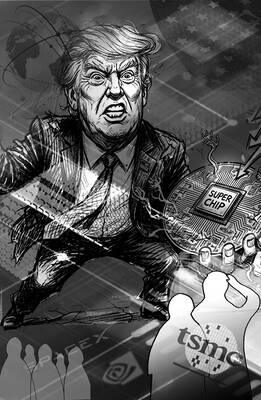
The White House’s decision to take a 9.9 percent stake in Intel Corp is looking like very shrewd business indeed. Since the government bought in at US$20.47 a share last August, the US chipmaker’s surging stock price has delivered the US a US$43 billion return. One of the reasons the investment has so far proved so sound is that the White House has made sure of it. According to The Wall Street Journal, Howard personally pushed deals on Intel’s behalf with some of the most lucrative clients imaginable. They include Nvidia Corp, the company at the heart of the AI
In a Taiwanese university classroom, a lecturer asks in English: “Can anyone give me an example from Taiwan?” Students look down. No one answers. After class, one student writes on the course platform in Mandarin: “I understood the concept, but I didn’t know how to answer in English.” That moment highlights a key issue in Taiwan’s English-medium instruction (EMI) reform: It is not just about more English-taught courses, but whether students can learn, participate and belong. EMI expansion is part of the Bilingual 2030 policy and the Ministry of Education’s BEST Program, aiming to improve English ability, support EMI teaching
The Ministry of the Interior, working with the navy and coast guard, is organizing Taiwan’s first joint exercise simulating escort tankers carrying liquefied natural gas (LNG) and oil through a Chinese blockade. The drills simulate fuel transport along three maritime corridors leading toward Japan, the Philippines and the US. Deputy Minister of the Interior Sawyer Mars (馬士元) said that a blockade of the Taiwan Strait would amount to “almost a 100 percent blockade of the regional energy supply.” Minister of National Defense Wellington Koo said planning to counter a blockade is standard practice in Taipei. While the exercise is limited in
A single photograph can cut through a lot of noise, but it can also be used to misrepresent the truth. At the very least, it can concentrate the mind on something that requires further investigation. On Monday last week, Ma Ying-jeou Foundation CEO Tai Hsia-ling (戴遐齡) and former National Security Council secretary-general King Pu-tsung (金溥聰) held a news conference in which they showed a photograph of former foundation CEO Hsiao Hsu-tsen (蕭旭岑), now Chinese Nationalist Party (KMT) deputy chairman. In the image Hsiao is seated next to Xiamen Taiwan Businessmen Association chairman Han Ying-huan (韓螢煥). The two men were holding


 RSS
RSS