


If the world is to have a decent economic recovery, an upturn will depend on America getting off its back and continuing to fulfill its role as global importer of last resort. No other country is capable of picking up the slack if America's economy remains soft. There is some optimism about Japan getting on its feet again, but over the past, vastly disappointing, decade, too many pseudo-recoveries have been glimpsed in Japan to justify such hopes.
Europe also seems likely to disappoint. Projections of European growth continue to decline, yet the outlook for government policy is for reduced spending and increased taxes as the fiscal stability and growth pact bites. Moreover, the European Central Bank appears helpless because it is bound by the self-imposed fetters of its inflation target. Nor are emerging markets yet large enough to play a meaningful role in the balance of total global demand.
So America remains the world economy's last best hope. But this is worrisome for two reasons. First, America cannot run enormous (and growing!) current-account deficits forever: at some point the desire of foreign investors to hold ever-increasing shares of their wealth in America must wane and then reverse. When that happens, the dollar will fall and the stimulus provided to the world by America's demand for imports will come to an end.
Second, there are no signs that the US government either understands or has the will to stimulate the American economy sufficiently to produce rapid economic growth. Consider US monetary policy. America's Federal Reserve has pushed the short-term safe interest rates it controls down to remarkably low levels -- 1.25 percent per year. Short-term interest rates cannot be pushed much lower. More importantly, would the limited amount that interest rates can yet be cut do much to boost demand? Not likely.
Long-term interest rates could be pushed significantly lower if the Federal Reserve were to undertake the unprecedented step of mammoth purchases of long-term government bonds. But would the Fed take that unprecedented step without a severe domestic crisis? A situation in which the US muddles through with growth that is positive but slower than the growth rate of potential output -- ? today's conditions -- is unlikely to prompt drastic action from the Fed. However, US growth that is positive but slow is of little help to the rest of the world.
Now consider fiscal policy. The baroque structure of US government has always been hostile to the effective exercise of fiscal policy. Attempts to use fiscal policy to stabilize the economy usually show up too late to help, no matter the situation. Fortunately, such efforts have usually been too small in magnitude to do significant economic destruction.
Until now. Whatever tax-law changes the US Congress approves this summer are unlikely to have big effects on the flow of purchasing power to households until April next year. Similarly, whatever spending increases the US Congress approves this fall will not have significant effects on government spending until the summer and fall of 2004. But this time, slow stimulus is amplified by failures in the design of the Bush economic program. Even the conservative-minded Economist observes that the Bush administration's proposals are not a short-term economic stimulus: they simply do "not provide the short, sharp boost for which many political leaders, including President George W. Bush himself, have been calling."
If and when the proposed tax cuts are fully phased in, they will not provide the US$1,000 a year boost to the income of 90 million households that the Bush administration implies they will. Instead, they will likely provide something like an additional US$250 a year to the incomes of typical households -- and much larger windfalls for households with annual incomes exceeding US$200,000. But these are the people least likely to take their tax cuts and spend them to boost aggregate demand.
Looking further out, US fiscal policy's long-run problems will become increasingly visible and urgent: there is not even a hint of a plan for reconciling the long-term costs of the social insurance state with American taxpayers' limited patience with high taxes. For most of the 1990s, the world economy did remarkably well, despite large-scale financial crises, the spread of AIDS in stagnating Africa, and the problems of transition economies. This was due to sound economic policy in the US (starting with the Bush-Mitchell-Foley tax increase of 1990), as well as some extraordinarily good luck in America.
There are no signs that wise economic policy in the US will continue in the first decade of the new century. If global prosperity is to return, America's economic luck will have to be even better than it was in the 1990s. The rest of the world economy would do well to play it safe and start making its own luck.
J. Bradford DeLong is professor of economics at the University of California at Berkeley and a former assistant US treasury secretary.
Copyright: Project Syndicate
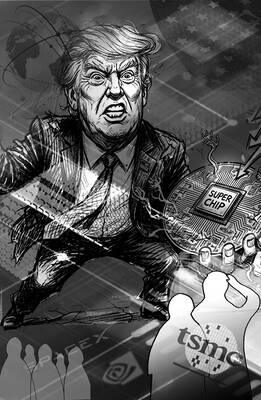
The White House’s decision to take a 9.9 percent stake in Intel Corp is looking like very shrewd business indeed. Since the government bought in at US$20.47 a share last August, the US chipmaker’s surging stock price has delivered the US a US$43 billion return. One of the reasons the investment has so far proved so sound is that the White House has made sure of it. According to The Wall Street Journal, Howard personally pushed deals on Intel’s behalf with some of the most lucrative clients imaginable. They include Nvidia Corp, the company at the heart of the AI
The Ministry of the Interior, working with the navy and coast guard, is organizing Taiwan’s first joint exercise simulating escort tankers carrying liquefied natural gas (LNG) and oil through a Chinese blockade. The drills simulate fuel transport along three maritime corridors leading toward Japan, the Philippines and the US. Deputy Minister of the Interior Sawyer Mars (馬士元) said that a blockade of the Taiwan Strait would amount to “almost a 100 percent blockade of the regional energy supply.” Minister of National Defense Wellington Koo said planning to counter a blockade is standard practice in Taipei. While the exercise is limited in
A single photograph can cut through a lot of noise, but it can also be used to misrepresent the truth. At the very least, it can concentrate the mind on something that requires further investigation. On Monday last week, Ma Ying-jeou Foundation CEO Tai Hsia-ling (戴遐齡) and former National Security Council secretary-general King Pu-tsung (金溥聰) held a news conference in which they showed a photograph of former foundation CEO Hsiao Hsu-tsen (蕭旭岑), now Chinese Nationalist Party (KMT) deputy chairman. In the image Hsiao is seated next to Xiamen Taiwan Businessmen Association chairman Han Ying-huan (韓螢煥). The two men were holding
I first met Professor Ray Jiing (井迎瑞) as a film and documentary student at Shih Hsin University’s (SHU) Department of Radio Television and Film in 1988. The following year, he went on to become the director of the Chinese Taipei Film Archive — forerunner of the Taiwan Film and Audiovisual Institute (TFAI). Over his eight-year tenure, Jiing rescued and restored over 200 classic Taiwanese films. In 1997, he established the Graduate Institute of Studies in Documentary and Film Archiving at Tainan National University of the Arts (TNNUA), and I joined the program in his third cohort of students. Beyond a


 RSS
RSS