


For some reason beyond our understanding the DPP suddenly has a bee in its bonnet about getting political influence out of the media. In particular it seems to be embarrassed by the sterling work that Legislator Trong Chai (蔡同榮) has done with Formosa TV to redress the absurd imbalance and quite obvious bias in the media's coverage of political affairs.
Anyone who remembers the runup to the 1996 presidential election will know how bad things used to be. The nightly flagship news programs on the three terrestrial TV channels, at that time controlled by the KMT, the ministry of defense and the Taiwan Provincial Government, devoted six minutes a night to Lee Teng-hui (李登輝) himself and another four minutes to other KMT news. The DPP, at the time going through a complicated series of primaries to select its candidate, got precisely no time whatsoever. As far as the media were concerned it was still a one-party state. Even the KMT admitted, in private, to being embarrassed.
Things have changed. For a start, Formosa TV was launched with an obvious bias toward the green camp. Then the KMT lost the election and so two of the three old terrestrials fell into the DPP's hands. The government now controls two terrestrials, the KMT one and Trong Chai and a gaggle of green-camp sympathizers a fourth. On top of this there are the cable and satellite channels: DPP lawmaker Chang Chun-hung (張俊宏) chairs the board of directors at Global TV, while TVBS has always been recognized as a mouthpiece for the more radically pro-China part of the blue camp. That there are clear political influences at work in broadcast media does not mean that there are not a plethora of opinions on offer. We are no longer force-fed only hagiography of the leader of the ruling party as the content of our nightly news programs, and a good thing too.
So it is puzzling why the DPP should suddenly revive the idea of "getting political influence out of the media." In the old days it wanted this because political influence was one-sided. These days that is not the case, on top of which, as TVBS demonstrates, lack of overt control by a particular political group does not make for editorial neutrality. An even better example of this is the print media, where any paper in existence before the lifting of martial law -- which means two out of the big three -- received its license because its publisher was a politically safe crony of the Chiang regime, a heritage which is still quite obvious in those newspapers' editorial content. Yet these are, of course, private companies, and whatever their editorial line is, it is not assumed on the orders of a political party.
Though it grieves us to say this, PFP lawmaker Shen Chih-hwei (沈智慧) -- who herself is the chairwoman of a radio station -- might be right when she accuses the government of reviving interest in this electoral promise to get politicians and political parties out of the media because it is one promise the DPP might actually be able to deliver on. The record of achievement is so thin that what we might now be seeing is the deliberate targeting of something assured of great public support -- whether or not it is justified -- and probably easy to push through the legislature, allowing the government to chalk up at least one success as the presidential election campaign opens. If this is the government's idea it is probably mistaken. The KMT will never give up control of CTV voluntarily. And in this legislature it cannot be compelled. And if it won't, why should Trong Chai get out of Formosa TV?
A gap appears to be emerging between Washington’s foreign policy elites and the broader American public on how the United States should respond to China’s rise. From my vantage working at a think tank in Washington, DC, and through regular travel around the United States, I increasingly experience two distinct discussions. This divergence — between America’s elite hawkishness and public caution — may become one of the least appreciated and most consequential external factors influencing Taiwan’s security environment in the years ahead. Within the American policy community, the dominant view of China has grown unmistakably tough. Many members of Congress, as
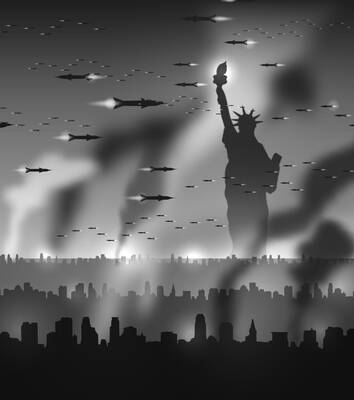
After declaring Iran’s military “gone,” US President Donald Trump appealed to the UK, France, Japan and South Korea — as well as China, Iran’s strategic partner — to send minesweepers and naval forces to reopen the Strait of Hormuz. When allies balked, the request turned into a warning: NATO would face “a very bad” future if it refused. The prevailing wisdom is that Trump faces a credibility problem: having spent years insulting allies, he finds they would not rally when he needs them. That is true, but superficial, as though a structural collapse could be caused by wounded feelings. Something
Former Taipei mayor and Taiwan People’s Party (TPP) founding chairman Ko Wen-je (柯文哲) was sentenced to 17 years in prison on Thursday, making headlines across major media. However, another case linked to the TPP — the indictment of Chinese immigrant Xu Chunying (徐春鶯) for alleged violations of the Anti-Infiltration Act (反滲透法) on Tuesday — has also stirred up heated discussions. Born in Shanghai, Xu became a resident of Taiwan through marriage in 1993. Currently the director of the Taiwan New Immigrant Development Association, she was elected to serve as legislator-at-large for the TPP in 2023, but was later charged with involvement
Out of 64 participating universities in this year’s Stars Program — through which schools directly recommend their top students to universities for admission — only 19 filled their admissions quotas. There were 922 vacancies, down more than 200 from last year; top universities had 37 unfilled places, 40 fewer than last year. The original purpose of the Stars Program was to expand admissions to a wider range of students. However, certain departments at elite universities that failed to meet their admissions quotas are not improving. Vacancies at top universities are linked to students’ program preferences on their applications, but inappropriate admission


 RSS
RSS