


France and Germany have every reason to celebrate the miracle of their friendship, sealed 40 years ago by the Elysee Treaty. But they have no reason to be satisfied with its current condition. Neither has Europe.
For most of modern history, the Franco-German antagonism -- the two countries' so-called "hereditary enmity" -- haunted Europe and the world. In his famous University of Zurich speech in 1946, Winston Churchill said, "The first step in the re-creation of the European Family must be a partnership between France and Germany." Franco-German reconciliation, guided by the leadership of men like General Charles de Gaulle and Konrad Adenauer, made post-war Europe's amazing successes possible.
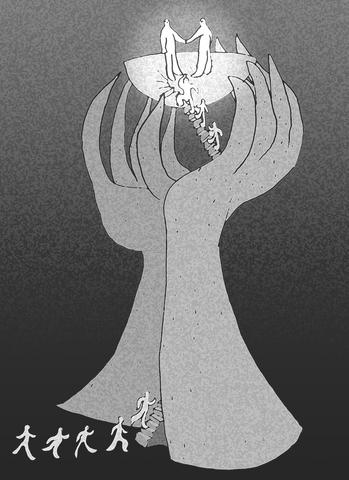
ILLUSTATION: MOUNTAIN PEOPLE
The last landmark in the Franco-German partnership was the Treaty of Maastricht, concluded in 1991. Reunited Germany surrendered its beloved currency, the mark, to boost European integration, but also to calm French fears that Germany was poised to establish monetary hegemony over the continent.
However, the legendary tandems of the past -- de Gaulle and Adenauer, Valery Giscard d'Estaing and Helmut Schmidt, Francois Mitterrand and Helmut Kohl -- have not been succeeded by a comparable duo. This is not only a problem of personal chemistry between Jacques Chirac and Gerhard Schroeder. The deeper cause of recent estrangement and national rivalry has been German reunification, which disturbed the bilateral balance.
Until 1990, France -- or, rather, much of its political class -- tacitly agreed with Nobel laureate Francois Mauriac's famous confession: "I love Germany so much that I prefer it to be split into two parts." Germany's division created a rough demographic parity between French and West Germans. By contrast, reunited Germany has some 80 million people, France only 60 million.
Moreover, a "balance of imbalance" promoted a sense of equality. While West Germany's economy was stronger, France was a nuclear power and a permanent, veto-wielding member of the UN Security Council. Germany long ago renounced possession of nuclear weapons, and it is unlikely to become a permanent member of the Security Council soon. Yet, from a French perspective, eastward enlargement of the EU augments Germany's weight. The future "Europe of 27" (or 28, with Turkey, but not counting the post-Yugoslav republics and Albania) will be very different from the "Europe of Six" that de Gaulle and Adenauer oversaw. Berlin's geographical position in the EU of tomorrow now seems more central, with Paris on the fringe.
Moreover, whereas the tone of German chancellors toward the French government had always been moderate, Schroeder's behavior has been assertive, with the EU's Nice summit in December 2000 driving Franco-German relations to a 40-year low point. Chirac insisted on absolute parity of votes between France and Germany in the EU Council of Ministers, ignoring their demographic disparity. Schroeder did not seem to grasp the enormous symbolic relevance his partner attached to the issue.
More importantly, the Nice meeting showed how far French and German ideas about European integration had drifted apart. While France prefers an intergovernmental approach, Germany remains prepared to transfer more national sovereignty to the Brussels.
Now, like a squabbling old couple, France and Germany are using their wedding anniversary as an opportunity to revive their partnership. Chirac and Schroeder gave a foretaste of what that means in practice when they made a joint proposal that the EU be led by a twin-presidency: a European Council president (chosen by the heads of government) and a commission president (elected by the European parliament). This compromise attempts to square the circle by combining the intergovernmental and unionist approaches.
Both governments seem convinced that more Franco-German summitry (now including joint sessions of their Cabinets) will remedy their marital crisis. Likewise, the extravagance of the jubilee celebrations in Versailles -- far more pompous than the modest ceremony in the Elysee 40 years ago -- will be inversely proportional to their political relevance.
The real problem is that revitalizing the Franco-German alliance must be based on a pro-European agenda, rather than each simply sticking to bad national habits. Unfortunately, there are worrying signs that this is happening.
For example, France remains unwilling to accept a fundamental reform of the EU's Common Agricultural Policy (CAP), of which it is the chief beneficiary. Last fall, Germany, the largest contributor to the EU budget, accepted a compromise prolonging the present CAP for a decade. As a result, farmers in future member countries will only receive 25 percent of West European levels of direct payments when they join next year, reaching parity only in 2013.
Germany, for its part, is better at signing agreements on enhanced defense cooperation among Europeans than it is at honoring them. It recently refused to purchase the full number of Airbus troop transport planes that it had promised to buy.
Most importantly, the political determination needed to begin long overdue social-welfare and labor-market reforms is weak in both countries. This is not only a domestic issue. As the most important Euro countries, France and Germany have a special responsibility for the health of Europe's economy and the credibility of its currency.
So let France and Germany enjoy their celebration in Versailles. When the party is over, hard choices must be made. No more time for nostalgia.
Michael Mertes, a former foreign policy advisor to Helmut Kohl, is an author and partner at Dimap Consult, a commercial think-tank based in Bonn and Berlin.
Copyright: Project Syndicate
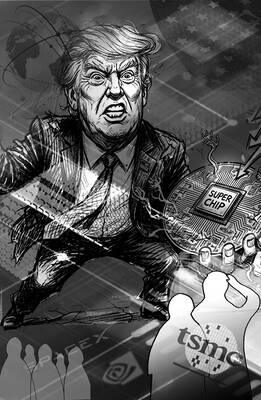
The White House’s decision to take a 9.9 percent stake in Intel Corp is looking like very shrewd business indeed. Since the government bought in at US$20.47 a share last August, the US chipmaker’s surging stock price has delivered the US a US$43 billion return. One of the reasons the investment has so far proved so sound is that the White House has made sure of it. According to The Wall Street Journal, Howard personally pushed deals on Intel’s behalf with some of the most lucrative clients imaginable. They include Nvidia Corp, the company at the heart of the AI
A single photograph can cut through a lot of noise, but it can also be used to misrepresent the truth. At the very least, it can concentrate the mind on something that requires further investigation. On Monday last week, Ma Ying-jeou Foundation CEO Tai Hsia-ling (戴遐齡) and former National Security Council secretary-general King Pu-tsung (金溥聰) held a news conference in which they showed a photograph of former foundation CEO Hsiao Hsu-tsen (蕭旭岑), now Chinese Nationalist Party (KMT) deputy chairman. In the image Hsiao is seated next to Xiamen Taiwan Businessmen Association chairman Han Ying-huan (韓螢煥). The two men were holding
I first met Professor Ray Jiing (井迎瑞) as a film and documentary student at Shih Hsin University’s (SHU) Department of Radio Television and Film in 1988. The following year, he went on to become the director of the Chinese Taipei Film Archive — forerunner of the Taiwan Film and Audiovisual Institute (TFAI). Over his eight-year tenure, Jiing rescued and restored over 200 classic Taiwanese films. In 1997, he established the Graduate Institute of Studies in Documentary and Film Archiving at Tainan National University of the Arts (TNNUA), and I joined the program in his third cohort of students. Beyond a
President William Lai Ching-te’s (賴清德) May 20 second-anniversary address was not just a routine policy review; it was damage control. US President Donald Trump’s remarks — that he did not want to see anyone move toward independence and that the delivery of a major Taiwan arms package could depend on the progress of US-China relations — unsettled Taiwan’s public and created an opening for opposition parties to question whether Taiwan was being treated as a bargaining chip in Washington’s dealings with Beijing. Lai’s speech was designed to close that opening. The address covered the expected ground: sovereignty, cross-strait relations, defense spending,


 RSS
RSS