


The Ministry of Finance took the first step toward correcting financial problems at the grass-roots level when it recently announced multi-tiered measures for managing the credit departments of farmers' and fishermen's associations. A high degree of consensus originally existed between all political parties regarding the termination of corrupt financial practices at these associations.
The reasons for this consensus were two-fold. First, the non-performing loan (NPL) ratios of these associations were high, and, if not rectified at an early stage, this problem would become a time bomb that could explode into a financial crisis at any time. Second, credit cooperatives were too small and uncompetitive, with low returns on investment even among those that were well managed. The system had to be changed and consolidated if it was to survive and develop.
As soon as the government submitted a concrete proposal for appropriate and timely reform, however, an immediate and clear division formed between the government and the opposition, and anti-reformist cries that farmers' and fishermen's associations will be abolished in the name of reform could be heard everywhere.
The reason for this reaction was that the associations have been used for a long time by the KMT as a resource for political mobilization and vote-buying during elections. Abolishing their credit departments would be tantamount to cutting off their lifeline and would have a corresponding impact on political parties.
The abnormal development of farmers' and fishermen's associations has continued for a long time, and each election of their representatives is attended by rumors of bribery. These corrupt practices are synonymous with Taiwan's "black gold" politics. This is a reform that must be carried out.
From the point of view of party politics, the reform of credit departments may have the following effects.
First, the TSU will expand its territory. In the past, the faction of old farmers among KMT legislators was the party's strongest pro-Lee Teng-hui (李登輝) group. When Lee took his leave of the KMT to organize the TSU, he would naturally have given priority to absorbing these people to bolster the strength of his new party. A reaction to the Cabinet's move for reform was inevitable. That the TSU will go with the flow and expand its territory with the help of the force of this reaction of course comes down to voter sentiment. It also shows that the relationship between the TSU and the DPP is one of superficial cooperation and underlying competition.
Second, the KMT will stick to its fundamentals. KMT power at the grassroots level still depends largely on local leaders, and when KMT Chairman Lien Chan (
Not only does the KMT pitch itself against public opinion, but it also takes a great gamble. If the KMT does not oppose these reforms, it will lose grassroots support. However, even if it does oppose reform, it cannot be sure of retaining grassroots support.
Third, the PFP will sit idly by and observe the situation. Even though the TSU is in line with the KMT and the PFP, according to the media, neither PFP Chairman James Soong (宋楚瑜) nor the party's legislative caucus whip has made any public statement about the reform. Maybe due to personal friendships with officials in farmers or fishermen's associations, or perhaps due to local voter sentiment, some PFP legislators may oppose reform measures.
But, as far as the PFP's voter base is concerned, the party has never had much support from this constituency. At the same time, thanks to the expertise and persistence of legislators with financial and economic backgrounds, I find blind opposition unlikely.
As far as anti-Lee sentiment and the party's relationship with the TSU are concerned, if the TSU says "east," the PFP will move west -- ie, now that Lee has voiced criticism and opposed the reform measures in public, the odds on the PFP supporting reform have increased significantly.
Fourth, the DPP stands to gain from the move. The imperative to end once and for all the corrupt practices of the farmers' and fishermen's credit departments is one that the DPP cannot shirk. But since reform will offend vested interests, a loss of votes from among those vested interests is inevitable. Reform will, however, enhance the party's reformist image, and it should be possible for it to make up for lost votes with new votes from the political center.
The Cabinet has already announced the financial reform program, and there is no way it can win back the voters it has already alienated. If the government now shrinks in the face of resistance, advocates of reform will be disenchanted and the Cabinet will lose at both ends.
Political considerations should not be used as an excuse for supporting or opposing the reform of farmers' and fishermen's associations. Turning this financial reform into a tool for political struggle would be the act of an irresponsible political party. NPL ratios at 100 of the 285 farmers' and fishermen's credit associations exceed 25 percent. At more than 175 associations they exceed 15 percent. If this is not corrected immediately, we will not dispel the clouds of a looming financial crisis.
Shen Fu-hsiung is a DPP lawmaker.
Translated by Perry Svensson
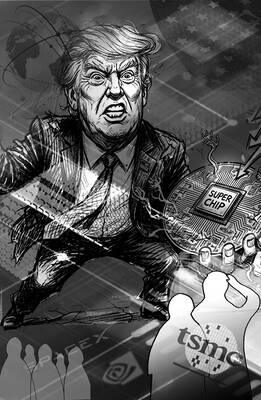
The White House’s decision to take a 9.9 percent stake in Intel Corp is looking like very shrewd business indeed. Since the government bought in at US$20.47 a share last August, the US chipmaker’s surging stock price has delivered the US a US$43 billion return. One of the reasons the investment has so far proved so sound is that the White House has made sure of it. According to The Wall Street Journal, Howard personally pushed deals on Intel’s behalf with some of the most lucrative clients imaginable. They include Nvidia Corp, the company at the heart of the AI
In a Taiwanese university classroom, a lecturer asks in English: “Can anyone give me an example from Taiwan?” Students look down. No one answers. After class, one student writes on the course platform in Mandarin: “I understood the concept, but I didn’t know how to answer in English.” That moment highlights a key issue in Taiwan’s English-medium instruction (EMI) reform: It is not just about more English-taught courses, but whether students can learn, participate and belong. EMI expansion is part of the Bilingual 2030 policy and the Ministry of Education’s BEST Program, aiming to improve English ability, support EMI teaching
A single photograph can cut through a lot of noise, but it can also be used to misrepresent the truth. At the very least, it can concentrate the mind on something that requires further investigation. On Monday last week, Ma Ying-jeou Foundation CEO Tai Hsia-ling (戴遐齡) and former National Security Council secretary-general King Pu-tsung (金溥聰) held a news conference in which they showed a photograph of former foundation CEO Hsiao Hsu-tsen (蕭旭岑), now Chinese Nationalist Party (KMT) deputy chairman. In the image Hsiao is seated next to Xiamen Taiwan Businessmen Association chairman Han Ying-huan (韓螢煥). The two men were holding
The Ministry of the Interior, working with the navy and coast guard, is organizing Taiwan’s first joint exercise simulating escort tankers carrying liquefied natural gas (LNG) and oil through a Chinese blockade. The drills simulate fuel transport along three maritime corridors leading toward Japan, the Philippines and the US. Deputy Minister of the Interior Sawyer Mars (馬士元) said that a blockade of the Taiwan Strait would amount to “almost a 100 percent blockade of the regional energy supply.” Minister of National Defense Wellington Koo said planning to counter a blockade is standard practice in Taipei. While the exercise is limited in


 RSS
RSS