


The nation's Constitution was enacted in China more than half a century ago with the people of Taiwan having no say in its creation. The people sent to China for the constitutional conferences did not represent Taiwanese public opinion. It is therefore extremely unfair that the people of Taiwan must accept as the basis for all their laws and regulations a Constitution adopted in China in 1947 -- a Constitution that has frequently caused political difficulties.
The most frequently ridiculed part of the Constitution is its insistence that the ROC's territory still includes all of China, including Outer Mongolia, which has long been the independent Republic of Mongolia. This ludicrous territorial claim, combined with the stubbornness and shallowness of the Chiang Kai-shek (蔣介石) government, led to Taiwan's ouster from the UN. It has also facilitated the Beijing government's claim that Taiwan is a local government under its jur-isdiction. Apart from the Feb. 28 massacre and the subsequent White Terror persecution, this ridiculous state of affairs is the most damaging thing done to the people of Taiwan by the Chiang regime.
Following Taiwan's speedy democratization, the significance of the Constitution has been reduced to almost that of a historical document. It is at odds with the realities of democratic politics Taiwan has been practicing for many years. Not in its articles nor in its spirit does the Constitution reflect the overall direction of Taiwan's democratization, despite the minor amendments made by the previous KMT government.
Since Taiwan abolished the National Assembly and began holding direct presidential elections, the Presidential Office and the Legislative Yuan have become the main seats of power in Taiwan's democratic political system. Meanwhile, party politics has also taken root. However, the semi-presidential system adopted in the Constitution is an obstacle to the realization of political accountability. For example, while the elected president should have executive power, he should also take political responsibility and be effectively monitored by the legislative branch. But these key mechanisms for constitutional politics do not exist. This has led to situations in which the elected president's power does not match his responsibilities.
Such situations do not bode well for the development of constitutional politics in Taiwan. We do not believe the French semi-presidential system can thoroughly resolve the deep-seated problems in Taiwan's Constitution. A US-style presidential system would better suit the general direction of Taiwan's political development. Also, the unwieldy five-branch structure of Taiwan's constitution has proven, after so many years of implementation, to be at odds with the principles of power distribution and balance. It should be amended into a three-branch structure.
Certainly, constitutional amendments should not be done in a hurry. Professor Lee Hong-hsi (
A gap appears to be emerging between Washington’s foreign policy elites and the broader American public on how the United States should respond to China’s rise. From my vantage working at a think tank in Washington, DC, and through regular travel around the United States, I increasingly experience two distinct discussions. This divergence — between America’s elite hawkishness and public caution — may become one of the least appreciated and most consequential external factors influencing Taiwan’s security environment in the years ahead. Within the American policy community, the dominant view of China has grown unmistakably tough. Many members of Congress, as
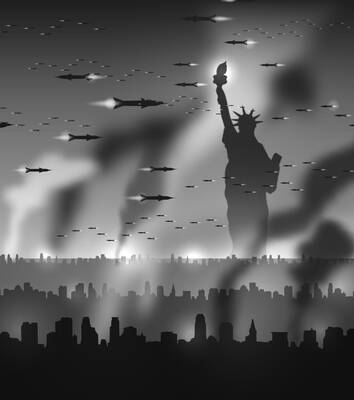
After declaring Iran’s military “gone,” US President Donald Trump appealed to the UK, France, Japan and South Korea — as well as China, Iran’s strategic partner — to send minesweepers and naval forces to reopen the Strait of Hormuz. When allies balked, the request turned into a warning: NATO would face “a very bad” future if it refused. The prevailing wisdom is that Trump faces a credibility problem: having spent years insulting allies, he finds they would not rally when he needs them. That is true, but superficial, as though a structural collapse could be caused by wounded feelings. Something
Former Taipei mayor and Taiwan People’s Party (TPP) founding chairman Ko Wen-je (柯文哲) was sentenced to 17 years in prison on Thursday, making headlines across major media. However, another case linked to the TPP — the indictment of Chinese immigrant Xu Chunying (徐春鶯) for alleged violations of the Anti-Infiltration Act (反滲透法) on Tuesday — has also stirred up heated discussions. Born in Shanghai, Xu became a resident of Taiwan through marriage in 1993. Currently the director of the Taiwan New Immigrant Development Association, she was elected to serve as legislator-at-large for the TPP in 2023, but was later charged with involvement
Out of 64 participating universities in this year’s Stars Program — through which schools directly recommend their top students to universities for admission — only 19 filled their admissions quotas. There were 922 vacancies, down more than 200 from last year; top universities had 37 unfilled places, 40 fewer than last year. The original purpose of the Stars Program was to expand admissions to a wider range of students. However, certain departments at elite universities that failed to meet their admissions quotas are not improving. Vacancies at top universities are linked to students’ program preferences on their applications, but inappropriate admission


 RSS
RSS