


A major public policy dispute has broken out over the Fourth Nuclear Power Plant (
Unlike more advanced democracies, Taiwan did not go through an "enlightenment" period. But the ideas presented by French Enlightenment thinker Jean Jacques Rousseau in his major work The Social Contract can still shed some light on the nuclear plant issue.
First of all, Rousseau thought citizens should be concerned about national affairs. "As soon as public service ceases to be citizens' chief business ... the State is not far from its fall," he said.
The deputies of the people, therefore, are merely their stewards -- not their representatives -- because "sovereignty ... cannot be represented."
"The people of England regard themselves as free; but they are grossly mistaken; they are free only during the election of members of parliament. As soon as the MPs are elected, the people become slaves," he said.
Rousseau believed there is often a great difference between the "will of all" (volonte de tous) and the "general will" (volonte generale). The latter considers only the common interest, and is a "pure activity of the intellect."
In contrast, the "will of all" takes private interest into account, and is no more than a sum of particular wills, according to Rousseau.
Each person gives himself or herself to the supreme leadership of the "general will" in accordance with the social contract -- not to any individual or political party.
When it comes to voting on public affairs, Rousseau said, "The more concert reigns in the assemblies ... the greater is the dominance of the general will. Conversely, long debates, dissensions and tumult proclaim the ascendancy of particular interests and the decline of the State." Also, the more important a public policy decision is, the more unanimity of opinion it requires.
Rousseau's thought has had an impact on democratic politics in the US and Western Europe. Looking from Rousseau's perspective, the key point in the nuclear power plant dispute is not about whether the Legislative Yuan has the power to decide on the resumption of construction, or whether the Executive Yuan has the power to halt construction.
Such an important public policy issue must be decided by the people's will, and the people have the obligation to be concerned about the issue and to decide the plant's fate. The people only abide by the "general will" -- not the "will of all." Obviously, the nuclear plant is a public policy issue related to Taiwan's long-term survival and development, and therefore should be debated until a majority of people agree. Only then will any decision represent the "general will." Otherwise, both the Executive Yuan's unilateral decision to scrap the plant, and the Legislative Yuan's decision to resume construction, will remain merely the "wills of all," none of which are decisions that the people should accept.
If thedecision to build the Fourth Nuclear Power Plant is incorreect, then the Legislative Yuan's decision to resume construction can still be changed. If the policy of building the plant is correct, then the Executive Yuan can resume construction even if the Legislative Yuan's decision is interpreted as not legally binding.
What the people are concerned about is this: if the ruling party believes its anti-nuclear policy is right, then why didn't it put any greater efforts into promoting its policy and winning over public support during its first six months in power before making the decision?
In particular, why didn't it explain to the people in detail that there would be no power shortages without the plant, what alternatives were available, and how the aftermath of the scrapped construction would be handled? Would it be feasible to build the plant and then decommission the first, second and third nuclear power plants successively?
Similarly, the people will also ask the opposition alliance: if its final goal is to build a nuclear-free nation, then why must it insist on building the plant? Is it because we have no other alternatives? If the plant is built, then how are we to handle the nuclear waste -- a major concern in the anti-nuclear camp?
Also, recent tectonic changes around the world have triggered one major earthquake after another, including the recent quakes in Central America and India. Taiwan's 921 earthquake destroyed every single house around the epicenter. How are the people to evacuate if the epicenter of a future tremor happens to be near the plant?
In 1996, China test-fired missiles into the sea off Keelung -- not too far from Kungliao, the site of the plant. What will happen if China fires missiles at the plant by mistake when cross-strait relations are tense? If US technology was not able to prevent the accidental missile attack on the Chinese embassy in Belgrade, how can we be so sure about the accuracy of Chinese missiles?
Nuclear plants are a controversial issue all over the world. Unlike the unification-independence dispute, this does not have to do with ethnic issues. The government should hold televised debates on the issue just like those during the presidential election campaign.
Are the people of Taiwan free only during elections, as Rousseau put it? Do they become slaves as soon as the elections are over? Why do we only see "general wills" fighting over this issue -- why can't we see the "will of all?" Why is it that we are only seeing political struggles instead of political persuasion?
Hsiao Hsiung-lin is an associate professor at National Taipei University.
Translated by Francis Huang
A gap appears to be emerging between Washington’s foreign policy elites and the broader American public on how the United States should respond to China’s rise. From my vantage working at a think tank in Washington, DC, and through regular travel around the United States, I increasingly experience two distinct discussions. This divergence — between America’s elite hawkishness and public caution — may become one of the least appreciated and most consequential external factors influencing Taiwan’s security environment in the years ahead. Within the American policy community, the dominant view of China has grown unmistakably tough. Many members of Congress, as
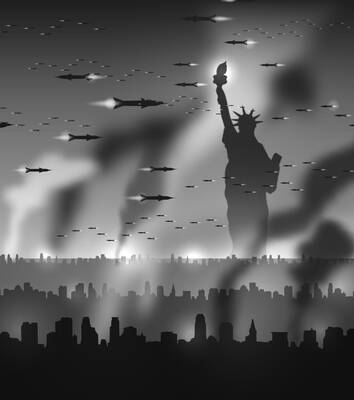
After declaring Iran’s military “gone,” US President Donald Trump appealed to the UK, France, Japan and South Korea — as well as China, Iran’s strategic partner — to send minesweepers and naval forces to reopen the Strait of Hormuz. When allies balked, the request turned into a warning: NATO would face “a very bad” future if it refused. The prevailing wisdom is that Trump faces a credibility problem: having spent years insulting allies, he finds they would not rally when he needs them. That is true, but superficial, as though a structural collapse could be caused by wounded feelings. Something
Former Taipei mayor and Taiwan People’s Party (TPP) founding chairman Ko Wen-je (柯文哲) was sentenced to 17 years in prison on Thursday, making headlines across major media. However, another case linked to the TPP — the indictment of Chinese immigrant Xu Chunying (徐春鶯) for alleged violations of the Anti-Infiltration Act (反滲透法) on Tuesday — has also stirred up heated discussions. Born in Shanghai, Xu became a resident of Taiwan through marriage in 1993. Currently the director of the Taiwan New Immigrant Development Association, she was elected to serve as legislator-at-large for the TPP in 2023, but was later charged with involvement
Out of 64 participating universities in this year’s Stars Program — through which schools directly recommend their top students to universities for admission — only 19 filled their admissions quotas. There were 922 vacancies, down more than 200 from last year; top universities had 37 unfilled places, 40 fewer than last year. The original purpose of the Stars Program was to expand admissions to a wider range of students. However, certain departments at elite universities that failed to meet their admissions quotas are not improving. Vacancies at top universities are linked to students’ program preferences on their applications, but inappropriate admission


 RSS
RSS