


Shortly after his retirement from the National Security Bureau (NSB), Major General Pan Hsi-hsien (潘希賢), the bureau's former personnel chief, left Taiwan to take up a position in China with the subsidiary of a Taiwanese firm. Initially, the incident merely exposed the flaws in implementing Taiwan's national security measures. However, Pan's detainment by Beijing authorities has highlighted the safety problems facing Taiwanese businessmen in China.
Over time, the Chinese government has gotten into the practice of labeling Taiwan businessmen as "Taiwanese spies" to justify its invasion of these individuals' personal liberty and safety. The return of Pan appears especially urgent, in view of this emerging practice.
Reportedly, Pan told the media that he had "erroneously entered the bandit-region"
Pan's account is hardly believable. In reality, the restrictions are virtually unenforceable and have become nothing more than a basis for appeals to an indivi-dual's conscience.
Article 9 of the "Statute Governing Relations Between The People On The Two Sides of The Taiwan Strait"
Article 15 of the "Regulation For Citizens In The Taiwan Area To Apply For Permission To Enter The Mainland Area" (
Since those who violate the regulation might lose their government positions, the rule naturally has a lot more force with incumbent civil servants than with retirees or those who have left their sensitive jobs. Those who have already left their government jobs face little risk of detection by the relevant security authorities if they enter China via a third country. Should they be caught, they merely face a fine of between NT$20,000 and NT$100,000. As the fines are an ineffective deterrent, the restriction is virtually unenforceable.
According to the regulations, an administrative or intelligence official has two weeks after his or her departure from a government position to notify the Bureau of Immigration
Pan retired from military service on June 1 and left for China on June 4 via Hong Kong. Obviously, he entered the "bandit region," not because he was ignorant of the regulations, but because he knew enough to enter China before the Bureau of Immigration learned about his retirement. The ineffectiveness of fines and the time lag make it hard to stop those who intentionally plan to violate the rules. Under the circumstances, it seems quite clear how existing regulations and law should be amended to address these problems.
The restriction on entry into China is obviously imposed out of national security considerations. The goal is to stop former government personnel from "joining the bandits" immediately after leaving their posts and leaking confidential information.
Another goal of the regulations is to protect the person in question. China has been severely criticized by the US and European countries for its human rights violations. The safety of businessmen in China is, therefore, under threat. Two years ago, China falsely accused a Taiwanese businessman, Kou Chien-ming
Pan put himself in peril when he entered China right after his retirement. He did nothing more than enter China without permission from Taiwan authorities. But the extensive media coverage of his trip led to him being labeled a "spy" by Chinese authorities and led to his detainment. Once China took Pan into custody, the case evolved into a suspected espionage incident. NSB Director-General Ting Yu-chou
Many Taiwanese business people have been kidnapped and murdered in China. The personal safety and property of the Taiwanese business community in China are threatened. If they also have to worry about espionage charges, an enormous political risk is being added to Tai-wanese investments in China
Pan's plight shows Taiwanese businessmen that the Chinese government is still waging a Cold War against Taiwan. This will only decrease the willingness of Taiwanese to invest in China.
Pan is obviously not a spy. Therefore, Beijing must release him as soon as possible.
Lee Ching-hsiung is a Taiwan Independence Party legislator.
Translated by Lise Chen
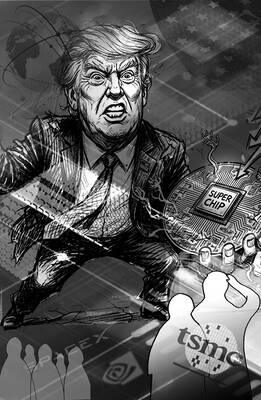
The White House’s decision to take a 9.9 percent stake in Intel Corp is looking like very shrewd business indeed. Since the government bought in at US$20.47 a share last August, the US chipmaker’s surging stock price has delivered the US a US$43 billion return. One of the reasons the investment has so far proved so sound is that the White House has made sure of it. According to The Wall Street Journal, Howard personally pushed deals on Intel’s behalf with some of the most lucrative clients imaginable. They include Nvidia Corp, the company at the heart of the AI
In a Taiwanese university classroom, a lecturer asks in English: “Can anyone give me an example from Taiwan?” Students look down. No one answers. After class, one student writes on the course platform in Mandarin: “I understood the concept, but I didn’t know how to answer in English.” That moment highlights a key issue in Taiwan’s English-medium instruction (EMI) reform: It is not just about more English-taught courses, but whether students can learn, participate and belong. EMI expansion is part of the Bilingual 2030 policy and the Ministry of Education’s BEST Program, aiming to improve English ability, support EMI teaching
The Ministry of the Interior, working with the navy and coast guard, is organizing Taiwan’s first joint exercise simulating escort tankers carrying liquefied natural gas (LNG) and oil through a Chinese blockade. The drills simulate fuel transport along three maritime corridors leading toward Japan, the Philippines and the US. Deputy Minister of the Interior Sawyer Mars (馬士元) said that a blockade of the Taiwan Strait would amount to “almost a 100 percent blockade of the regional energy supply.” Minister of National Defense Wellington Koo said planning to counter a blockade is standard practice in Taipei. While the exercise is limited in
A single photograph can cut through a lot of noise, but it can also be used to misrepresent the truth. At the very least, it can concentrate the mind on something that requires further investigation. On Monday last week, Ma Ying-jeou Foundation CEO Tai Hsia-ling (戴遐齡) and former National Security Council secretary-general King Pu-tsung (金溥聰) held a news conference in which they showed a photograph of former foundation CEO Hsiao Hsu-tsen (蕭旭岑), now Chinese Nationalist Party (KMT) deputy chairman. In the image Hsiao is seated next to Xiamen Taiwan Businessmen Association chairman Han Ying-huan (韓螢煥). The two men were holding


 RSS
RSS