


President Chen Shui-bian
His comment sparked off criticism and praise from ministers and local governments and loud opposition by the mayor of Taichung City and the commissioner of Taichung County. It is true, as Chen said, that it is not important whether local governments are upgraded or not, as long as the central government can come up with a way of dealing with the fiscal and manpower concerns of localities.
The new administration, therefore, must plan for a comprehensive long-term solution. Uncoordinated short-term fixes just to get votes won't work.
The downsizing of the provincial government did away with the subsidies it used to distribute to local governments, heightening the disparity of resources between municipalities and other local governments. Many mountainous localities -- populated mostly by Aborigines (including Orchid Island) -- have long suffered under a system that does not take into account differences in culture, way of life, or the natural environment. These localities should strive for political autonomy.
Chen's promises should be realized by revising the laws governing local governmental structures and passing a new "National Land Law"
Rapid development in Taiwan has created the problem of a megalopolis -- linked urban areas that cross administrative borders. Traffic, the economy, urban development and consumption are all now linked in these areas and must be tackled together.
If the Taichung City government becomes a special municipality or if a number of Taichung County townships are merged into Taichung City before its government is upgraded, then how will the central government deal with problems between the city and county governments in Taipei, Hsinchu, Chiayi, Tainan and Kaohsiung? And what about Keelung?
If Taichung City is upgraded the new administration should expect a backlash from local political factions and squabbling over resources.
Chen should base his policy on the overall national interest and do away with old political burdens that clog Taiwan's political system.
He should forsake political maneuvering aimed at winning votes and concentrate on establishing a safe and secure domestic environment. Chen should place no less importance on reforming local politics than cross-strait issues.
Wang To is a DPP Legislator.
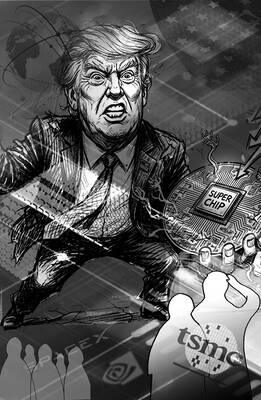
The White House’s decision to take a 9.9 percent stake in Intel Corp is looking like very shrewd business indeed. Since the government bought in at US$20.47 a share last August, the US chipmaker’s surging stock price has delivered the US a US$43 billion return. One of the reasons the investment has so far proved so sound is that the White House has made sure of it. According to The Wall Street Journal, Howard personally pushed deals on Intel’s behalf with some of the most lucrative clients imaginable. They include Nvidia Corp, the company at the heart of the AI
A single photograph can cut through a lot of noise, but it can also be used to misrepresent the truth. At the very least, it can concentrate the mind on something that requires further investigation. On Monday last week, Ma Ying-jeou Foundation CEO Tai Hsia-ling (戴遐齡) and former National Security Council secretary-general King Pu-tsung (金溥聰) held a news conference in which they showed a photograph of former foundation CEO Hsiao Hsu-tsen (蕭旭岑), now Chinese Nationalist Party (KMT) deputy chairman. In the image Hsiao is seated next to Xiamen Taiwan Businessmen Association chairman Han Ying-huan (韓螢煥). The two men were holding
I first met Professor Ray Jiing (井迎瑞) as a film and documentary student at Shih Hsin University’s (SHU) Department of Radio Television and Film in 1988. The following year, he went on to become the director of the Chinese Taipei Film Archive — forerunner of the Taiwan Film and Audiovisual Institute (TFAI). Over his eight-year tenure, Jiing rescued and restored over 200 classic Taiwanese films. In 1997, he established the Graduate Institute of Studies in Documentary and Film Archiving at Tainan National University of the Arts (TNNUA), and I joined the program in his third cohort of students. Beyond a
President William Lai Ching-te’s (賴清德) May 20 second-anniversary address was not just a routine policy review; it was damage control. US President Donald Trump’s remarks — that he did not want to see anyone move toward independence and that the delivery of a major Taiwan arms package could depend on the progress of US-China relations — unsettled Taiwan’s public and created an opening for opposition parties to question whether Taiwan was being treated as a bargaining chip in Washington’s dealings with Beijing. Lai’s speech was designed to close that opening. The address covered the expected ground: sovereignty, cross-strait relations, defense spending,


 RSS
RSS