


There won't be any marching bands, folk dancers, flag twirlers or acrobats in the square in front of the presidential office today; Double Ten National Day celebrations have been cancelled as a result of the 921 earthquake. People are not in the mood to celebrate. Those whose lives have been wrecked by the quake probably do not feel much like reflecting on political issues either. Yet the lack of National Day hoopla does afford an excellent opportunity to reflect on what exactly the significance of Double Ten day might be.
Double Ten day, as every Taiwanese knows, celebrates the Wuchang uprising in 1911, which led to the overthrow of the Qing dynasty and the establishment of the Republic of China. It doesn't matter that much of the mythology surrounding the uprising is erroneous; that the uprising happened by accident -- the conspirators' plans were exposed to the Qing authorities by a home-made bomb exploding; the conspirators either had to go ahead with an uprising or face almost immediate execution -- nor that the so-called father of the country Sun Yat-sen was in the US at the time, and far from hurrying home to lead the revolt, hurried to London to persuade the British government to back his claim to be the leader of the republican government. Oh well, few national myths conform to the historical record.
What is more to the point from the Taiwanese point of view is, of course, that at the time the uprising took place Taiwan had been a Japanese territory for 16 years and was to remain so for another 34. Then it was not returned to China as the government claims, but rather was given to the Chinese government to run pending a final settlement of the claims against Japan resulting from WWII. The subsequent flight of the Chinese government to Taiwan and its maintenance of a colonial regime in which locals were excluded from political power is hardly something for the Taiwanese to celebrate, nor is the fact that they have been forced to adopt the mainland-China derived national mythology of their occupiers.
So why celebrate Double Ten day in Taiwan. For 40 years after the mainland occupation this reason might well have been that it was impolitic not to. But today? The Wuchang uprising is not part of Taiwan's history, but of another country, a country to which Taiwan's link had been severed by the time the uprising took place and which has never, either legally or emotionally, been restored. Perhaps Taiwan is unique in that its National Day commemorates something that happened somewhere else to other people. It is, of course, a wonderfully apt metaphor for the confusion of identity which defines Taiwan's psychology.
What might therefore be substituted as a National Day if the government could ever admit the reality of the inappropriateness of Double Ten? How about July 15, the end of martial law in 1987? Then again there is Dec. 21, to commemorate Taiwan's first real democratic election -- for the National Assembly -- in 1991. Or there's March 23 to commemorate the election of the president in 1996 which marked the completion of Taiwan's formal democratization -- though some might think it unsuitable to select such a date while the winner of that election is still in power.
There is one more date worth considering, May 25. This commemorates the establishment in Taipei of the Republic of Taiwan in 1895 by a rebel movement unwilling to accept the abandonment of the island by the Qing and its succession to Japan. Since the republic collapsed after 11 days, there seems little to celebrate perhaps. But then, that it did collapse, and so quickly, contains a very useful lesson to Taiwanese about their society's fragility.

A gap appears to be emerging between Washington’s foreign policy elites and the broader American public on how the United States should respond to China’s rise. From my vantage working at a think tank in Washington, DC, and through regular travel around the United States, I increasingly experience two distinct discussions. This divergence — between America’s elite hawkishness and public caution — may become one of the least appreciated and most consequential external factors influencing Taiwan’s security environment in the years ahead. Within the American policy community, the dominant view of China has grown unmistakably tough. Many members of Congress, as
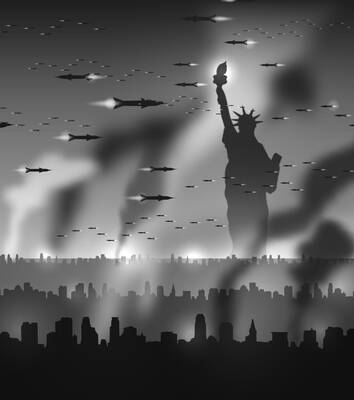
After declaring Iran’s military “gone,” US President Donald Trump appealed to the UK, France, Japan and South Korea — as well as China, Iran’s strategic partner — to send minesweepers and naval forces to reopen the Strait of Hormuz. When allies balked, the request turned into a warning: NATO would face “a very bad” future if it refused. The prevailing wisdom is that Trump faces a credibility problem: having spent years insulting allies, he finds they would not rally when he needs them. That is true, but superficial, as though a structural collapse could be caused by wounded feelings. Something
Former Taipei mayor and Taiwan People’s Party (TPP) founding chairman Ko Wen-je (柯文哲) was sentenced to 17 years in prison on Thursday, making headlines across major media. However, another case linked to the TPP — the indictment of Chinese immigrant Xu Chunying (徐春鶯) for alleged violations of the Anti-Infiltration Act (反滲透法) on Tuesday — has also stirred up heated discussions. Born in Shanghai, Xu became a resident of Taiwan through marriage in 1993. Currently the director of the Taiwan New Immigrant Development Association, she was elected to serve as legislator-at-large for the TPP in 2023, but was later charged with involvement
Out of 64 participating universities in this year’s Stars Program — through which schools directly recommend their top students to universities for admission — only 19 filled their admissions quotas. There were 922 vacancies, down more than 200 from last year; top universities had 37 unfilled places, 40 fewer than last year. The original purpose of the Stars Program was to expand admissions to a wider range of students. However, certain departments at elite universities that failed to meet their admissions quotas are not improving. Vacancies at top universities are linked to students’ program preferences on their applications, but inappropriate admission


 RSS
RSS