


The media has been full of news about Premier Frank Hsieh's (謝長廷) intention to allow casinos on Kinmen, an idea he has apparently discussed with President Chen Shui-bian (陳水扁). The news has politicians on Penghu champing at the bit to get a slice of the pie. From the chorus of approval rising from both sides of the political spectrum in the legislature, it does appear that Hsieh has worked wonders at achieving harmony in local politics. In one fell swoop he removed the necessity of rectifying the name of Taiwan, as a new ROC has just been born: the "Republic of Casino."
Hsieh has made it clear that, if the residents of Kinmen agree to the proposal and the appropriate legislation is passed, the government would lend its help. Clearly the government does not intend to obstruct the idea.
There is very little sense in all of this. To make matters worse, the premier even seems to want to involve the Democratic Progressive Party in this dodgy affair by calling on the party caucus to hold an open vote on the proposal among its legislators. His reasoning appears to be that he should create the impression that the central government is merely bowing to the wishes of the legislators, and that it should not prevaricate in carrying out the legislators' orders.
If the caucus doesn't want to risk its reputation by being seen as a supporter of gambling, it can evade responsibility by holding a secret ballot on the issue, so that legislators can freely express their individual preferences. Politicians can reap huge benefits by lifting the gambling ban, while the government and governing party avoids the ignominy of being branded as pro-gambling.
But have the premier and his Cabinet consulted affected parties on both sides of this contentious issue, or initiated a public debate about it? Have they seriously addressed the concrete reasons or reams of evidence against the establishment of casinos? Have they made the public aware of the numerous authoritative studies containing persuasive arguments against the motion they are proposing? No, they have not. Not in any way, shape or form.
We are totally opposed to lifting the ban on gambling on Kinmen and Penghu, either in accordance with the wishes of the local government or through an anonymous vote in the legislature. We are against the very idea of allowing casinos to open in certain appointed regions, even if the residents of the area favor the proposal.
If the Cabinet doesn't want to be seen as pro-gambling, it should allow people both for and against gambling to make their voices heard and submit the issue to media debate. The public will then be able to make a decision based on information about the possible consequences of lifting the ban on gambling, and a referendum can be held. The reasons for this are as follow:
First, the residents of the islands would be more likely to indulge in gambling if they have a casino on their doorstep, and they are likely to gamble themselves out of house and home and ruin their families and reputations. Therefore, even if casinos are only opened in a specific district, it will still lead to public security concerns, create a public nuisance and have an impact on politics, the economy, education and culture. This will exert a far-reaching influence on the public at large.
Where there is gambling, there is black-gold politics, and it will be the root cause of suffering among innocent bystanders. Since the decision would have far-reaching consequences, it should be placed before the general public in a referendum.
Second, if gambling in Penghu and Kinmen were to be approved in a referendum, Matsu, Lanyu and other outlying islands will likely follow suit. There will be a domino effect, eventually bringing legalized gambling from the outlying islands to the main island, making Taiwan a full-fledged "Republic of Casino."
Third, research conducted by the University of Illinois in the US found that for each US$1 the government earns from taxes on gambling, it has to fork out US$3 in social welfare benefits. Legalizing gambling on outlying islands is not the way to develop the economy. Politicians advocating the legalization of gambling should not cheat the public with talk of NT$70 billion in tax revenue. Instead, they should honestly explain why the public should pay NT$210 billion for social welfare in exchange for NT$70 billion in tax revenue.
Politicians from the pan-blue and pan-green camps are at odds with each other on almost every issue. But both camps are in favor of the legalization of gambling. If this is what is meant by "symbiosis," then it is a matter of both camps living in parasitic symbiosis with tremendously inappropriate benefits. It will corrupt the souls of gamblers and break their families.
It is truly disheartening to see that while inter-party strife has eased, Hsieh's philosophy of reconciliation and symbiosis has turned into reconciliation with the underworld and living in symbiosis with sin. The promptness with which our politicians have sunk into immorality is lamentable indeed.
Shih Chao-hwei is the director of the Applied Ethics Research Center at Hsuan Chuang University and founder of the Anti-Gambling Legalization Alliance.
Translated by Paul Cooper and Ya-ti Lin
A gap appears to be emerging between Washington’s foreign policy elites and the broader American public on how the United States should respond to China’s rise. From my vantage working at a think tank in Washington, DC, and through regular travel around the United States, I increasingly experience two distinct discussions. This divergence — between America’s elite hawkishness and public caution — may become one of the least appreciated and most consequential external factors influencing Taiwan’s security environment in the years ahead. Within the American policy community, the dominant view of China has grown unmistakably tough. Many members of Congress, as
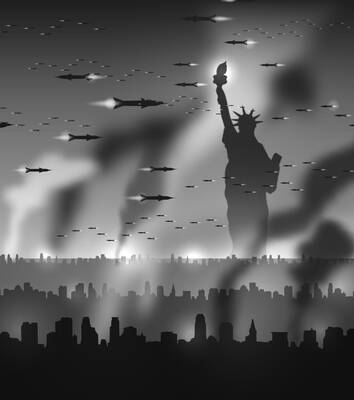
After declaring Iran’s military “gone,” US President Donald Trump appealed to the UK, France, Japan and South Korea — as well as China, Iran’s strategic partner — to send minesweepers and naval forces to reopen the Strait of Hormuz. When allies balked, the request turned into a warning: NATO would face “a very bad” future if it refused. The prevailing wisdom is that Trump faces a credibility problem: having spent years insulting allies, he finds they would not rally when he needs them. That is true, but superficial, as though a structural collapse could be caused by wounded feelings. Something
Former Taipei mayor and Taiwan People’s Party (TPP) founding chairman Ko Wen-je (柯文哲) was sentenced to 17 years in prison on Thursday, making headlines across major media. However, another case linked to the TPP — the indictment of Chinese immigrant Xu Chunying (徐春鶯) for alleged violations of the Anti-Infiltration Act (反滲透法) on Tuesday — has also stirred up heated discussions. Born in Shanghai, Xu became a resident of Taiwan through marriage in 1993. Currently the director of the Taiwan New Immigrant Development Association, she was elected to serve as legislator-at-large for the TPP in 2023, but was later charged with involvement
Out of 64 participating universities in this year’s Stars Program — through which schools directly recommend their top students to universities for admission — only 19 filled their admissions quotas. There were 922 vacancies, down more than 200 from last year; top universities had 37 unfilled places, 40 fewer than last year. The original purpose of the Stars Program was to expand admissions to a wider range of students. However, certain departments at elite universities that failed to meet their admissions quotas are not improving. Vacancies at top universities are linked to students’ program preferences on their applications, but inappropriate admission


 RSS
RSS