


A new debate on the national flag is taking place in Taiwan. The battle lines are predictable: the KMT and James Soong's (宋楚瑜) PFP are clinging to the old flag, brought over from China in 1945, while the TSU and significant parts of the DPP are in favor of a new flag that represents the new, democratic Taiwan.
It is good to take a step back and see how this issue is perceived by the international community, particularly the US and Europe. Overseas observers, governments and parliaments see Taiwan in a positive light because of its recent democratization, but the US and Europe can't bring themselves to normalize relations with Taiwan because of pressure from China.
This pressure is deep-rooted, primarily in the civil war fought from the 1920s through 1949 between the Chinese Communists and the KMT of Chiang Kai-shek (蔣介石). To the Chinese, the KMT and the ROC flag became symbols of that decades-long conflict.
Taiwan went through its democratic transformation in the 1980s and 1990s, which culminated in the election of President Chen Shui-bian (陳水扁) in March 2000. However, the new government took on the shell of the old system, including its symbols, such as the 1947 Constitution, the 1911 "made in China" flag and the equally outdated anthem -- a 1928 KMT song.
It is clear that those symbols have little to do with present-day Taiwan -- they are left-over attributes of the KMT's days in China. While it is perhaps understandable that the KMT old guard wants to cling to them out of a fast-disappearing sense of security, it would be wise for Taiwan to move to a new set of symbols.
The reasons are as follows: As long as Taiwan clings to symbols that are associated with the old civil war, it is a reminder that this civil war is not quite finished. For closure, it is necessary that these symbols are buried. An even more important reason is to find a new flag, anthem and Constitution that truly represent the new Taiwan. This process may take a few years, but it is an essential part of becoming a "new" nation. In the case of the US, it took 11 years -- from the 1776 Declaration of Independence to the 1787 Constitutional Convention. The US national anthem, The Star-Spangled Banner, wasn't written until 1814.
The old symbols represent only the KMT. Present-day Taiwan is made up of Aborigines, the Hakka- and Hokkien-speaking population, as well as the mainlanders who came over after 1945.
For Taiwan to survive, they all need to identify with the new Taiwan and evolve into a new identity that is truly Taiwanese in nature.
From the international perspective, it is also necessary to develop a new Taiwanese identity.
As long as Taiwan continues to present itself as the ROC, the international community will be forced -- by the "one China" dictum -- to maintain the line that only informal, economic and cultural ties are possible.
Only when Taiwan states clearly and unequivocally that it distances itself from the ROC identity, and presents itself as a new and democratic nation, will it be able to open the doors toward full recognition and diplomatic relations.
A fair and open debate about the national flag and anthem would be a good start.
Gerrit van der Wees and Mei-chin Chen are editors of Taiwan Communique, an international publication dedicated to democracy in Taiwan and full and equal membership of Taiwan in the international community.
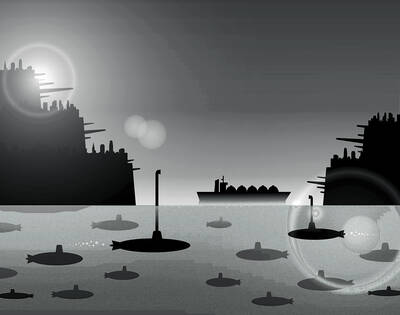
In the event of a war with China, Taiwan has some surprisingly tough defenses that could make it as difficult to tackle as a porcupine: A shoreline dotted with swamps, rocks and concrete barriers; conscription for all adult men; highways and airports that are built to double as hardened combat facilities. This porcupine has a soft underbelly, though, and the war in Iran is exposing it: energy. About 39,000 ships dock at Taiwan’s ports each year, more than the 30,000 that transit the Strait of Hormuz. About one-fifth of their inbound tonnage is coal, oil, refined fuels and liquefied natural gas (LNG),
To counter the CCP’s escalating threats, Taiwan must build a national consensus and demonstrate the capability and the will to fight. The Chinese Communist Party (CCP) often leans on a seductive mantra to soften its threats, such as “Chinese do not kill Chinese.” The slogan is designed to frame territorial conquest (annexation) as a domestic family matter. A look at the historical ledger reveals a different truth. For the CCP, being labeled “family” has never been a guarantee of safety; it has been the primary prerequisite for state-sanctioned slaughter. From the forced starvation of 150,000 civilians at the Siege of Changchun
The two major opposition parties, the Chinese Nationalist Party (KMT) and the Taiwan People’s Party (TPP), jointly announced on Tuesday last week that former TPP lawmaker Chang Chi-kai (張啟楷) would be their joint candidate for Chiayi mayor, following polling conducted earlier this month. It is the first case of blue-white (KMT-TPP) cooperation in selecting a joint candidate under an agreement signed by their chairpersons last month. KMT and TPP supporters have blamed their 2024 presidential election loss on failing to decide on a joint candidate, which ended in a dramatic breakdown with participants pointing fingers, calling polls unfair, sobbing and walking
In the opening remarks of her meeting with Chinese President Xi Jinping (習近平) in the Great Hall of the People in Beijing on Friday, Chinese Nationalist Party (KMT) Chairwoman Cheng Li-wun (鄭麗文) framed her visit as a historic occasion. In his own remarks, Xi had also emphasized the history of the relationship between the KMT and the Chinese Communist Party (CCP). Where they differed was that Cheng’s account, while flawed by its omissions, at least partially corresponded to reality. The meeting was certainly historic, albeit not in the way that Cheng and Xi were signaling, and not from the perspective


 RSS
RSS