


Mathematics theory hardly sounds like comic book material, but a pioneering Greek graphic novel on math in early 20th century Europe has become an unlikely hit, grabbing bestseller spots on online bookshop Amazon.
Logicomix: An Epic Search for Truth tracks the battle of mathematical minds — often against madness — before the invention of the computer.
The narrator and hero of the book, in the Top 10 of both Amazon.com and Amazon.co.uk this month, is none other than British philosopher, logician and pacifist Bertrand Russell (1872-1970).
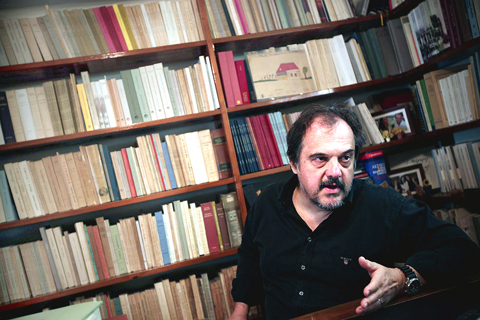
PHOTO: AFP
Running at more than 300 pages, it chronicles Russell’s tortuous quest for the foundations of mathematics and his search for logic as a shield from the insanity that consumed other members of his family.
The story takes in his relations with thinkers and mathematical giants of the era, two of his four marriages, and his hidden feelings for the young wife of fellow mathematician Alfred North Whitehead.
The microcosm of great minds is played against the backdrop of broader events in Europe, as the rise of Nazism directly threatens some of the protagonists.
“We wanted a narrator and Russell was ideal,” said writer Apostolos Doxiadis, who co-authored the story with computer science professor Christos Papadimitriou at the University of California, Berkeley.
“By the very nature of his career and the timeline of his life, he saw more and participated in more of the story than anyone else. And secondly, he was the only one of these characters who was not a mega-nerd,” Doxiadis told reporters. “He was a political activist, a womanizer, traveler, adventurer, great talker, a wit and a dandy.”
Born into a liberal aristocratic English family and the grandson of a former British prime minister, Russell is considered one of the 20th century’s most important philosophers. He was also an early advocate of sexual freedom.
He was jailed for pacifism during World War I and later campaigned against nuclear proliferation and the Vietnam War.
Crafting the unlikely novel about him took seven years, from discussions between the creators to five years of feverish scripting, drawing, inking and coloring.
“It was a super-marathon,” Doxiadis said.
Like many other cartoon books, the album was pieced together like a movie with wall-to-wall story boards and Doxiadis, who has a film-making background, acting out the characters.
Artists Alecos Papadatos and Annie Di Donna spent three weeks traveling to locations cited in the novel, from Cambridge, England, where Russell studied, to London, Paris, Vienna, Italy, and the sanatorium in Halle, Germany, where one of his heroes, mathematician Georg Cantor, spent the last months of his life. Madness plays a prominent part in the novel, and not by accident.
“In this particular branch of mathematics — mathematical logic — there was a very, very high incidence of serious mental illness. That was something we found particularly interesting,” the author said.
Originally published in Greek last fall, Logicomix enjoyed a successful run at home.
Its authors were unprepared for the reception in the US and Britain, however, where it sold out on the first day it was released last month.
Later last month, the New York Times greeted the comic’s US debut with a bemused “well, this is unexpected.” It said the story was “presented with real graphic verve” and “for the most part the ideas are conveyed accurately, with delightful simplicity.”
“I think the publishers [Bloomsbury] were shocked. I was shocked, too,” Doxiadis said.
It sped up bestseller lists to the top 10 spots in comics, fiction and general book rankings on both Amazon.com and Amazon.co.uk.
“No Greek book has sold abroad like this in 30 years,” said Dinos Vrettos, a manager at a major Athens bookstore.
The aim of Logicomix is “to tell a fascinating story about the history of ideas” said Doxiadis, who in 2001 published a novel titled Uncle Petros and Goldbach’s Conjecture about a boy’s quest for knowledge on his reclusive mathematician uncle.
“In Logicomix, the story I think is in some ways emblematic of much of what happened in the 20th century, with its search for certainty, for knowledge and what often went with it, for power over life,” Doxiadis said. “The fact that this idea looked like, to put it mildly, not a very likely idea for a comic book, never deterred me.”

The National Chungshan Institute of Science and Technology yesterday showcased its locally developed variants of the Vision 60 robotic patrol dog, which it plans to deploy on the nation’s outlying territories in the South China Sea. The variants were produced under the Joint Lab project — created by the institute and domestic companies — and assembled with domestically produced motors, lenses and artificial intelligence (AI) systems alongside licensed tech from the US, Missile and Rocket Systems Research Division deputy director Jen Kuo-kang (任國光) told the media event at a military base in Taipei’s Dazhi (大直) area. Taiwan has built up its strengths

RIGHT DIRECTION: Taiwan’s efforts to prevent forced labor include a proposal to ‘fully prohibit’ employers from withholding workers’ documents, an official said Taiwan is to establish a mechanism to restrict imports of goods linked to forced labor, the Executive Yuan said yesterday, after the US proposed imposing additional tariffs on Taiwanese goods over labor concerns. “The Ministry of Labor and the Ministry of Economic Affairs are to establish an interministerial review procedure,” Executive Yuan spokesperson Michelle Lee (李慧芝) said at a news briefing in Taipei. “The government is to use the Foreign Trade Act [貿易法] as the legal basis to restrict imports of goods produced with forced labor” and bring its supply chain governance more in line with international standards on human rights, resilience

NOT IMMEDIATE: Taiwan has a chance to appeal the proposed 10 percent tariff before it starts, while other countries face a 12.5 percent tariff from the trade office Taiwan is among 60 economies determined by the US to have failed to impose or enforce a ban on the importation of goods produced with forced labor, according to a notice released on Tuesday by the Office of the US Trade Representative (USTR), which proposed imposing an additional 10 percent or more tariff on them. The USTR in a statement said that following an investigation, it had determined under Section 301 of the Trade Act of 1974 that the failure of the 60 economies to impose and effectively enforce a prohibition on the importation of goods produced with forced labor is

TIT-FOR-TAT: The US allegedly revoked the visa of a Chinese national working at Xinhua News Agency in the US in response to Beijing’s expulsion of Vivian Wang The Presidential Office yesterday condemned China for expelling a New York Times correspondent from Beijing following the newspaper’s interview with President William Lai (賴清德), saying the move highlighted Beijing’s suppression of press freedom and its threat to international news media. Taiwan has noted a series of recent incidents in which Beijing used similar tactics to “threaten and pressure international media outlets and journalists,” Presidential Office spokeswoman Karen Kuo (郭雅慧) said in a statement. “This concerns not only press freedom and freedom of expression, but also the safety of journalists, and Taiwan and relevant partners are paying close attention to the situation,” she


 RSS
RSS