


Once it was the exclusive preserve of men but not any more: hundreds of women in Ivory Coast are ignoring patriarchal tradition and turning to the growing of cocoa.
Agathe Vanie, who founded an association of women growers in her village of Boko, said the reason was simple: “the misery of women in the face of the financial wealth of the men who own cocoa plantations.”
The association at Boko, which lies about 200km west of the capital Abidjan in the southern forest district of Divo, has grown to about 1,000 members since it was founded in 2005. It is the first — and thought to be the only one — of its kind in this west African country, finances its own costs and receives no state subsidies.
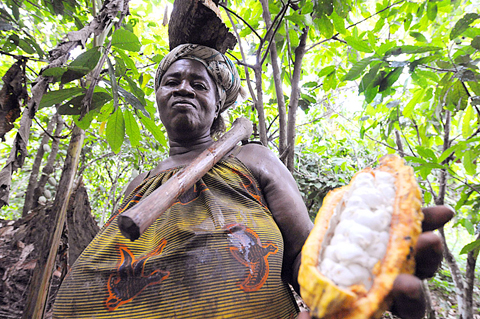
PHOTO: AFP
“Women cannot inherit or even create a cocoa plantation under our patriarch-dominated tradition,” said Vanie, criticizing what she called a “backwards and misogynist” practice.
“We decided, whatever it took, to … allow them to have plots of land,” said Vanie, whose country is the world’s largest producer and exporter of cocoa, accounting for more than 40 percent of the world’s cocoa production.
“I meet village chiefs and I explain to them that women can make a contribution to expenses that are increasingly heavy because of the cost of living and the price of food,” she said. “To begin with the reply was brutal and final: ‘No! A woman does not have the right to own a plantation and later give us orders.’”
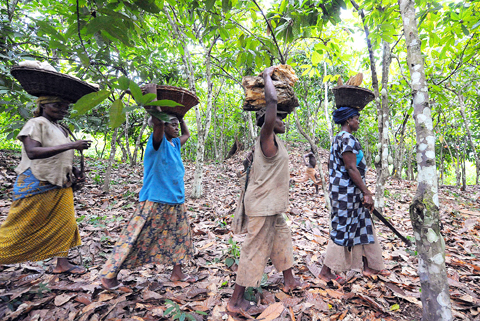
PHOTO: AFP
But Clementine Galo, in her 70s, managed to become a woman cocoa planter and is happy today to have been one of those who took up the challenge.
“I was abandoned by my husband and I have only the plantation to meet my needs and prepare for my final days,” she said, standing by her trees, spread over two hectares, with their yellow pods of ripe beans.
Nearby, her friend Henriette Gneza proudly showed off her 20 hectares.
Last year she harvested 10 tonnes of beans and with the income paid school fees for her two children.
She could do even better this year, with prices of beans expected to rise.
The association also seeks to organize women into cooperatives to win new recruits to look after aging plantations.
But it has been an uphill battle in a country of 20 million where despite women’s increasingly active role in society, men still tend to make the decisions, head families and settle arguments.
“This activity gives them financial independence and lets them fight poverty in rural areas,” said Antoine Anon Dokou, a member of the association.
A report from the United Nations Development Program found that the poverty level in Ivory Coast reached 43 percent of the population last year, three or four points up on the figure in 2002 when civil strife split the country.
Women in the countryside are often the hardest-hit.
Vanie’s association wants to see her initiative copied and would like to launch a federation of women coffee and cocoa producers.
“Women have overcome their fear of men and difficulties in getting credit,” association treasurer Veronique Gopo said. “We are going out to win over our sisters in other regions.”
“We talk about ... the emancipation of women,” said Boko village chief Pierre Gbaza Zohouri, who backs the project. “In town you share household costs. Why not in the village?”
“They have my blessing,” he added with a hint of resignation.
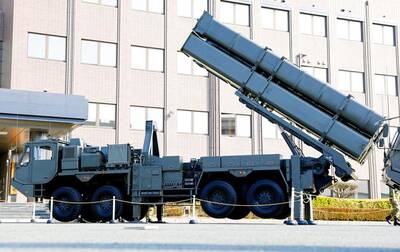
Japan has deployed long-range missiles in a southwestern region near China, the Japanese defense minister said yesterday, at a time when ties with Beijing are at their lowest in recent years. The missiles were installed in Kumamoto in the southern region of Kyushu, as Japan is attempting to shore up its military capacity as China steps up naval activity in the East China Sea. “Standoff defense capabilities enable us to counter the threat of enemy forces attempting to invade our country ... while ensuring the safety of our personnel,” Japanese Minister of Defense Shinjiro Koizumi said. “This is an extremely important initiative for
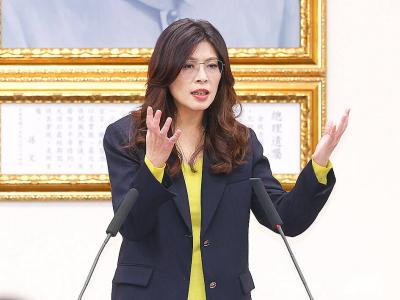
Chinese Nationalist Party (KMT) Chairwoman Cheng Li-wun (鄭麗文) today accepted an invitation from Chinese President Xi Jinping (習近平) to lead a delegation to China next month, saying she hopes to promote the peaceful development of cross-strait relations and bring stability to the Taiwan Strait. “I am grateful and happy to accept this invitation,” Cheng said in a statement from the KMT chairperson’s office. Cheng said she hopes both sides can work together to promote the peaceful development of cross-strait relations, enhance exchange and cooperation, bring stability to the Taiwan Strait and improve people’s livelihoods. At today's news conference, Cheng said any efforts to

MORE POPULAR: Taiwan Pass sales increased by 59 percent during the first quarter compared with the same period last year, the Tourism Administration said The Tourism Administration yesterday said that it has streamlined the Taiwan Pass, with two versions available for purchase beginning today. The tourism agency has made the pass available to international tourists since 2024, allowing them to access the high-speed rail, Taiwan Railway Corp services, four MRT systems and four Taiwan Tourist Shuttles. Previously, five types of Taiwan Pass were available, but some tourists have said that the offerings were too complicated. The agency said only two types of Taiwan Pass would be available, starting from a three-day pass with the high-speed rail and a three-day pass with Taiwan Railway Corp. The former costs NT$2,800

The nation’s fastest supercomputer, Nano 4 (晶創26), is scheduled to be launched in the third quarter, and would be used to train large language models in finance and national defense sectors, the National Center for High-Performance Computing (NCHC) said. The supercomputer, which would operate at about 86.05 petaflops, is being tested at a new cloud computing center in the Southern Taiwan Science Park in Tainan. The exterior of the server cabinet features chip circuitry patterns overlaid with a map of Taiwan, highlighting the nation’s central position in the semiconductor industry. The center also houses Taiwania 2, Taiwania 3, Forerunner 1 and


 RSS
RSS