


Shrugging off the post-SARS slowdown and competition, the four-decade-old Uni-President Enterprise Co (統一企業), the nation's largest food conglomerate, is poised for fast expansion and sales growth should its plan to list on the Hong Kong market go through soon, market watchers say.
"We estimate that [parent] Uni-President Group (
If Tsai's bullish prediction comes true, Uni-President Group, whose combined revenues reached NT$258 billion (US$7.93 billion) last year, will soon outperform top-tier Japanese competitors, whose annual revenues average above NT$400 billion.
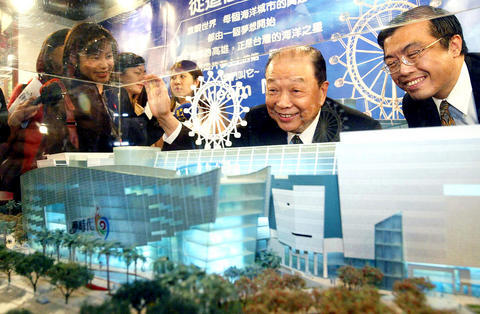
PHOTO: LIN CHENG-KUN, TAIPEI TIMES
Speaking at the company's 40th anniversary last week, president Alex Lo (羅智先) -- the son-in-law of group co-founder and chairman Kao Ching-yuan (高清愿) -- has vowed to become the market leader in Asia in the next decade while Kao himself, in the early 1990s, had aimed even higher with the goal of expanding the group to become the world's largest food conglomerate with US$120 billion in annual revenues by 2017.
Although Lo refused to clarify the company's recent progress on the Hong Kong listing plan, Uni-President's growing ambition to take up sizable shares in Chinese markets is evident after setting up a Cayman-based holding company with a goal of raising US$150 million in Hong Kong by year's end for loan repayment and re-investment in China.
Moreover, the company's board in June further decided to increase its capital from the current NT$33.5 billion to NT$48 billion in preparation for future China-bound investments -- a decision that goes against the market trend when most Taiwanese companies were buying back shares to strengthen their earnings per share (EPS).
The recapitalization plan will allow Uni-President, which is constrained by the government's 40 percent cap on China-bound investment, to increase its bets in China by a maximum of NT$580 million after having invested US$350 million in China since 1992, which is nearing the 40 percent ceiling of its capital.
The market has mixed views toward Uni-President's recapitalization move, which will end up diluting its current EPS to hurt shareholders' substantial return.
"But we are still positive because we believe Uni-President will take advantage of the extra capital to create future value for shareholders in compensation for the near-term EPS dilution," says Tsai, expressing confidence in Uni-President's future growth in China.
For example, the group won a sponsorship spot for Beijing's Olympic Games next year, which would bring more exposure to Chinese consumers and soon catch the group up with Taiwanese competitor Ting Hsin International Corp (頂新集團) in instant noodle sales, she says.
"As a famous fast-noodle brand, Uni-President's participation in the 2008 Olympic Games has helped strengthen the game's sponsorship," the Beijing Organizing Committee for the 2008 Olympic Games' (BOCOG) vice president and secretary-general Wang Wei (王偉) said last November.
Taipei-based China Credit Information Service Ltd's (中華徵信所) editor-in-chief Liu Jen (劉任) is just as optimistic, saying that Uni-President has leaped from a China concept stock to a China-gain stock after the group's revenues in China exceeded those from Taiwan.
Liu lauded Uni-President's strategy of starting business in nearly 50 Chinese cities and coordinating all business branches in China as a whole, saying the move has gradually paid off and created synergy.
Under Lo's leadership the past few years, Uni-President has further succeeded in differentiating itself from Ting Hsin, which aims to quickly monopolize Chinese markets by seeking both strategic partners such as HeBei Hualong Food Group (
"Ting Hsin, which used to look down on Uni-President, is now beginning to see Uni-President as a threat," Liu says, adding that Uni-President has a complete expansion plan that includes investments in other Asian countries such as Thailand and Vietnam.
In Taiwan, Lo has also successfully re-oriented the company's focus back to food and livelihood-related businesses by ruthlessly liquidating several profit-losing and unrelated diversification branches such as Grand Commercial Bank (
Liu said that beverage sales contributed 42.5 percent to the group's overall annual revenues last year while food businesses contributed another 31.4 percent -- proof that the re-orientation toward core food-related business has put the company back on the right track.
According to China Trust's annual ranking this year, Uni-President Group is the 33rd largest conglomerate by assets in Taiwan with annual combined revenues seeing a 6.3 percent growth last year from the previous year's NT$242 billion.
Subsidiary Uni-President Enterprise also saw a 6.4 percent growth last year after annual revenues climbed to NT$42.8 billion last year from NT$40.3 billion in 2005.
But not everyone is so sure about Uni-President's China outlook as the country presents both opportunities and challenges to businesses.
Although they found the recapitalization plan "acceptable," foreign securities analysts from USB Global Asset Management (瑞銀環球資產管理) and Macquarie Equities (Asia) (麥格理證券) once gave a neutral and less-than-neutral rating respectively on Uni-President shares, which they believed are too expensive to buy on the TAIEX.
Macquarie even disagreed with the market view, saying that Uni-President's competitiveness in China is not as strong as many might expect.
But Yuanta's Tsai still believes that Uni-President's valuation will be worth buying once it lists on the Hong Kong markets because its price-to-earning (PE) ratio of 30 would out-value most of Shanghai's A shares, whose PE ratio averages above 60.
Started as a fodder factory and flour mill, Uni-President was founded in mid 1967 by members of the Tainan Group (台南幫) including tycoon Wu Hsiou-chin (吳修齊) and Kao with an initial capital of NT$30 million and a meager 80 employees.
Uni-President spent its first decade as a manufacturer of instant noodles, oil, beverage and dairy products and focused on boosting sales by building a network of channels in the second decade.
The company opened 14 7-Eleven convenience stores in 1979, which have been in service 24 hours a day since 1983. The number of stores grew to 100 stores nationwide in 1986 -- one year before Uni-President listed on the TAIEX.
"Some 20 years ago, the idea of opening up convenience stores such as 7-Eleven was innovative enough in itself," says Katherine Chang (
Chang said that Uni-President has been a market leader in not only product innovation but also in introducing multi-national brands such as Starbucks from the US and MUJI (
As Uni-President entered its third decade, it set the goal of expanding business through marketing, which has attracted many copycats.
Taking the 7-Eleven subsidiary as an example, Chang says that the company is capable of turning "ordinary products into top-selling ones," adding the launch of a cartoon spokesdog "Open" (Open小將) has attracted interest from international businesspeople.
Over the last 10 years, Uni-President has not only expanded into Chinese and Asian markets but has also tapped into retailing, channeling, commercial trading and service-oriented businesses with China-bound investments turning profit in 2000.
In 2003, Uni-President finalized a NT$18.5 billion project to build the Dream Mall in southern Kaohsiung, which was launched in May.
Although the latest investment may only bring in profits for Uni-President after five to seven years, Uni-President is doing just fine after posting a record-high profit of NT$5 billion in the first half of this year.
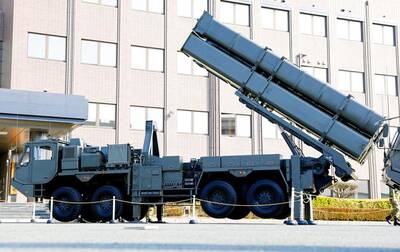
Japan has deployed long-range missiles in a southwestern region near China, the Japanese defense minister said yesterday, at a time when ties with Beijing are at their lowest in recent years. The missiles were installed in Kumamoto in the southern region of Kyushu, as Japan is attempting to shore up its military capacity as China steps up naval activity in the East China Sea. “Standoff defense capabilities enable us to counter the threat of enemy forces attempting to invade our country ... while ensuring the safety of our personnel,” Japanese Minister of Defense Shinjiro Koizumi said. “This is an extremely important initiative for
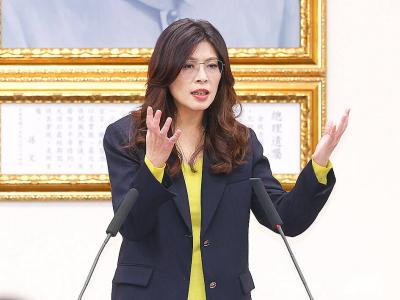
Chinese Nationalist Party (KMT) Chairwoman Cheng Li-wun (鄭麗文) today accepted an invitation from Chinese President Xi Jinping (習近平) to lead a delegation to China next month, saying she hopes to promote the peaceful development of cross-strait relations and bring stability to the Taiwan Strait. “I am grateful and happy to accept this invitation,” Cheng said in a statement from the KMT chairperson’s office. Cheng said she hopes both sides can work together to promote the peaceful development of cross-strait relations, enhance exchange and cooperation, bring stability to the Taiwan Strait and improve people’s livelihoods. At today's news conference, Cheng said any efforts to
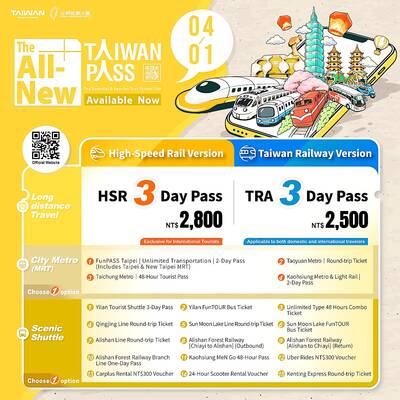
MORE POPULAR: Taiwan Pass sales increased by 59 percent during the first quarter compared with the same period last year, the Tourism Administration said The Tourism Administration yesterday said that it has streamlined the Taiwan Pass, with two versions available for purchase beginning today. The tourism agency has made the pass available to international tourists since 2024, allowing them to access the high-speed rail, Taiwan Railway Corp services, four MRT systems and four Taiwan Tourist Shuttles. Previously, five types of Taiwan Pass were available, but some tourists have said that the offerings were too complicated. The agency said only two types of Taiwan Pass would be available, starting from a three-day pass with the high-speed rail and a three-day pass with Taiwan Railway Corp. The former costs NT$2,800
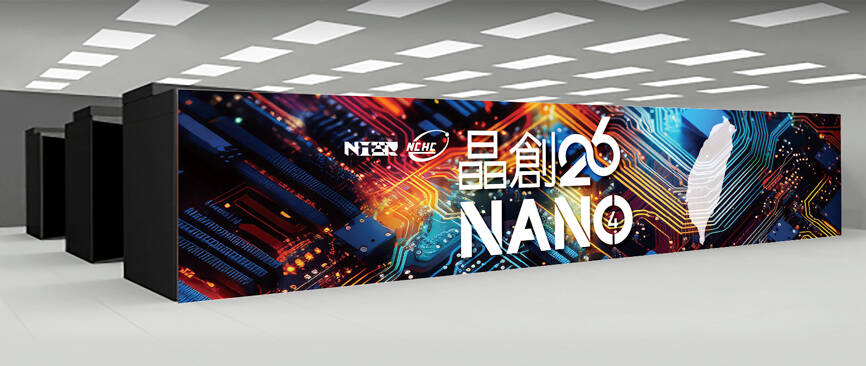
The nation’s fastest supercomputer, Nano 4 (晶創26), is scheduled to be launched in the third quarter, and would be used to train large language models in finance and national defense sectors, the National Center for High-Performance Computing (NCHC) said. The supercomputer, which would operate at about 86.05 petaflops, is being tested at a new cloud computing center in the Southern Taiwan Science Park in Tainan. The exterior of the server cabinet features chip circuitry patterns overlaid with a map of Taiwan, highlighting the nation’s central position in the semiconductor industry. The center also houses Taiwania 2, Taiwania 3, Forerunner 1 and


 RSS
RSS