


The new casinos popping up in Macau over the past three years have helped the Chinese territory surpass the Las Vegas Strip as the world's most lucrative gambling center.
This week, the city begins its most ambitious -- and perhaps riskiest -- phase of development with tomorrow's opening of the US$2.4 billion Venetian Macao Resort Hotel. It's the latest mega project from American billionaire Sheldon Adelson, chairman of Las Vegas Sands Corp.
The big bet is that Macau can be much more than a playground for day-tripping gamblers -- mostly from China -- who spend most of their time in the casinos.
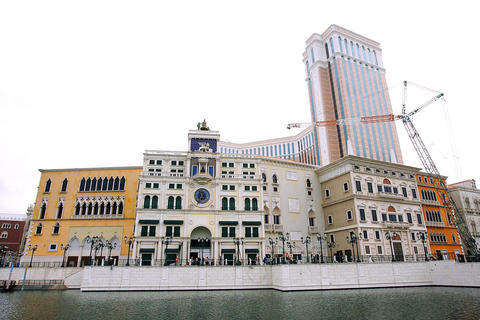
PHOTO: AFP
Developers are hoping the tiny territory will also be able to attract shoppers, conventioneers and tourists hungry for gourmet dinners, pool-side sun-tanning and glitzy shows.
The Venetian Macao is the first mega resort that will try to bring in the new crowds of visitors willing to spend two or three days in the city.
With gondoliers sailing down canals, the 3,000-room Venetian tries to recreate the beauty of Venice. The complex also boasts a 15,000-seat sports arena, retail space for 350 stores, 111,500m2 of convention space, fine dining, and a Cirque du Soleil-produced show.
Everything will be housed in what will be the largest building in Asia and the second-largest in the world, just behind a Boeing Co plant in Washington state.
JP Morgan Securities analyst Billy Ng said the Venetian's plan makes sense to him.
The mega resort "will broaden the customer base," he said. "In theory, it should bring in a lot of customers who have never thought about going to Macau."
Ng and some other observers are also bullish that Las Vegas Sands can capitalize on its expertise in running trade shows at casinos in Vegas and replicate that success in Macau. The Venetian's convention facilities will help fill up the thousands of rooms and boost weekday traffic, they say.
Business travelers to conventions have a larger budget to spend on hotels and the Venetian will probably be attractive to this segment, said Jonathan Galaviz, a partner at Globalysis Ltd, a Las Vegas-based consultancy.
"Asia has yet to see a multi-billion dollar integrated resort with a strong convention center component to it like the scale that the Venetian Macao will provide," he said.
William Weidner, president of Las Vegas Sands Corp, has said that 44 major conventions have already been scheduled at the Venetian for the next two years.
He also said he expects the average guest to stay at the Venetian for three to four days, compared to the current average of just 1.2 days in other Macau hotels.
Some analysts, though, are not so optimistic.
The Venetian can not transform deep-seated Chinese attitudes about gambling overnight, they say, and whether Chinese gamblers will be as generous at the restaurant and at the shows as they are at the casino is still a big question.
"We go to Vegas prepared to splurge. [Chinese gamblers] come to Macau for reckless gambling. We expect to give but they expect to take," said Gabriel Chan, an analyst with Credit Suisse Hong Kong.
"There aren't shows on yet,'' he said. ``And you can't shop all day every day. The Venetian is a big property, but it's not enough to create a critical mass for everyone to stay at least two nights."
The lack of alternative entertainment and transport support in the area will also pose problems in the short term, analysts say.
The Venetian is just the first property to kick-start mega-tourism plans for the Cotai Strip, a reclaimed area that, according to Adelson, will mimic the heart of the Las Vegas Strip upon completion.
The Sands is set to open more hotels next door for a total of 20,000 hotel rooms on the Strip.
That's a lot of rooms, but they won't be affordable for the average Chinese gambler.

‘NO SECURITY RISK’: The Railway Bureau reassured the public that the technicians’ activities were limited to technical guidance and did not involve sensitive systems The Railway Bureau yesterday said it had invited eight Chinese technicians to assist with an airport MRT construction project. The bureau issued the confirmation after an Internet user said Chinese nationals had entered the construction zone of Taiwan Taoyuan International Airport’s Terminal 3 project. They asked why “individuals from an enemy state” were allowed access to such a major national infrastructure project, which raised serious concerns over Taiwan’s industrial safety, sensitive systems and information security. The bureau’s Northern Region Engineering Branch Office said subcontractor Taiwan Handle Industrial Co (台灣手把工業) of the Taoyuan airport MRT’s “Contract No. CU05 Project A14 Station Civil, MEP &

The National Chungshan Institute of Science and Technology yesterday showcased its locally developed variants of the Vision 60 robotic patrol dog, which it plans to deploy on the nation’s outlying territories in the South China Sea. The variants were produced under the Joint Lab project — created by the institute and domestic companies — and assembled with domestically produced motors, lenses and artificial intelligence (AI) systems alongside licensed tech from the US, Missile and Rocket Systems Research Division deputy director Jen Kuo-kang (任國光) told the media event at a military base in Taipei’s Dazhi (大直) area. Taiwan has built up its strengths
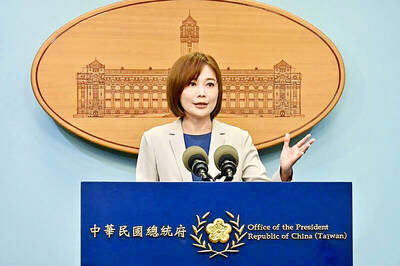
TIT-FOR-TAT: The US allegedly revoked the visa of a Chinese national working at Xinhua News Agency in the US in response to Beijing’s expulsion of Vivian Wang The Presidential Office yesterday condemned China for expelling a New York Times correspondent from Beijing following the newspaper’s interview with President William Lai (賴清德), saying the move highlighted Beijing’s suppression of press freedom and its threat to international news media. Taiwan has noted a series of recent incidents in which Beijing used similar tactics to “threaten and pressure international media outlets and journalists,” Presidential Office spokeswoman Karen Kuo (郭雅慧) said in a statement. “This concerns not only press freedom and freedom of expression, but also the safety of journalists, and Taiwan and relevant partners are paying close attention to the situation,” she
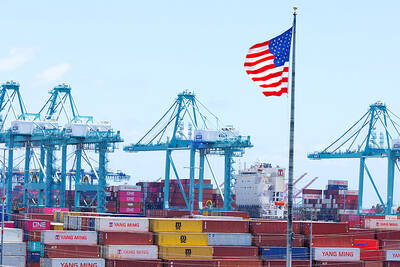
NOT IMMEDIATE: Taiwan has a chance to appeal the proposed 10 percent tariff before it starts, while other countries face a 12.5 percent tariff from the trade office Taiwan is among 60 economies determined by the US to have failed to impose or enforce a ban on the importation of goods produced with forced labor, according to a notice released on Tuesday by the Office of the US Trade Representative (USTR), which proposed imposing an additional 10 percent or more tariff on them. The USTR in a statement said that following an investigation, it had determined under Section 301 of the Trade Act of 1974 that the failure of the 60 economies to impose and effectively enforce a prohibition on the importation of goods produced with forced labor is


 RSS
RSS