


There's never been a better time to be a news junkie. The Internet itself means that you can get your fill of news in record time, as it allows you to surf from news site to news site, taking in the headlines from disparate sources like never before. But now a new generation of software applications -- dubbed variously RSS readers, news aggregators, or RSS aggregators -- is taking news delivery and consumption to another level.
Put simply, news aggregators can potentially inform you about news that matters to you faster and more efficiently than any other type of news delivery medium.
Traditional newspapers and news sources are themselves aggregators. They receive news from multiple sources, select the news that they believe you'll be interested in, and then present it in a format that becomes familiar.
But if you like to be in control, there's a problem: the control over which news is presented -- and how it's presented -- is in someone else's hands. And even if you're not a control freak, you can see inherent inefficiencies in the way that most of us retrieve our news online. We still surf from site to site, analogous to moving from newspaper to newspaper, instead of leveraging the data-sending power of the Internet to have customized news pushed to us from various sources and combined into one format. That's what news aggregation is all about.
`really simple syndication'
The foundation of news aggregators is a technology known as RSS, short for "really simple syndication." RSS is a system that allows news providers to put news stories or other information into standard format that can be viewed and organized with an RSS-aware software program.
Lots of applications today are RSS-aware. Popular search engines such as Google and Yahoo can handle RSS materials -- called "feeds" -- as can some e-mail programs, including Mozilla Thunderbird. You can configure Google and Yahoo to display feeds that you select from other sites that supply news or information.
But RSS aggregators -- Web-based sites or applications designed specifically for the purpose of selecting and displaying RSS feeds -- are gaining traction as the tool of choice for those who want the best customized news experience.
There are two types of RSS aggregators -- Web-based and application-based. Web-based aggregators are nice because there's no software to install: any browser will suffice. Application-based RSS aggregators are handy if you want access to the news you download even after disconnecting from the Internet.
Newsgator (www.newsgator.com) is typical of the growing number of Web-based RSS aggregators on the market. After creating a free account at the site, you follow a wizard that takes you through the process of selecting initial news feeds that interest you.
You can choose from among dozens of popular news sources -- including major newspapers, news wire services, and Web-only news delivery services -- and sort your news into typical categories such as world, technology, business, entertainment, and more.
incentive
But because RSS feeds can come from just about any Web site, you can also include "news" from sources such as blogs and online forums that allow broadcasts of their information via RSS. Most sites that have the ability to supply information via RSS do enable RSS feeds, since someone receiving an RSS feed from a particular site will likely end up browsing the site itself to learn more. So information-rich Web sites have every incentive to offer RSS feeds.
Other popular Web-based aggregators include Bloglines (www.bloglines.com) and Google Reader (www.google.com/reader), recently updated to make displayed feeds much more attractive. Once you have a Web-based RSS aggregator set up, you'll be amazed at the power at your fingertips. You'll have access to many news stories from disparate sources, and you'll even be delighted by pictures and graphics brought over from some news sites.
Omea Reader (www.jetbrains.com/omea) is typical of the application-based RSS aggregators. You download the program, install it, and then walk through a configuration procedure that tells the program your preferences, imports your browser bookmarks, and gets you started collecting and reading news.
At this time, new users will probably want to stick with Web-based RSS aggregators, as they tend to be easier to set up and use, and since all RSS feeds are delivered through the Web, the experience of a Web-based RSS aggregator seems more appropriate.

Japan has deployed long-range missiles in a southwestern region near China, the Japanese defense minister said yesterday, at a time when ties with Beijing are at their lowest in recent years. The missiles were installed in Kumamoto in the southern region of Kyushu, as Japan is attempting to shore up its military capacity as China steps up naval activity in the East China Sea. “Standoff defense capabilities enable us to counter the threat of enemy forces attempting to invade our country ... while ensuring the safety of our personnel,” Japanese Minister of Defense Shinjiro Koizumi said. “This is an extremely important initiative for

Chinese Nationalist Party (KMT) Chairwoman Cheng Li-wun (鄭麗文) today accepted an invitation from Chinese President Xi Jinping (習近平) to lead a delegation to China next month, saying she hopes to promote the peaceful development of cross-strait relations and bring stability to the Taiwan Strait. “I am grateful and happy to accept this invitation,” Cheng said in a statement from the KMT chairperson’s office. Cheng said she hopes both sides can work together to promote the peaceful development of cross-strait relations, enhance exchange and cooperation, bring stability to the Taiwan Strait and improve people’s livelihoods. At today's news conference, Cheng said any efforts to
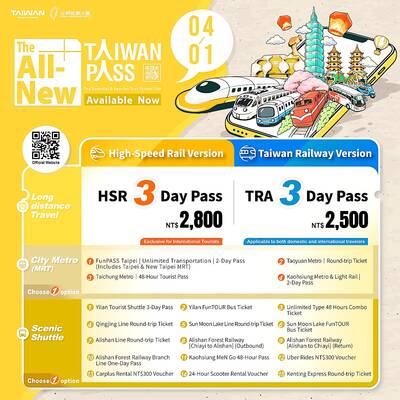
MORE POPULAR: Taiwan Pass sales increased by 59 percent during the first quarter compared with the same period last year, the Tourism Administration said The Tourism Administration yesterday said that it has streamlined the Taiwan Pass, with two versions available for purchase beginning today. The tourism agency has made the pass available to international tourists since 2024, allowing them to access the high-speed rail, Taiwan Railway Corp services, four MRT systems and four Taiwan Tourist Shuttles. Previously, five types of Taiwan Pass were available, but some tourists have said that the offerings were too complicated. The agency said only two types of Taiwan Pass would be available, starting from a three-day pass with the high-speed rail and a three-day pass with Taiwan Railway Corp. The former costs NT$2,800

The nation’s fastest supercomputer, Nano 4 (晶創26), is scheduled to be launched in the third quarter, and would be used to train large language models in finance and national defense sectors, the National Center for High-Performance Computing (NCHC) said. The supercomputer, which would operate at about 86.05 petaflops, is being tested at a new cloud computing center in the Southern Taiwan Science Park in Tainan. The exterior of the server cabinet features chip circuitry patterns overlaid with a map of Taiwan, highlighting the nation’s central position in the semiconductor industry. The center also houses Taiwania 2, Taiwania 3, Forerunner 1 and


 RSS
RSS