


Annabella Rosemurgy, a 25-year-old actress -- "but don't tell my agent, who thinks I'm 18" -- and her best friend, Rebecca Oranges, 28, a hairstylist, arrived at the Short Stop bar here on a Saturday night for a drink and, possibly, a flirt. After grabbing a Jack and Coke (for Rosemurgy) and a Corona (for Oranges), the two surveyed the crowd. But it was only when they entered the nightspot's photo booth that they hit their stride, air-kissing the camera and striking favorite poses like the one they call "the Charlie's Angels," mock-guns pointing.
"The photo booth comes before boys," Rosemurgy said. "We were like little cats looking in a fishbowl, waiting for our pictures."
Three US$3 photo strips later, Rosemurgy had an idea: How about a visit to Lucky Strike Lanes, where there is a booth that was a hit with none other than Paris Hilton.
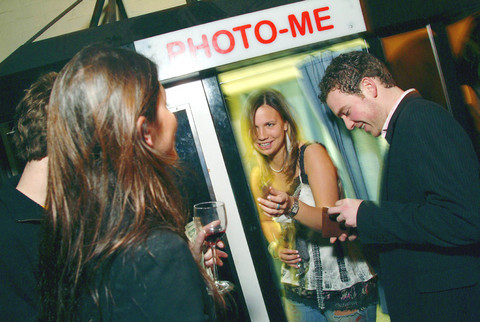
PHOTO: THE NEW YORK TIMES
"The booth there is the best," Rosemurgy said.
Formerly relegated to passport and visa offices (where they have now been replaced by digitized versions or an actual person with an actual camera), the old-fashioned photo booth is making a comeback. Bars and restaurants in San Francisco and New York are using them to attract customers, and individuals are buying them for their homes. But perhaps not surprisingly it is in Hollywood where they have become the toy du jour, with celebrities installing them as permanent party gimmicks for guests who never tire of seeing themselves in close-up.
"There's no better foreplay than to have someone dive deeper into their own vanity on their own turf," said Dave Navarro, the guitarist with Jane's Addiction whose recent memoir, Don't Try This at Home, features his photo-booth portrait on the book jacket and many photo strips inside.
For more than a year Navarro kept an old photo booth in his house to document visitors for the memoir, and though he has relegated it to the garage, his wife, Carmen Electra, won't let him get rid of it altogether.
"She thinks it's art," he said on the phone one recent morning from their home. "Is that what you said, honey?"
Electra, an actress and a guest performer with the Pussycat Dolls, said yes, it was.
Photo booths, which were introduced in the 1920s, when strips cost US$0.25, are not created equal. Those with black and white film are the most desirable among clubgoers and the Hollywood elite, and they must be "dip 'n' dunks," as they are known in the business, which were manufactured before the early '80s or so.
Patti Peck, the owner of Edendale Grill Restaurant and Mixville Bar in the Silver Lake area here, which has had a booth since 2003 that has been a draw for actors like Jared Leto and Jorja Fox, explained the dip 'n' dunk process.
"Inside, there's a carousel of little different chemicals, and the little piece of paper gets dipped in one solution and then the next solution and then `Yoink!'" she said, mimicking the sound of a photo strip arriving. "It's kind of magical."
Brett Ratner, the film director whose credits include After the Sunset, is also enamored of the machines. His vintage booth was the first purchase he made after buying Hilhaven Lodge, the former home of both Ingrid Bergman and Kim Novak. He said the booth is invariably the life of the party. He is at work on a sequel to Hilhaven Lodge: The Photo Booth Pictures, his book of machine-made snaps.
Quentin Tarantino installed a photo booth at his house in the Hollywood Hills last year. Ratner said Tarantino got the idea from him after he saw his photo booth at the birthday party he gave for his former fiancee, the actress Rebecca Gayheart. After Rob Zombie, a rock music figure and film director, rented booths for both his wedding and his birthday party, he was hooked, too: Zombie is inquiring about buying his own.
According to Photo-Me USA of Grand Prairie, Texas, the largest supplier of old-fashioned photo booths, purchases cost US$3,500 to US$9,000; rentals start at US$2,000.
Photo booths even found their way into the movie awards season. At the Golden Globes show in January, Pat O'Brien, the host of the CBS celebrity program The Insider, greeted the Globe winners Leonardo DiCaprio and Jamie Foxx by shuttling them into a booth.
"`Let's do a smiley one,'" he recalled DiCaprio saying. O'Brien also made funny faces with Hilary Swank and Annette Bening.
Jamie Lee Curtis, who rented a booth for her 18-year-old daughter Anne's birthday party at the Hyatt in January, said, "There's something about the anonymity of a photo booth -- that you get to pull the curtain and do whatever you want -- that is very provocative and freeing. And dangerous."
The Short Stop's owner, Oliver Wilson, knows what Curtis was talking about. "You see people going absolutely bananas in there," he said. "There's a certain sexuality to it."
Among the things he has seen: "Girls taking off their shirts. These are, like, good girls who have jobs and stuff. And guys taking down their pants."
Matthew Barnard, a bartender at the Short Stop, recalled, "I had to kick a guy out one night because he was naked in there."
Perhaps Hallie Faben, a 24-year-old film editor, has the most novel use for photo booths. She says they can come in handy in the dating game. After stopping by the Short Stop on a first date, she recounted, her companion suggested a whirl in the machine.
"But our body language was kind of weird," Faben said, describing the photo strip, "so I took it as a sign that we shouldn't date."
Patented in 1925 by a Siberian immigrant, Anatol Josepho, photo booths were initially known as Photomatons, according to Babbette Hines, whose 2002 art book, Photobooth, showcases some of her thousands of photo strips, which date back to the 20's and include GIs heading off to World War II posing with their sweethearts. When Josepho sold the patent for US$1 million in 1927 and the deal was written about on the front page of The New York Times the machines became famous, attracting the governor of New York, Al Smith, and senator-elect Robert Wagner to the country's first booth, which was installed in Manhattan.
By the '30s the booths were at fairs, carnivals, department stores and in train stations across the United States, said Nakki Garonin, who is writing a history of photo booths. Then as now they were a way to playfully capture one's image for little more than the cost of several ice cream cones. They also acquired the patina of chic: In the '60s Andy Warhol installed one at his Factory, where Baby Jane Holzer and Edie Sedgwick posed in it.
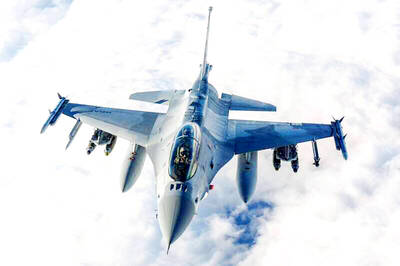
LONG FLIGHT: The jets would be flown by US pilots, with Taiwanese copilots in the two-seat F-16D variant to help familiarize them with the aircraft, the source said The US is expected to fly 10 Lockheed Martin F-16C/D Block 70/72 jets to Taiwan over the coming months to fulfill a long-awaited order of 66 aircraft, a defense official said yesterday. Word that the first batch of the jets would be delivered soon was welcome news to Taiwan, which has become concerned about delays in the delivery of US arms amid rising military tensions with China. Speaking on condition of anonymity, the official said the initial tranche of the nation’s F-16s are rolling off assembly lines in the US and would be flown under their own power to Taiwan by way
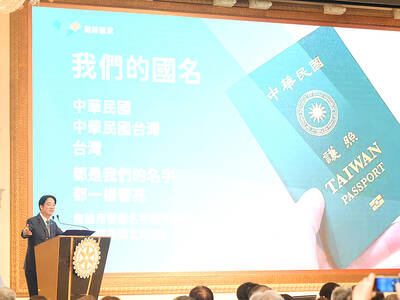
‘OF COURSE A COUNTRY’: The president outlined that Taiwan has all the necessary features of a nation, including citizens, land, government and sovereignty President William Lai (賴清德) discussed the meaning of “nation” during a speech in New Taipei City last night, emphasizing that Taiwan is a country as he condemned China’s misinterpretation of UN Resolution 2758. The speech was the first in a series of 10 that Lai is scheduled to give across Taiwan. It is the responsibility of Taiwanese citizens to stand united to defend their national sovereignty, democracy, liberty, way of life and the future of the next generation, Lai said. This is the most important legacy the people of this era could pass on to future generations, he said. Lai went on to discuss
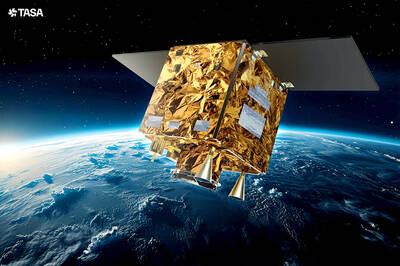
OBJECTS AT SEA: Satellites with synthetic-aperture radar could aid in the detection of small Chinese boats attempting to illegally enter Taiwan, the space agency head said Taiwan aims to send the nation’s first low Earth orbit (LEO) satellite into space in 2027, while the first Formosat-8 and Formosat-9 spacecraft are to be launched in October and 2028 respectively, the National Science and Technology Council said yesterday. The council laid out its space development plan in a report reviewed by members of the legislature’s Education and Culture Committee. Six LEO satellites would be produced in the initial phase, with the first one, the B5G-1A, scheduled to be launched in 2027, the council said in the report. Regarding the second satellite, the B5G-1B, the government plans to work with private contractors
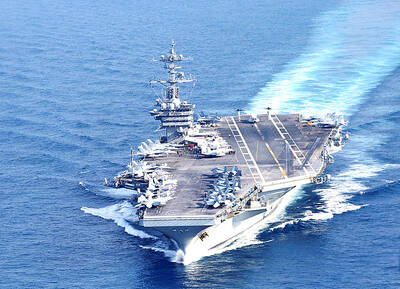
MISSION: The Indo-Pacific region is ‘the priority theater,’ where the task of deterrence extends across the entire region, including Taiwan, the US Pacific Fleet commander said The US Navy’s “mission of deterrence” in the Indo-Pacific theater applies to Taiwan, Pacific Fleet Commander Admiral Stephen Koehler told the South China Sea Conference on Tuesday. The conference, organized by the Center for Strategic and International Studies (CSIS), is an international platform for senior officials and experts from countries with security interests in the region. “The Pacific Fleet’s mission is to deter aggression across the Western Pacific, together with our allies and partners, and to prevail in combat if necessary, Koehler said in the event’s keynote speech. “That mission of deterrence applies regionwide — including the South China Sea and Taiwan,” he


 RSS
RSS