


On the banks of the Tigris River in Baghdad, a combat zone only weeks ago, a row of art galleries showcase abstract art, made in Iraq.
Clients are scarce at the galleries on Abu Nawas Street.
Only a few wander in on a July afternoon, what with looting and shooting prevalent after the toppling of former President Saddam Hussein.
PHOTO: AP
"We can't put a high price on a painting, because no one will buy it," said Abdullah Omar, co-owner of the Al-Meezan Gallery, pointing to a geometric work he said is worth twice the US$300 price tag.
Omar and other gallery owners are betting on a rebound as soon as Baghdad Airport reopens and artists and dealers travel abroad.
Art sellers say they long for the freedom of expression and commerce that regime change can bring.
The hope, too, is that Iraqi artists living abroad will soon sell works in their home country.
Already, Omar said he is taking 200 paintings by a group of Iraqi artists to Berlin for a temporary showing, a trip that would have been unthinkable under Hussein.
With few fetching more than US$300 at home, the paintings -- abstract works in minimalist tones and Orientalist-style street scenes -- might seem like bargains to Westerners.
But local looters, oblivious to aesthetics, shunned the art when they broke in last month to cart off computers and electrical equipment.
"They don't understand it," said Omar, who has slept in his gallery ever since.
Undervalued
With time, the market for Iraqi art will "definitely" grow, says Mehreen Rizvi, a 20th century specialist in Mideast art at Sotheby's Holdings Inc in London, "because of the high quality of the work -- the Iraqis are the best-known of all the Arab artists -- and because it's so undervalued."
Rizvi organized a sale of contemporary Mideast paintings in April, the third of its kind. Even with the war just over, Iraqi paintings were sold at or near their estimated prices, with one large work, Suad Al Attar's Tender Moment, fetching ?8,500 (US$13,500).
"Imagine if the mother country opens up, and artists can come out, bring their paintings, and exhibit them," she said.
"You'll get a lot more exposure, a lot more interest from people, therefore collectors, therefore money," Rizvi said.
The market is "steadily and progressively getting better," confirms Iraqi artist Maysaloun Faraj, who opened London's Aya Gallery in November and has edited a catalog of Iraqi contemporary art.
In Amman, where many Iraqi painters have settled, the Orfali Gallery reports a doubling of sales in the past two months.
"People are investing in paintings, because they think the artists will go to Baghdad and we won't have any more works from them," said owner Rana Snober Sharif.
Baghdad-based art galleries expect some of that buzz to spread to them.
"Clearly, business will pick up," said Haider Hashim, 35, owner of the riverside Akad Gallery in Baghdad, whose walls are covered with lithographs by artist Ismael Fattah, one of Iraq's best-known.
For now, Hashim is short of his 30-canvas monthly sales target. He suffers the ricochet effect of lawlessness: Jordanian border guards are seizing paintings purchased at Baghdad galleries that foreign buyers are taking out of the country "because they think they were stolen from Saddam's palaces," he says.
That discourages buyers.
Government gifts
Prewar clients at the neighboring Inaa Gallery, where delicate watercolors mingle with sculpted bronze figurines, included aides to the prime minister and information minister, who offered art as gifts to visiting dignitaries.
In a good month, the gallery sold US$3,000 worth of art, taking a 15 percent cut, says manager Ghayath Al Jazairi -- as little as a quarter of the commission some galleries in the West would demand.
As he speaks, a Western journalist walks in to inquire about prices, and a crew of Korean aid workers in green vests and Safari hats streams in and out. Closing time, which on Al Jazairi's business card is still 9:00pm, has been brought forward to 7:30pm, just before nightfall when looters roam. Al Jazairi sleeps in the gallery to guard the works.
Still, regime change means "we will open up to the world," says Al Jazairi, who once ran the Iraqi artists' association.
Outside the regime
Already, the fall of Saddam Hussein has stirred a painting revival. Inside the leafy enclave where Hussein and his sons once lived is the headquarters of the US Civilian Military Operations Center, replete with faux French fauteuils and gaudy consoles. It's now a temporary exhibition hall for budding talent, courtesy of the coalition.
Hanging next to bulletin boards bedecked with 4th of July greeting cards and illustrated posters of venomous snakes are coarse renditions of doves, parrots and women in Arabian garb, selling for as little as US$25 each.
One US$75 calligraphic work is marked "sold."
"Young Iraqi artists are very happy to be outside the regime, so they're trying to express that in their art," said US Army Captain William Sumner, a Civil Affairs culture officer working there, who has handed over a restaurant in Baghdad's war-wrecked Zawra Park to the 300-member visual-arts society.
Surreal souvenier
At the Flowers Land Hotel, patronized mainly by journalists, the reception area is strewn with unframed canvases priced US$25 to US$150 -- depictions of Arab horsemen and swooning women, or nocturnal village scenes reminiscent of paintings by Marc Chagall.
Dealer Abbas Moslem, a mustachioed ex-chauffeur of 47 who sits on a divan in his shirtsleeves awaiting customers, said he misses the days when merchants from Saudi Arabia, the Gulf states and Kuwait bought his works, as did Hussein's secretary, who sent bodyguards to shop for art. He's optimistic though.
"Of course there will be more business in the future, especially if they open Baghdad Airport," he said. "All the hotels will be fully booked."
Moslem is clinging to one memento of the fallen regime: A surrealistic painting of an ape growling at a dagger-waving knight, which was looted from the former information minister's home and which he bought for US$30.
Portrait of Saddam
Over in the commercial Karadah district, 40-year-old painter Majid Al-Saedi opened the Asfar Gallery in 2000 to earn a living, as the government stopped backing artists and buying up all of their exhibited works.
Last year, he was asked by the government to do a birthday portrait of Hussein.
"I painted it well," he says with a wry smile.
Nowadays, "you have carpenters who sell art because they heard it was good business," he said on the gallery's front porch after a power cut extinguished lights and fans.
Painting is "easy work: you buy paint, make a few brush strokes, and ask hundreds of dollars because Europeans like it."
"Now, business is for them," he says, pointing across the street to the Captain Gallery.
Renoir copies
There, amid plastic red roses and the large "Welcome" mat in the entrance, are US$60 copies of paintings by French Impressionist Pierre Auguste Renoir in shades of bright orange, night views of the Shiite shrines of Karbala and Najaf, and paintings of sprightly dolphins.
Owner Majed Al Gheissi, a former prisoner in the 1991 Gulf War who works out of his father's old carpeting shop, says current customers are US soldiers paying US$5 or US$10 a picture.
He sold US$150 worth last month; his rent alone is US$100.
Ushering visitors to a storage room dimmed by the power cut, he points to a large copy of a 19th-century German Orientalist painting that he sells for US$200, pocketing half the cash.
"All of these are copies," he boasts in his cream-colored robe. "If you buy this one, I will get another one."

‘NO SECURITY RISK’: The Railway Bureau reassured the public that the technicians’ activities were limited to technical guidance and did not involve sensitive systems The Railway Bureau yesterday said it had invited eight Chinese technicians to assist with an airport MRT construction project. The bureau issued the confirmation after an Internet user said Chinese nationals had entered the construction zone of Taiwan Taoyuan International Airport’s Terminal 3 project. They asked why “individuals from an enemy state” were allowed access to such a major national infrastructure project, which raised serious concerns over Taiwan’s industrial safety, sensitive systems and information security. The bureau’s Northern Region Engineering Branch Office said subcontractor Taiwan Handle Industrial Co (台灣手把工業) of the Taoyuan airport MRT’s “Contract No. CU05 Project A14 Station Civil, MEP &

The National Chungshan Institute of Science and Technology yesterday showcased its locally developed variants of the Vision 60 robotic patrol dog, which it plans to deploy on the nation’s outlying territories in the South China Sea. The variants were produced under the Joint Lab project — created by the institute and domestic companies — and assembled with domestically produced motors, lenses and artificial intelligence (AI) systems alongside licensed tech from the US, Missile and Rocket Systems Research Division deputy director Jen Kuo-kang (任國光) told the media event at a military base in Taipei’s Dazhi (大直) area. Taiwan has built up its strengths
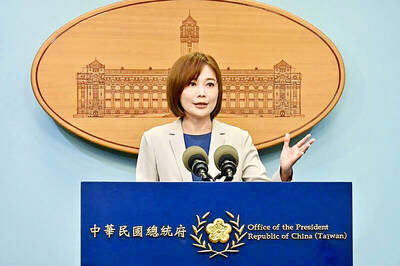
TIT-FOR-TAT: The US allegedly revoked the visa of a Chinese national working at Xinhua News Agency in the US in response to Beijing’s expulsion of Vivian Wang The Presidential Office yesterday condemned China for expelling a New York Times correspondent from Beijing following the newspaper’s interview with President William Lai (賴清德), saying the move highlighted Beijing’s suppression of press freedom and its threat to international news media. Taiwan has noted a series of recent incidents in which Beijing used similar tactics to “threaten and pressure international media outlets and journalists,” Presidential Office spokeswoman Karen Kuo (郭雅慧) said in a statement. “This concerns not only press freedom and freedom of expression, but also the safety of journalists, and Taiwan and relevant partners are paying close attention to the situation,” she

NOT IMMEDIATE: Taiwan has a chance to appeal the proposed 10 percent tariff before it starts, while other countries face a 12.5 percent tariff from the trade office Taiwan is among 60 economies determined by the US to have failed to impose or enforce a ban on the importation of goods produced with forced labor, according to a notice released on Tuesday by the Office of the US Trade Representative (USTR), which proposed imposing an additional 10 percent or more tariff on them. The USTR in a statement said that following an investigation, it had determined under Section 301 of the Trade Act of 1974 that the failure of the 60 economies to impose and effectively enforce a prohibition on the importation of goods produced with forced labor is


 RSS
RSS