


In the clear summer sky, the V-22 Osprey was showing its stuff. It went backward, zoomed at an angle, hovered close to the ground and then shot straight up into the air. Buck Rogers himself couldn't have created a more dramatic sight: a hybrid craft, half helicopter and half airplane, that danced in the sky and appeared to defy the laws of aerodynamics.
It was exactly the performance the US Marine Corps wanted to show.
After two decades in development, the US Marines, along with the Osprey's contractors, Boeing and the Bell Helicopter subsidiary of Textron, are making their final push to gain Pentagon approval for the Osprey, an aircraft as high in promise as in problems. The government has spent more than US$12 billion so far on the Osprey, which has the notoriety of having suffered three fatal crashes in test flights, leading to the deaths of 30 people, 26 of them Marines.
PHOTO: NY TIMES
Still, the US Marines are determined, and they see the Osprey as crucial to their mission in the world.
"It won't be long before everyone wants one of these," said Colonel Daniel Schultz, the V-22 program manager. "It's the promise of the future."
The Osprey, which can take off like a helicopter and fly like a plane, can travel twice as fast and five times as far as the US Marines' current helicopter fleet from the Vietnam era.
PHOTO: NY TIMES
But neither the Osprey's razzle-dazzle aerobatics nor the US Marine Corps' doggedness has been able to silence critics, who remain convinced that the Osprey's design is too complicated and inherently flawed. The craft is being pushed into production without adequate testing, they argue, and it is simply too dangerous and too expensive.
"The Marines have a tremendous can-do attitude," said Philip E. Coyle III, a senior adviser at the Center for Defense Information, a military research group in Washington. "But when they're overly committed to a program like this, they can end up looking foolish as well as killing people."
Coyle is a former assistant defense secretary who ran the Pentagon's weapons testing program in the 1990s.
Just last May, the General Accounting Office offered its own criticisms. It said the Osprey program "plans to enter full-rate production without ensuring that the manufacturing processes are mature" and that Osprey production continues with inadequate assessments.
But critics fear that the passion of its supporters and the weight of history will keep moving the project along.
"The Osprey is on the road to recovery, and the proponents are pushing really hard," said Chris Hellman, a director at the Center for Arms Control and Non-Proliferation, a research group in Washington. "My problems with the Osprey remain. The V-22 has gotten to the point where so much money has gone into it, it will probably go ahead regardless."
By the end of 2005, the Pentagon will decide whether to ask Congress to finance a combat-ready fleet of 458 Ospreys -- at a projected price of US$48 billion. The bulk of the Ospreys would go to the US Marines, with 98 for the Army Special Forces and the Navy. For the most part, the Osprey is designed for amphibious troop transport and assault.
The Osprey has also received backing from the Bush administration, which is calling for a "low rate" production of 11 test Ospreys annually in the fiscal 2004 Pentagon budget.
Hawking their wares
Aiding the US Marines' push in Washington are two formidable lobbying powerhouses, Boeing and Textron. Each is a 50-percent partner in the Osprey and has platoons of lobbyists working Capitol Hill, along with those of the Osprey's many subcontractors.
Right now, each Osprey has a price tag of US$68.7 million; by comparison, an F-16 fighter jet costs around US$20 million. One of the challenges for the Osprey program is to bring the per-craft cost down to around US$58 million, a number critics say is still staggeringly expensive for a craft that is essentially a replacement helicopter.
With numbers that large, the Osprey is expected to give each company up to US$20 billion over the life of the 12-year project. For the Chicago-based Boeing, which had revenue of US$54 billion last year, it would be a significant amount of money. For Bell Helicopter, it is more important than that. Even today, the project accounts for 38 percent of the annual revenue of Bell Helicopter, which also wants to use the Osprey's tilt-rotor technology to make a commercial version of the craft. The Osprey also accounts for 6 percent of Textron's US$10.7 billion revenue.
In a presentation before the aerial demonstration here, Schultz defended the revised testing program that began when the Osprey returned to the skies in May 2002. In the new program, many of Osprey's initial developmental tests were eliminated -- to the dismay of many critics -- and replaced with ones that Schultz said were better designed to simulate battlefield conditions and address the problems underlying the crashes. The main problems involved the Osprey's aerodynamics and hydraulics.
Not only do the Osprey's backers feel that it's good enough for the military, they also feel it is good enough for the president. They are angling to have a V-22 Osprey selected in the current competition to replace Marine One, the presidential helicopter. "It would be perfect for the president," said Bob Leder, a spokesman for Bell Helicopter.
Among the unconvinced are retired military aviators, some members of Congress and other military industry analysts. They say the problems behind the multiple crashes have not been resolved and that the complicated design is only setting up the Osprey for more tragic problems -- the current optimism notwithstanding. For years, a group of retired military aviators, calling itself the "red ribbon panel," has issued one critical warning after another.
Design tricks
"While there are some very good design tricks, it's got the same basic problems," said Harry P. Dunn, a retired Air Force colonel who heads the group. "It's not a question of if someone gets killed, but when."
Most critics say the Osprey lacks enough maneuverability at low altitudes, and they question whether the manufacturers have solved an aerodynamic problem, called vortex ring state, that caused an April 2000 crash in Arizona in which 19 Marines died. In that condition, the craft becomes caught in its own turbulence and loses lift.
US Representative Jim Gibbons, a Nevada Republican who flew F-4s in Vietnam and in the Gulf War as an Air Force combat pilot, is a doubter, too.
"This has all the earmarks of becoming the Edsel of the aviation industry," he said, referring to Ford Motor Co's famously ill-fated automobile. "The Osprey is a nice tool, but is it the right tool in the circumstances?"
Gibbons is a member of the House Armed Services Committee.
High and dry
He questions the Osprey's effectiveness at high altitudes, like the mountains of Afghanistan. He also says the downdraft that comes from the Osprey's powerful rotors as it hovers is so great, US Marine rescue missions could become impossible, especially over water.
Yet with Boeing, Bell and Osprey subcontractors spreading V-22 work in more than 40 states and 200 congressional districts, Gibbons is one of the few critics in Congress.
The history of Osprey crashes casts a long shadow over the sales effort. The April 2000 crash that killed 19 Marines occurred just as the Pentagon was to decide whether to approve the Osprey. The following December, an Osprey crashed in a forest outside Jacksonville, North Carolina, killing four more Marines. After that crash, which was attributed to a leak in hydraulic lines, the Osprey was grounded and testing suspended.
More deaths
Nearly a decade earlier, in July 1992, a test Osprey crashed into the Potomac River, killing four Boeing employees and three Marines.
Even at that early date, the Osprey was catching flak. Vice President Dick Cheney, who was defense secretary at the time, repeatedly tried to halt the program, arguing that it was too costly. But every time he tried to starve the Osprey for financing, he was overruled by a Congress that kept the money flowing.
At the Osprey demonstration at the Patuxent River Naval Air Station in Maryland, Schultz and his team of test pilots put the Osprey through aerial paces intended to counter specific complaints. In a mere 12 seconds, the craft can tilt its rotor, switching from helicopter to airplane mode.
As the Osprey hovered like a helicopter 25 feet off the ground, doing a tap dance of gyrations, Schultz said: "Can't maneuver? I believe this shows maneuvers."
The craft then rocked back and forth in the air, did a nose dive toward the ground, hovered, and finally put its nose in the air and headed upward. It even demonstrated that it could land with only one engine. (The other was idling.) When the Osprey finished its 15-minute show, it dropped out of the sky and put its rotors into the air.
Then, one by one, each blade of the rotor collapsed downward, like fading flower petals. Once collapsed, the blades then bundled themselves together. With its blades compactly tucked away in this fashion, the Osprey showed that it would not take up a lot of space on an aircraft deck -- addressing another complaint.
As he stepped out of the Osprey, Boeing's top V-22 test pilot, Thomas L. MacDonald, said the air show at Patuxent explained why the US Marines are so gung-ho for the Osprey.
"As a former Navy airplane and helicopter pilot, I'm acutely aware of the limitations of both," MacDonald said. "With the Osprey, the Marines will be able to get to the fight without dying on the way and get out without being killed on the way back."
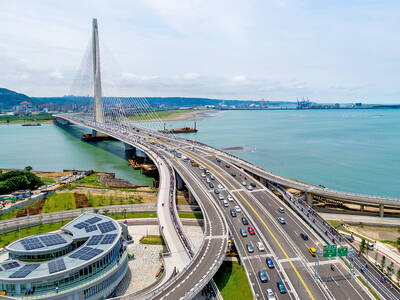
The Ministry of Transportation and Communications yesterday inaugurated the Danjiang Bridge across the Tamsui River in New Taipei City, saying that the structure would be an architectural icon and traffic artery for Taiwan. Feted as a major engineering achievement, the Danjiang Bridge is 920m long, 211m tall at the top of its pylon, and is the longest single-pylon asymmetric cable-stayed bridge in the world, the government’s Web site for the structure said. It was designed by late Iraqi-British architect Zaha Hadid. The structure, with a maximum deck of 70m, accommodates road and light rail traffic, and affords a 200m navigation channel for boats,
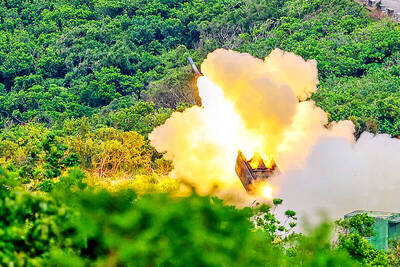
PRECISION STRIKES: The most significant reason to deploy HIMARS to outlying islands is to establish a ‘dead zone’ that the PLA would not dare enter, a source said A High Mobility Artillery Rocket System (HIMARS) would be deployed to Penghu County and Dongyin Island (東引) in Lienchiang County (Matsu) to force the Chinese military to retreat at least 100km from the coastline, a military source said yesterday. Taiwan has been procuring HIMARS and Army Tactical Missile Systems (ATACMS) from the US in batches. Once all batches have been delivered, Taiwan would possess 111 HIMARS units and 504 ATACMS, which have a range of 300km. Considering that “offense is the best defense,” the military plans to forward-deploy the systems to outlying islands such as Penghu and Dongyin so that

WHAT WAS ALL THAT FOR? Jaw Shaw-kong said that Cheng Li-wen had pushed for more drastic cuts and attacked him, just for the outcome to be nearly identical to his bill The legislature yesterday passed a supplementary budget bill to fund the purchase of separate packages of US military equipment, with the combined amount of spending capped at NT$780 billion (US$24.8 billion). The Chinese Nationalist Party (KMT) and Taiwan People’s Party (TPP) used their legislative majority to pass the bill, which runs until 2033 and has two main funding provisions. One was for NT$300 billion of arms sales already approved by the US for Taiwan on Dec. 17 last year, the other was for NT$480 billion for another arms package expected to be announced by Washington. The bill, which fell short of the NT$1.25

‘CLEAR MESSAGE’: The bill would set up an interagency ‘tiger team’ to review sanctions tools and other economic options to help deter any Chinese aggression toward Taiwan US Representative Young Kim has introduced a bill to deter Chinese aggression against Taiwan, calling for an interagency “tiger team” to preplan coordinated sanctions and economic measures in response to possible Chinese military or political action against Taiwan. “[Chinese President] Xi Jinping [習近平] has directed the People’s Liberation Army to be ready to invade Taiwan by 2027. China has a plan. America should have one too,” Kim said in a news release on Thursday last week. She introduced the “Deter PRC [People’s Republic of China] aggression against Taiwan act” to “ensure the US has a coordinated sanctions strategy ready should


 RSS
RSS