


Call it buzz, cool, magic or whatever -- the Media Lab at the Massa-chusetts Institute of Technology cannot thrive without it.
But like many businesses that flourished during the 1990s technology boom, the lab -- the place where researchers talked about cyberspace, multimedia and virtual reality long before those words became household terms -- has struggled to generate excitement and reposition itself now that the bubble has burst.
In the rambunctiously creative years after its founding in 1985, the Media Lab was celebrated for its insights into how new technology might change traditional forms of communication and everyday life.
These days, other research institutions are competing with the lab to create prototypes of the communication technologies of the future. Newer subjects of interest like atomic and molecular studies, overseas expansion, and new links to other parts of MIT threaten to blur its image. And raising money from corporate sponsors, who have in the past provided almost all the lab's funding, is tougher.
"There's lots of competition now," said Robert Buderi, an editor at MIT's Technology Review magazine and an expert on corporate research.
"I can see many of the same concepts demonstrated at places like Carnegie-Mellon, Microsoft, Xerox PARC, IBM and U.C. Berkeley." he said.
Organizationally, at least, the Media Lab is still in a league of its own. In the last few years, it has given birth to sister labs in India and Ireland, as well as the Center for Bits and Atoms, a federally funded research center that concentrates on physics and chemistry projects and is housed in the lab's I.M. Pei-designed building. All now operate under the umbrella of a new organization called Media Labs, headed by Nicholas Negroponte, the famously outspoken founding director of the Media Lab.
"Fundamentally, we bet on people and then continually experiment with how to organize it," said Walter Bender, who succeeded Negroponte as director of the original lab in September 2000.
"I don't think that anyone has as diverse a collection of activities and the real magic of the place is the interaction," he said.
Unlike other major university research institutions, the original Media Lab here has always relied on its ability to attract corporate sponsors. Until the recession, the success of that model was the envy of other institutions.
"There was a culture there of spending money like water," said Aaron Bobick, who left the Media Lab in 1999 to become director of the Graphics, Visualization and Usability Center at Georgia Tech.
"It used to be that money wasn't a reason that things couldn't get done," he said.
The Media Lab still has plenty of corporate fans. More than 75 percent of this year's US$40 million budget comes from 120 companies, who share access to the technology developed at the lab.
But attracting cash has been a struggle in recent years, prompting the lab to turn increasingly to government and foundation funding sources it once ignored. Foreign governments account for most of the budgets of the sister labs overseas, and the US$13.75 million grant from the National Science Foundation in late 2001 to set up the Center for Bits and Atoms dwarfed any previous contribution from Washington.
The new sources have not been enough to avoid sobering cutbacks. In 2001, the lab imposed sharp reductions in travel, restrictions on free meals and, eventually, the layoffs of 40 support employees, the first such cuts in its history.
Bender said the corporate share of the Media Lab's budget is likely to fall to about 60 percent in the com-ing years. Still, many of the lab's sponsors are strongly committed to its mission. Companies like BT, the former British Telecom, and Motor-ola, both of which donate more than US$1 million annually to the lab, view it as both a window into new business opportunities and an insurance policy against getting blindsided by technology developments they did not anticipate.
Critics have long said that so much of the lab's research is fanciful and impractical that investing in it is foolish. Basic membership costs US$100,000 annually for a minimum of three years. And there is no ques-tion that the lab has provided grist for the critics since it opened.
Negroponte, a charismatic professor from the Department of Architecture, recruited a diverse collection of free thinkers in setting up the lab, including Marvin Minsky, a specialist in machine intelligence, and Seymour Pappert, a well-known learning theorist. The graduate students they brought came from design, computer programming and sociology backgrounds to receive degrees in a new discipline they called "media arts and science."

‘NO SECURITY RISK’: The Railway Bureau reassured the public that the technicians’ activities were limited to technical guidance and did not involve sensitive systems The Railway Bureau yesterday said it had invited eight Chinese technicians to assist with an airport MRT construction project. The bureau issued the confirmation after an Internet user said Chinese nationals had entered the construction zone of Taiwan Taoyuan International Airport’s Terminal 3 project. They asked why “individuals from an enemy state” were allowed access to such a major national infrastructure project, which raised serious concerns over Taiwan’s industrial safety, sensitive systems and information security. The bureau’s Northern Region Engineering Branch Office said subcontractor Taiwan Handle Industrial Co (台灣手把工業) of the Taoyuan airport MRT’s “Contract No. CU05 Project A14 Station Civil, MEP &

A US uncrewed surface vessel (USV) encountered multiple Chinese warships during an autonomous transit of the Taiwan Strait, US defense company Seasats said in a statement on Wednesday. Seasats announced that a Lightfish USV had completed the first autonomous transit of the Taiwan Strait. Over five days, the USV traversed the entire length of the Strait while constantly monitoring surface vessel traffic, the company said. The Lightfish encountered multiple Chinese warships, one of which was a Chinese People’s Liberation Army Navy (PLAN) Type 056 corvette, it said. The Chinese vessels were operating “well within Taiwan’s exclusive economic zone without transmitting their identity via the
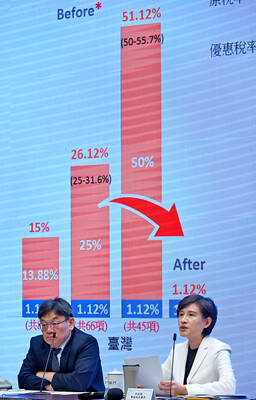
GREATER REACH? Auto parts and wood products would face tariffs of up to 15%, matching those targeting the EU, Japan and South Korea, Vice Premier said The US has announced that preferential tariff treatment for Taiwan’s non-semiconductor Section 232 goods would take effect retroactively from May 1, the Executive Yuan said yesterday. The US government yesterday posted a notice on the Federal Register’s public inspection Web site previewing tariff concessions for Taiwan under a memorandum of understanding (MOU) on Taiwan-US investment after two months of negotiations. The MOU signed on Jan. 15 stipulated three major preferential tariff arrangements: a 15 percent “reciprocal” tariff rate for Taiwan without stacking most-favored nation (MFN) rates; preferential Section 232 treatment for semiconductors and related products; and preferential Section 232 treatment for non-semiconductor

The National Chungshan Institute of Science and Technology yesterday showcased its locally developed variants of the Vision 60 robotic patrol dog, which it plans to deploy on the nation’s outlying territories in the South China Sea. The variants were produced under the Joint Lab project — created by the institute and domestic companies — and assembled with domestically produced motors, lenses and artificial intelligence (AI) systems alongside licensed tech from the US, Missile and Rocket Systems Research Division deputy director Jen Kuo-kang (任國光) told the media event at a military base in Taipei’s Dazhi (大直) area. Taiwan has built up its strengths


 RSS
RSS