


The cola wars are taking on a new dimension in Europe, where Muslims are being asked to pledge allegiance to one of two new brands.
"Liberate Your Taste" says the slogan for Qibla Cola; its rival Mecca-Cola tells its buyers: "Don't drink stupid, drink committed."
By offering a dose of activism along with the usual sugar, preservatives and carbonated water, the entrepreneurs behind both new drinks are trying to cash in on anti-American sentiment within Britain's 2.5 million Muslim community.
"The Qibla brand offers a real alternative for people concerned about the practices of some major Western multinationals who support causes that oppress Muslims," said company founder Zahida Parveen.
"By choosing to boycott major brands, consumers are sending a powerful signal: that the exploitation of Muslims cannot continue unchecked."
Qibla was launched in the British market this week following the success of French-Tunisian businessman Tawfiq Mathlouthi's Mecca brand in France.
Mecca, launched in November, was originally targeted at France's Muslim community. But it quickly caught on to a broader market and the bottles -- each one described by Mathlouthi as "a little gesture against US imperialism and foreign policy" -- are also being distributed in Britain. Both companies have plans to expand to other European countries.
Parveen and Mathlouthi deny a direct attack on Coca-Cola, though the red-and-white swoosh labeling on both products bears a strong resemblance to the US brand. But, they say, the soft drink giant represents American capitalism.
Amirah Ali, a spokeswoman for the London-based Islamic Human Rights Association, said the war on terrorism has made all American brands a focus for resentment, and buying alternative brands makes the Muslim community "feel better."
"It makes us feel like we can do something," Ali said. "Coca-Cola has become a big symbol of America. It's a tangible symbol at a time when there is increasing unhappiness about US foreign policy."
In London's Brick Lane, where there is a large Muslim community, opinions on the success of a boycott are mixed.
"I don't think it does anything. How does that help people who are suffering in Palestine?" said Abdul Mahmood, who was buying Coca-Cola from a local store.
But Ahmed Hussein said he would purchase alternatives if they were readily available. "Economic power is important and anything we can do to break that is a good thing."
Martin Norris, communications director for Coca-Cola UK, said the company did not engage in religious or political arguments and dismissed the newcomers.
"I think consumers are able to make a very clear distinction between the soft drink they want to drink and whatever the policies of the American government are," Norris said.
Qibla and Mecca have pledged to commit 10 percent of their profits to Islamic charities.
Norris responded that Coca-Cola provided investment where it operated, including in the Palestinian administrative headquarters in the West Bank, where it opened a plant in 1998.
"We have a plant in Ramallah which has 200 employees and is supporting the local economy. We think that's a better way of serving the community," he said.
Coca-Cola has said that an unofficial boycott of US products in the Arab Middle East in retaliation for Washington's support of Israel has hurt its bottom line in the region.
Zam Zam Cola, the Iranian drink introduced after that country's 1979 Islamic revolution, had huge sales growth a few years ago when a prominent Muslim cleric ruled that Coke and Pepsi were "un-Islamic."
Zam Zam is now exporting to Saudi Arabia and other Persian Gulf countries, shipping more than 10 million bottles in the last four months of 2002.
Qibla -- named for the direction the faithful face when praying toward Mecca -- has plans to expand into the Middle East, Africa, South Asia and the Far East.
Abdul Hamid Ebrahim, a spokesman for the company, said Muslim countries like Indonesia, Pakistan and Bangladesh are being targeted. Qibla hopes to increase production to a million bottles a month in March.
Mecca says it has sold more than 2 million bottles in France since November and has orders in Britain for 2 million bottles a month. It said it also has orders from Belgium, Germany, Australia and Canada.
Still, that's a long way from Coca-Cola, which sells more than 40 million servings every hour around the world.

‘NO SECURITY RISK’: The Railway Bureau reassured the public that the technicians’ activities were limited to technical guidance and did not involve sensitive systems The Railway Bureau yesterday said it had invited eight Chinese technicians to assist with an airport MRT construction project. The bureau issued the confirmation after an Internet user said Chinese nationals had entered the construction zone of Taiwan Taoyuan International Airport’s Terminal 3 project. They asked why “individuals from an enemy state” were allowed access to such a major national infrastructure project, which raised serious concerns over Taiwan’s industrial safety, sensitive systems and information security. The bureau’s Northern Region Engineering Branch Office said subcontractor Taiwan Handle Industrial Co (台灣手把工業) of the Taoyuan airport MRT’s “Contract No. CU05 Project A14 Station Civil, MEP &

A US uncrewed surface vessel (USV) encountered multiple Chinese warships during an autonomous transit of the Taiwan Strait, US defense company Seasats said in a statement on Wednesday. Seasats announced that a Lightfish USV had completed the first autonomous transit of the Taiwan Strait. Over five days, the USV traversed the entire length of the Strait while constantly monitoring surface vessel traffic, the company said. The Lightfish encountered multiple Chinese warships, one of which was a Chinese People’s Liberation Army Navy (PLAN) Type 056 corvette, it said. The Chinese vessels were operating “well within Taiwan’s exclusive economic zone without transmitting their identity via the
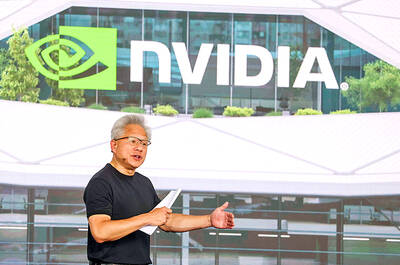
‘BOOMING’: ’ The number of partners we have here is incredible. You can see from their stock prices. They’re doing so well, they’re so happy,’ Jensen Huang said Nvidia Corp’s spending in Taiwan has ballooned to about US$150 billion a year, 10 times the US$10 billion to US$15 billion the company spent five years ago, Nvidia chief executive officer Jensen Huang (黃仁勳) said yesterday, suggesting Taiwan’s strategic importance in the global artificial intelligence (AI) supply chain. “Taiwan is the epicenter of the AI revolution. This is where the chips come, packaging comes. This is where the systems are made. This is where AI supercomputers were created,” Huang said at a meeting for the company’s employees in Beitou-Shilin Technology Park (北投士林科技園區) in Taipei, the planned site of Nvidia’s Taipei headquarters. “Taiwan
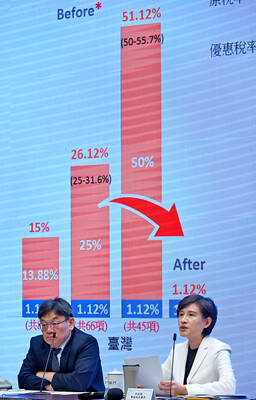
GREATER REACH? Auto parts and wood products would face tariffs of up to 15%, matching those targeting the EU, Japan and South Korea, Vice Premier said The US has announced that preferential tariff treatment for Taiwan’s non-semiconductor Section 232 goods would take effect retroactively from May 1, the Executive Yuan said yesterday. The US government yesterday posted a notice on the Federal Register’s public inspection Web site previewing tariff concessions for Taiwan under a memorandum of understanding (MOU) on Taiwan-US investment after two months of negotiations. The MOU signed on Jan. 15 stipulated three major preferential tariff arrangements: a 15 percent “reciprocal” tariff rate for Taiwan without stacking most-favored nation (MFN) rates; preferential Section 232 treatment for semiconductors and related products; and preferential Section 232 treatment for non-semiconductor


 RSS
RSS