


Welcome to Marikina, population 437,000: shoe capital of the Philippines and home to Imelda Marcos' famed footwear collection.
How things have changed.
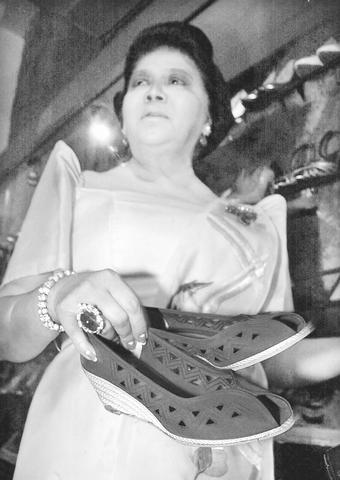
PHOTO: REUTERS
"When I was little there were rough roads, no lights," said 36-year old Rosalie Manuel, sitting in the doorway of the Marikina footwear museum that houses more than 600 pairs of former first lady's massive shoe collection.
But change has also brought industrialization and Filipino shoemakers face crushing competition from low-price, high-quality imports that threaten to render the neighborhood unrecognizable or wipe out its shoe industry entirely.
Manuel, a guide at the museum, was born the same year flamboyant former first lady Marcos moved into the presidential palace, later amassing a collection of silk-covered slingbacks that were made in Marikina's backyard workshops.
Since then, sprawling metropolitan Manila, home to more than 12 million people, has all but engulfed the sleepy riverside town of Marikina, turning it into one of the city's quieter middle-class neighborhoods.
Roadside stands now sell trendy platforms instead of Marikina's trademark dainty, beaded slippers. Wholesale shops set up in family garages sell moulded soles from South Korea and leather from Taiwan instead of the locally made products of 50 years ago.
Yet some things here in Marikina haven't changed at all.
Centuries-old homes
Centuries-old stone houses -- a rare sight in Manila, which was nearly flattened by Allied bombs during World War II -- still stand, some bearing bullet holes from the time when Japanese soldiers occupied the town and shoemakers joined the guerrillas in the nearby mountains.
The neighborhood's first shoe workshop still occupies a prominent street corner, the 400-year-old house with arched doorways now home to a cultural center.
Inside Marikina's family compounds, 70 percent of all shoes in the Philippines are still made here, by hand and in small batches.
Not for long, say pessimists, who see mass production in China as the main threat.
"They do it so fast. We do it slowly because we do it by hand." said shoemaker association head Carmelita Riofrio, sitting behind an office desk littered with shoe lasts and order forms.
In a network of outbuildings in Riofrio's family compound, dozens of workers trace and cut out shapes of leather by hand, stitch and glue them together to the sounds of American pop songs pouring out from overhead speakers.
Her own parents made baby boots, one bronzed specimen sitting proudly on her desk.
"For little manufacturers like me, change is very limited. We're using the same system handed down from generations ago," Riofrio said, her husband sitting in a corner and helping to label teetering stacks of shoeboxes.
Riofrio says she could double her current weekly output of 800 to 1,000 pairs per week if she spent one million pesos (US$19,570) on Korean or Taiwanese machinery.
But she doesn't have the money, and other members of the shoemaking association she heads are in the same position, she says.
Since China became a member of the WTO at the beginning of December, small businesses such as hers have been scrambling for a solution.
Economists say machinery may not be enough to save them.
"China will be a tough competitor because their labor costs are so low," said Luz Lorenzo, head of research at ATR Kim Eng Securities in Manila.
"Manufacturing in general will be the toughest field. If you want to survive, you have to move away from areas in which they are strong, like labor-intensive products."
Lorenzo said the Philippines could weather China's increasing dominance in manufacturing by capitalizing on strengths unique in Asia: a highly skilled work force fluent in English.
"Skilled labor is really quite competitive, and the best use for that is in services," Lorenzo said.
Call centers, accounting services or design and testing for information technology are the best options, the ATR Kim Eng Securities analyst said.
Despite stubborn barriers to economic development such as corruption, rampant kidnappings, armed rebel groups and creaking infrastructure, the Philippines has one of Asia's highest literacy rates.
Reasons to invest
In the Philippines, primary primary school students are taught exclusively using English.
Shoemaker Riofrio, herself a former primary school teacher, says she'd like to be optimistic about the future of her business but is reluctant to encourage her two university-aged sons to take on the family business.
"It's OK. I still make enough for three meals everyday. Plus smerienda [snacks]," she said, laughing. "But if [my children] are doing this 10 years from now ? only if it will be changed to mechanization."
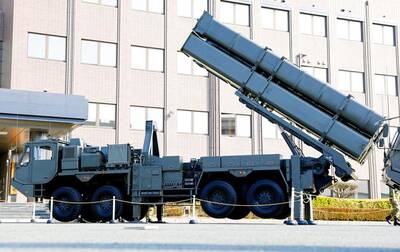
Japan has deployed long-range missiles in a southwestern region near China, the Japanese defense minister said yesterday, at a time when ties with Beijing are at their lowest in recent years. The missiles were installed in Kumamoto in the southern region of Kyushu, as Japan is attempting to shore up its military capacity as China steps up naval activity in the East China Sea. “Standoff defense capabilities enable us to counter the threat of enemy forces attempting to invade our country ... while ensuring the safety of our personnel,” Japanese Minister of Defense Shinjiro Koizumi said. “This is an extremely important initiative for
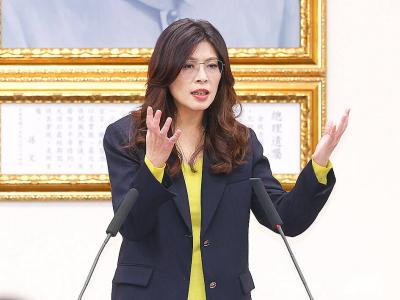
Chinese Nationalist Party (KMT) Chairwoman Cheng Li-wun (鄭麗文) today accepted an invitation from Chinese President Xi Jinping (習近平) to lead a delegation to China next month, saying she hopes to promote the peaceful development of cross-strait relations and bring stability to the Taiwan Strait. “I am grateful and happy to accept this invitation,” Cheng said in a statement from the KMT chairperson’s office. Cheng said she hopes both sides can work together to promote the peaceful development of cross-strait relations, enhance exchange and cooperation, bring stability to the Taiwan Strait and improve people’s livelihoods. At today's news conference, Cheng said any efforts to
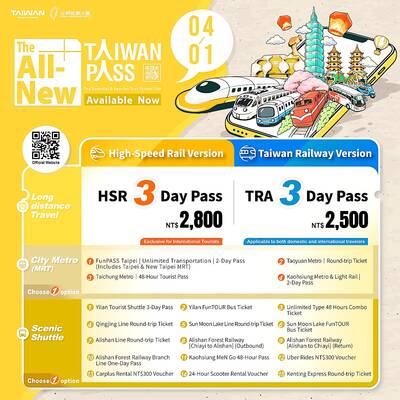
MORE POPULAR: Taiwan Pass sales increased by 59 percent during the first quarter compared with the same period last year, the Tourism Administration said The Tourism Administration yesterday said that it has streamlined the Taiwan Pass, with two versions available for purchase beginning today. The tourism agency has made the pass available to international tourists since 2024, allowing them to access the high-speed rail, Taiwan Railway Corp services, four MRT systems and four Taiwan Tourist Shuttles. Previously, five types of Taiwan Pass were available, but some tourists have said that the offerings were too complicated. The agency said only two types of Taiwan Pass would be available, starting from a three-day pass with the high-speed rail and a three-day pass with Taiwan Railway Corp. The former costs NT$2,800
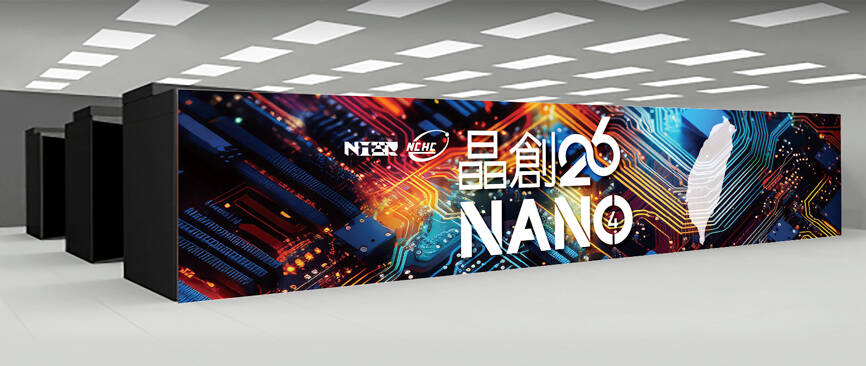
The nation’s fastest supercomputer, Nano 4 (晶創26), is scheduled to be launched in the third quarter, and would be used to train large language models in finance and national defense sectors, the National Center for High-Performance Computing (NCHC) said. The supercomputer, which would operate at about 86.05 petaflops, is being tested at a new cloud computing center in the Southern Taiwan Science Park in Tainan. The exterior of the server cabinet features chip circuitry patterns overlaid with a map of Taiwan, highlighting the nation’s central position in the semiconductor industry. The center also houses Taiwania 2, Taiwania 3, Forerunner 1 and


 RSS
RSS