


Brian Roberts' first instinct was to try to trump Rupert Murdoch. More than a year ago, Roberts, the president of Comcast, was eagerly watching Murdoch's News Corp maneuver for control of the DirecTV service. That would have given Murdoch the access he craved into American living rooms, creating the most formidable enemy yet for the cable industry.
But over a lunch at Lindy's deli across from Pennsylvania Station in Manhattan, another idea was planted in Roberts' head.
"Brian, your destiny is to acquire AT&T Broadband," Hank Vigil, a vice president at Microsoft, told him, according to a person at the lunch. "If that comes up, we'll help you."
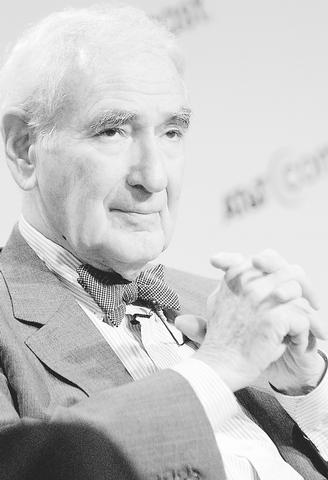
PHOTO: NY TIMES
Thursday, with Microsoft's help, Comcast did just that. The Philadelphia-based cable company won a fierce bidding war for control of AT&T's cable operations for US$47 billion in stock and the acquisition of US$20 billion in debt, creating the nation's largest cable operator in the year's largest deal.
The new AT&T Comcast will have 22 million subscribers; its largest rival in subscription television will be a pending combination of DirecTV not with the News Corp, but with another satellite operator, EchoStar. Should that deal survive regulatory scrutiny, it would create a company with 17 million subscribers.
The two companies will be the biggest, and presumably most powerful, pipelines into American homes of information, entertainment and media services.
Others thought they were destined for that role -- Murdoch, for one, before EchoStar edged him out in his pursuit of DirecTV, and AT&T's chairman, Michael Armstrong, for another, until Wall Street lost patience with his deal making. The losers for the AT&T cable systems, AOL Time Warner and Cox Communications, are likely, among others, to push for even more consolidation in the cable business.
But for now, Comcast -- led by Roberts and his father, Ralph Roberts, 81, the chairman and founder -- rules the roost. Their acquisition of AT&T Broadband marks the culmination of nearly four decades of growth that began in 1963, when the family bought a small cable operator in Tupelo, Mississippi, with 1,200 subscribers.
"We were able to build it up to a point where they would even talk to us," Ralph Roberts joked Thursday, pointing at Armstrong in the news conference at the New York Hilton where the deal was presented.
Just three months ago, Armstrong was giving the Robertses the silent treatment, after Comcast made an unsolicited US$44.5 billion bid for AT&T Broadband.
Earlier in the year, Brian Roberts and Armstrong had privately discussed a friendly merger. But those talks, which usually took place in discreet dining rooms at hotels in Philadelphia and Manhattan, broke down when AT&T's board rejected any deal in which Comcast would control more than 50 percent of the combined company.
Convinced he could force AT&T to reconsider, Roberts went public with Comcast's bid, belittling Armstrong and AT&T management as part of his strategy to create enough shareholder pressure to force a sale.
The unsolicited bid enraged Armstrong. But it did force AT&T -- whose plan was to spin off its cable units to shareholders -- to put the business up for sale.
For Brian Roberts, the problem was that he now had competition. Comcast, AOL Time Warner and Cox all made bids for AT&T. And even though Microsoft, an investor in Comcast since 1997, was in his corner, the software giant put itself in just about everyone else's corner, too. Microsoft had made side deals with Comcast, Cox and even AT&T in the event the company decided to stay independent -- all to block what the software company considers its more important rival in broadband services: AOL Time Warner.
Two weeks ago, in the Manhattan offices of AT&T's lawyers, Wachtel Lipton Rosen & Katz, Armstrong and his lieutenants reviewed the first round of bids. AT&T's board ended up dismissing them as too low, and the bidders were told to deliver new offers by 6pm Sunday, Dec. 16.
For almost a week, the bidders and their advisers holed up in conference rooms at Wachtel Lipton; AT&T officials and their advisers shuttled from room to room to negotiate. While the various bidders apparently never ran into one another, each regularly tried to peek at the registration book in the lobby, trying to gauge who had been at the offices when.
On Saturday, in a private dining room at a Midtown hotel, Brian and Ralph Roberts had lunch with Armstrong; afterward, executives close to Comcast said, the two men felt that they had repaired their relationship with Armstrong, and that they might have the inside track.
After nearly 48 uninterrupted hours of negotiations, the three bidders submitted their revised bids the next day. And then they waited. And waited.
On Tuesday night, Brian Roberts was working the room at Comcast's Christmas party at the studios of Comcast's QVC home shopping network outside Philadelphia when his cell phone rang.
Charles Noski, AT&T's chief financial officer, was on the line, asking for Roberts' final, final,offer. After some back and forth, Roberts replied that he would call back in the morning.
At 8:30am Wednesday, Roberts called Noski and said Comcast would raise its bid by about US$800 million. Then he boarded an Amtrak Metroliner train in Philadelphia and headed to New York, instructing his lawyer, Dennis S. Hersch, who heads the mergers practice at the law firm Davis Polk & Wardwell, to fax the new proposal to AT&T.
At 10:30am, just a half hour before AT&T's board was scheduled to begin meeting at Wachtel Lipton, Armstrong and Noski conferred with their advisers -- Richard Katcher of Wachtel, Gene Sykes of Goldman, Sachs, and Christopher Lawrence of Credit Suisse First Boston -- and decided management would recommend Comcast's offer.
Arriving in New York, Roberts headed for the St. Regis Hotel, where he took a nap, planning to wake by 4pm, when the board meeting was scheduled to end. His bankers, Paul Taubman of Morgan Stanley; Robert Kindler of J.P. Morgan Chase; John Trousdale of Merrill Lynch; and Steven Rattner and Peter R. Ezersky of the Quadrangle Group, waited at the offices of Davis Polk.
Four o'clock came and went.
Roberts, his father and top Comcast executives crammed into Roberts' hotel room, watching CNBC to pass the time.
Cox executives were at Teterboro Airport in New Jersey, ready to come into the city if they won or fly back to Atlanta, where Cox is based, if they did not. Richard Parsons, the chief executive-designate of AOL Time Warner, awaited the result in his office in Rockefeller Center.
At 5:45, Roberts' phone rang. It was Armstrong. "You doing anything?" he asked. "Come over. You won."
Brian and Ralph Roberts led a squadron of executives, lawyers and bankers on a jubilant march to Wachtel Lipton's offices.
There, Brian Roberts and Armstrong signed the documents. Three different sets had been prepared, depending on the winner.
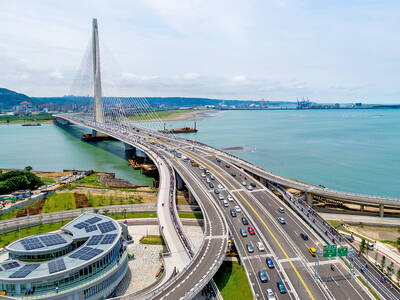
The Ministry of Transportation and Communications yesterday inaugurated the Danjiang Bridge across the Tamsui River in New Taipei City, saying that the structure would be an architectural icon and traffic artery for Taiwan. Feted as a major engineering achievement, the Danjiang Bridge is 920m long, 211m tall at the top of its pylon, and is the longest single-pylon asymmetric cable-stayed bridge in the world, the government’s Web site for the structure said. It was designed by late Iraqi-British architect Zaha Hadid. The structure, with a maximum deck of 70m, accommodates road and light rail traffic, and affords a 200m navigation channel for boats,

PRECISION STRIKES: The most significant reason to deploy HIMARS to outlying islands is to establish a ‘dead zone’ that the PLA would not dare enter, a source said A High Mobility Artillery Rocket System (HIMARS) would be deployed to Penghu County and Dongyin Island (東引) in Lienchiang County (Matsu) to force the Chinese military to retreat at least 100km from the coastline, a military source said yesterday. Taiwan has been procuring HIMARS and Army Tactical Missile Systems (ATACMS) from the US in batches. Once all batches have been delivered, Taiwan would possess 111 HIMARS units and 504 ATACMS, which have a range of 300km. Considering that “offense is the best defense,” the military plans to forward-deploy the systems to outlying islands such as Penghu and Dongyin so that

WHAT WAS ALL THAT FOR? Jaw Shaw-kong said that Cheng Li-wen had pushed for more drastic cuts and attacked him, just for the outcome to be nearly identical to his bill The legislature yesterday passed a supplementary budget bill to fund the purchase of separate packages of US military equipment, with the combined amount of spending capped at NT$780 billion (US$24.8 billion). The Chinese Nationalist Party (KMT) and Taiwan People’s Party (TPP) used their legislative majority to pass the bill, which runs until 2033 and has two main funding provisions. One was for NT$300 billion of arms sales already approved by the US for Taiwan on Dec. 17 last year, the other was for NT$480 billion for another arms package expected to be announced by Washington. The bill, which fell short of the NT$1.25
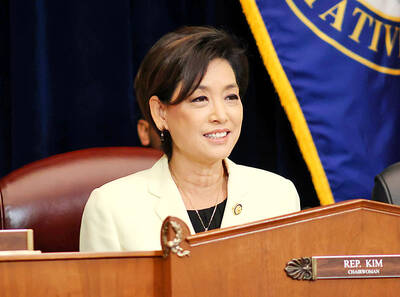
‘CLEAR MESSAGE’: The bill would set up an interagency ‘tiger team’ to review sanctions tools and other economic options to help deter any Chinese aggression toward Taiwan US Representative Young Kim has introduced a bill to deter Chinese aggression against Taiwan, calling for an interagency “tiger team” to preplan coordinated sanctions and economic measures in response to possible Chinese military or political action against Taiwan. “[Chinese President] Xi Jinping [習近平] has directed the People’s Liberation Army to be ready to invade Taiwan by 2027. China has a plan. America should have one too,” Kim said in a news release on Thursday last week. She introduced the “Deter PRC [People’s Republic of China] aggression against Taiwan act” to “ensure the US has a coordinated sanctions strategy ready should


 RSS
RSS