


Taipei Times: There has been much speculation in the media that nagging delays on the high speed rail project may push back its launch date of October 2005. Is there any truth to these reports?
Nita Ing (殷琪) : At this moment 2005 is definitely our target. I think there's nothing within this organization, nothing between us and the government that's even being discussed as causing possible delays to the project. We have a master schedule for the project and we're still basically tracking all activities according to that schedule.
TT: Are there any reasons to believe that the project may be delayed for several months to half a year?
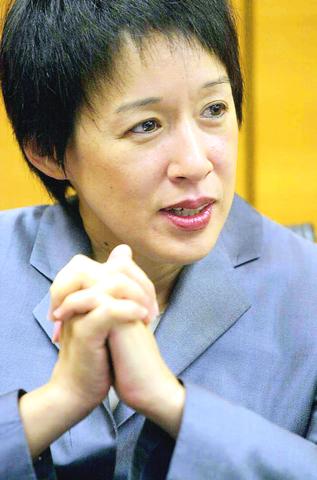
PHOTO: CHIANG YING-YING, TAIPEI TIMES
Ing: There are many issues that we're concerned about [but] those are normal for a project of this size. We don't say we are not expecting a delay, we're just saying there's no reason for us to expect that and we're still on the master schedule. Presently all of our civil work is delayed. Some by three months, some by four months and some maybe even more than that. But we have very good confidence that by spring next year the work will pick up.
The reasons for the delays are several. One is internal. This is a very new company and all of our people -- especially the people who come from other countries -- have come in here trying to work within a system that has developed as it goes along.
The other thing is our contractors. I think all our contractors are good and responsible, but they're all joint ventures. Most of them have had working experience together but never on such a grand scale project. The time it takes for them to work together and to mobilize within themselves also causes some delay. The other is contractors have to work with another entity -- consultants -- which is something that Taiwan-ese contractors are not familiar with. The consultants are not only the designers of the infrastructure, they are also supervisors and auditors who ensure the project is being carried on the right way. So there are different mentalities between contractors and consultants. To get them to establish a method of working together took some time because of the nature of the project.
Another major reason goes back to the 921 earthquake. The quake set us back approximately two months in terms of the government deciding whether or not high-speed rail or infrastructure specifications had to be reregulated. At the end of the day the government decided that the high-speed rail was sustainable.
TT: In June Taiwan High Speed Railway Corp (THSRC, 台灣高鐵) postponed boosting its capital until Septem-ber due to the state of the econ-omy. Have you been able to raise the money in the time since and how much more difficult did the nation's economic situation make this task?
Ing: As of Sept. 12 all the money was to be in -- NT$499 billion. This year and next year one of our biggest challenges is to raise capital. Next year we need to raise NT$18 billion. There was a lot of speculation among local media that we were going to be in financial trouble because we were not going to be able to raise the capital for this year. We lowered the amount, but basically it's substantial enough for us to carry on the project until the next capitalization towards the end of next year.
Looking forward, we are approaching many new possible shareholders, such as government enterprises that can strategically contribute to THSRC. We're in the process of discussing this with them and also some firms in the private sector. But we know it will be very difficult for new shareholders in the private sector to come in because not everyone's investing.
TT: One of the biggest industrial issues this year was over the vibrations the high speed rail will cause and their effects on firms in the Tainan Science-based Industrial Park (台南科學園區), which the railroad passes through. What led to the debate between THSRC and the government of the level of vibration from the railway?
Ing: Over a year-and-a-half ago there was a resolution on this issue because at the time we went to the government and said we have to tender the project out and need contract specifications. Because the government didn't have any [specifications], it was decided at a joint meeting to use 68db [decibel] as the standard. But earlier last year the National Science Council tried to reverse that. The reversal attempt was not a wise thing to do.
TT: The issue really came to a head in May this year when you harshly criticized the government in a televised statement over its handling of the matter. What were the main reasons for your dissatisfaction with the government's handling of the matter?
Ing: They didn't really handle it -- to put it very bluntly. The vibration issue is a technical issue that should have been dealt with from day one. We had a memorandum with the government before we actually signed the contract and ... that was one of the most critical issues that we felt we would face.
The memorandum attached to the contract said if the government did not address these 28 items within a year, we would just walk away. The vibration issue was one of the 28 items. We felt it was the government's responsibility to set a standard of vibration so we could design according to it, contract out according to the standard and that would be our responsibility. Our people went to meetings for approximately two to three months. In those meetings, week after week, we knew it just wasn't going to be resolved, nobody wanted the responsibility.
The government's inability to face up to the issue and resolve it in the right way is the problem -- they thought it was a technical issue, so technical people had to deal with it. Technical people cannot resolve issues that have to do with two major infrastructure projects crossing each other on the same plot of land. Technical people cannot be responsible for correcting decisions that were at the level of national land planning.
TT: What drove you in the end to such a public rebuke?
Ing: The reason why I really had to go in there and do that in front of the media was really to put a brake on the thing. At the time, even earlier this year, people started having election agendas. There were also two other groups of entities -- one in Kaohsiung and one in another sector of Tainan -- which wanted science parks in their locations, so they were stirring up issues regarding vibrations and trying to blame the whole issue on the high-speed rail.
The low-frequency vibration basically only affects the IC manufacturing production houses -- it doesn't affect biotechnology, it does not affect [LCD] glass factories. I came out to speak because every single one of the factories said `your low-frequency vibrations are going to be damaging to our glass manufacturing' or if they were biotechnology firms, then the complaint was `something is going to happen to our rabbits.' We had to put a brake on it. Too many people were in the picture and it was a mess. University professors who wanted to do research projects came into the picture -- they had fantastic ideas on how to correct the issue. Three years ago, when we pointed the vibration issue out to the government, Taiwan had very few vibration experts. Three years later when this became an issue, we had hundreds of them.
TT: In the intervening time -- during which a senior National Science Council official resigned -- has the issue moved any closer to being resolved?
Ing: Yes. It was never our intention to see people leaving their jobs, but that was one of the consequences. I think now the National Science Council is doing the correct thing, which is facing up to the various companies that will be affected. The council right now is doing various studies on things they can do. One is to protect a certain area of land, the other is ow to protect the various manufacturing facilities.
What we've done basically was to make a structural change to the viaduct. There was a section of it where they [the spans] were all 25m in length. Because of simulations done in the US by a very specialized consulting company we extended the spans to 30m. And that will basically decrease vibrations by 1db. Now a lot of the input has to come from the companies. They have to tell the government and the council what their requirements are. And so I think it's going to take a few months before we see the results of that.
TT: As a member of the investment panel in the Economic Devel-opment Advisory Conference (EDAC), do you believe the consensus proposals put forward by the five panels offer long-term solutions to Taiwan's economic woes?
Ing: I don't think the government can save the economy -- I don't think the conference can save the economy. There's no one single thing that's going to save the economy. At least EDAC did one thing -- it built a certain sentiment within the people that were there and also within society that we need to have consensus, we need to have agreements on some things. So it's a forward move. It does give government a freer hand to push certain policies simply because of the consensus. It also is going to give some pressure to the Legislative Yuan, when they begin the new session, because there was consensus. In terms of the economy, everybody has their own specific responsibility.
What is a little troubling is that I know it's political. Policies can't be formed by 200 or so people coming from different backgrounds especially from the business sector. I was really looking forward to the president [Chen Shui-bian (陳水扁)] forming some kind of permanent economic council such as what they have in the US. A very small group of senior advisers. That would be more stable.
TT: Do you think there is too much interference by the government in Taiwan's economy?
Ing: Socially we're so used to a big government which takes care of us. The government gives us directions and when it's wrong we can scream and yell. But it's different now. Across the board in all countries we're going to see smaller governments. Governments in essence don't have the same kind of power they had before. So a lot of things are up to us to do. You don't say cut taxes so we'll be more competitive. The problem is whether your product is going to be competitive; is your management behavior going to be competitive.
This country, this society has an extreme dependency. We're in conflict. We're saying to the government `keep your hands out of our business, don't tell us whether or not to go to China,' but when we're in trouble we say `please ask the bank not to tighten up on my credit line.' Something is very wrong with that mentality.
I look forward to a government that will say `no' -- to say `this is my long term policy, this is for the good of the country' and to face up to some of the issues that we're going to have, such as higher unemployment.
TT: Will easing restrictions on direct business and transport ties with China help stimulate the economy and aid Taiwan companies like many people claim?
Ing: It may, but I think it's short term. The three links, the issue of transportation and communication, sooner or later that's going to come into being. Sure it's more convenient and it lowers the cost of doing business. The `no haste, be patient' policy was really a non-doing policy. That's not very proactive when all your businesses have to go for commercial reasons. It's not practical.
The government needs to be much more proactive in knowing exactly what are some of the things it can do to give support to companies who go -- especially the major ones -- to really understand why they need to go and to really support them from home base.
I don't believe that once a company has shifted all its manufacturing facilities to China that it is longer a Taiwanese company. If companies have to move in order to thrive and survive the government needs to open windows for them so they will not be frustrated and they will limit their risk. To throw that whole policy away is the right thing.
But for the business community to go there and to be pampered like they use to be pampered here and then to come back and say China is better than Taiwan -- I condemn that type of mentality, because it's not an economic issue it's a political issue.

The National Chungshan Institute of Science and Technology yesterday showcased its locally developed variants of the Vision 60 robotic patrol dog, which it plans to deploy on the nation’s outlying territories in the South China Sea. The variants were produced under the Joint Lab project — created by the institute and domestic companies — and assembled with domestically produced motors, lenses and artificial intelligence (AI) systems alongside licensed tech from the US, Missile and Rocket Systems Research Division deputy director Jen Kuo-kang (任國光) told the media event at a military base in Taipei’s Dazhi (大直) area. Taiwan has built up its strengths

RIGHT DIRECTION: Taiwan’s efforts to prevent forced labor include a proposal to ‘fully prohibit’ employers from withholding workers’ documents, an official said Taiwan is to establish a mechanism to restrict imports of goods linked to forced labor, the Executive Yuan said yesterday, after the US proposed imposing additional tariffs on Taiwanese goods over labor concerns. “The Ministry of Labor and the Ministry of Economic Affairs are to establish an interministerial review procedure,” Executive Yuan spokesperson Michelle Lee (李慧芝) said at a news briefing in Taipei. “The government is to use the Foreign Trade Act [貿易法] as the legal basis to restrict imports of goods produced with forced labor” and bring its supply chain governance more in line with international standards on human rights, resilience

NOT IMMEDIATE: Taiwan has a chance to appeal the proposed 10 percent tariff before it starts, while other countries face a 12.5 percent tariff from the trade office Taiwan is among 60 economies determined by the US to have failed to impose or enforce a ban on the importation of goods produced with forced labor, according to a notice released on Tuesday by the Office of the US Trade Representative (USTR), which proposed imposing an additional 10 percent or more tariff on them. The USTR in a statement said that following an investigation, it had determined under Section 301 of the Trade Act of 1974 that the failure of the 60 economies to impose and effectively enforce a prohibition on the importation of goods produced with forced labor is

TIT-FOR-TAT: The US allegedly revoked the visa of a Chinese national working at Xinhua News Agency in the US in response to Beijing’s expulsion of Vivian Wang The Presidential Office yesterday condemned China for expelling a New York Times correspondent from Beijing following the newspaper’s interview with President William Lai (賴清德), saying the move highlighted Beijing’s suppression of press freedom and its threat to international news media. Taiwan has noted a series of recent incidents in which Beijing used similar tactics to “threaten and pressure international media outlets and journalists,” Presidential Office spokeswoman Karen Kuo (郭雅慧) said in a statement. “This concerns not only press freedom and freedom of expression, but also the safety of journalists, and Taiwan and relevant partners are paying close attention to the situation,” she


 RSS
RSS