


Few people in the world have more sensitive jobs than economic policy makers. Markets rise and fall by their words. Investors eat, sleep and breathe their every syllable.
Living standards change with their deeds and actions.
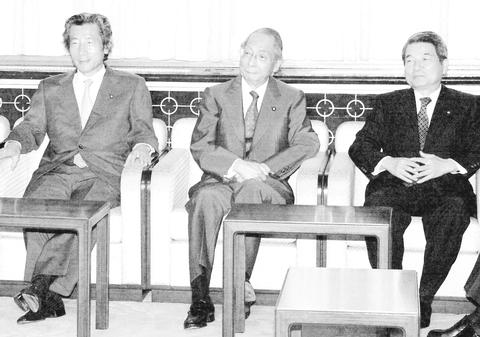
PHOTO: AFP
All of which explains why financial bigwigs need to watch what they say, even in jest. Japan this week saw many a verbal faux pas -- some that moved markets, some that didn't. In each case, however, investors could be excused for wondering what gives in the world's second-biggest economy.
With apologies to David Letterman, here's a list of the top-10 silly things said by Japan's economic policy makers this week. Drum roll, please.
The Top 10 silly things said about Japan's economy:
10. "I felt really let down," said Finance Minister Masajuro Shiokawa when asked how he felt about the Nikkei 225 stock average falling below 11,000 for the first time in 17 years. "We can't think of any immediate measures to support stock prices, which irritates me," he offered yesterday. (Same with investors, mate. You know, the people who thought you guys were finally getting serious about fixing the economy. They too may be let down and irritated.)
9. "We shouldn't focus only on issues right in front of us." Prime Minister Junichiro Koizumi about the Nikkei dwindling to its lowest since 1984. (You mean swooning stocks, deflation, recession, those kinds of things? We thought you were elected to do just that: tackle the big problems right under your nose.)
8. "The country won't be able to meet the 1.7 percent growth target this fiscal year,'' opined Taro Aso, the Liberal Democratic Party's chief policy maker. (Thanks for the news flash; tell us something we don't know!!!!!)
7. "Though some people argue altering the tax system won't support stocks, I think they're wrong.'' Hideyuki Aizawa, head of Japan's ruling-party's tax panel, of plans to trim capital gains taxes on stocks. (What's the point of cutting capital gains taxes when there's no capital gains to be had?)
6. "I don't think stock movements will devastate financial institutions' business base," said Bank of Japan Governor Masaru Hayami, when asked whether sliding stocks would hurt banks. (Nice try, Hayami. But as a banker, the central one, you know full well the stock market's plunge is slamming banks' balance sheets. Let's at least hope you do.)
5. "The central bank will ponder its next move flexibly if further monetary relaxation measures become necessary," said BOJ Executive Director Minoru Masubuchi. (Maybe something got lost in the translation, but it could mean BOJ folks will be doing a whole lot of stretching and bending before plopping down on a beach chair to, well, ponder. Then again, if Japan's monetary policy were any more relaxed, it would be dead.)
4. "By doubling the number of inspectors, we'll be able to conduct more audits." Takashi Fujiwara, a Financial Services Agency deputy director general, on plans to investigate banks more actively. (It's Japan's only growth industry -- counting loans, and bad ones at that.)
3. "I don't think the country can pay back its ?666 trillion [US$5.6 trillion] debt,'' said Heizo Takenaka, Japan's minister for economic and fiscal policy. ``In the past, the governments of France after the Napoleonic War and England after World War II amassed extraordinary debt which they never paid back." (Maybe he should get his nose out of the history books and start reading some economic texts. Still, might be worth tapping him for a loan.)
2. "No that's not it, it's the US," said Shoji Mori, commissioner of the Financial Services Agency, when asked whether concerns about Japan's banking system were hurting stocks. (Sure, the US is to blame for the 75 percent loss the Nikkei has experienced since 1989.
Nope, the US didn't help the global economy one bit in 1997, 1999, or 2000 for that matter. Gotta be the reason.)
1. "I don't understand why [the Nikkei is] falling so much.'' Shiokawa again. ``The only thing I can do is believe that something that falls will eventually start rising.'' (Sir Isaac Newton might turn in his grave if he heard that mangling of his theory of gravity.)
Honorable mention, as it wasn't said by a Japanese official: ``CORRECTION: DJIA CLOSE 10,090.90, NOT 100,090.90,'' reported a major Japanese news organization. (What's an extra zero between friends. But, hey, if that was true, just think how high the Nikkei might be, Mori-san!)
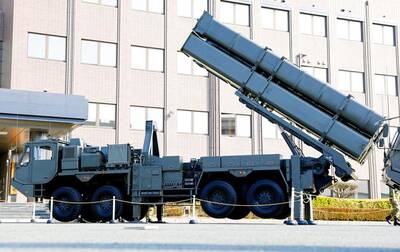
Japan has deployed long-range missiles in a southwestern region near China, the Japanese defense minister said yesterday, at a time when ties with Beijing are at their lowest in recent years. The missiles were installed in Kumamoto in the southern region of Kyushu, as Japan is attempting to shore up its military capacity as China steps up naval activity in the East China Sea. “Standoff defense capabilities enable us to counter the threat of enemy forces attempting to invade our country ... while ensuring the safety of our personnel,” Japanese Minister of Defense Shinjiro Koizumi said. “This is an extremely important initiative for
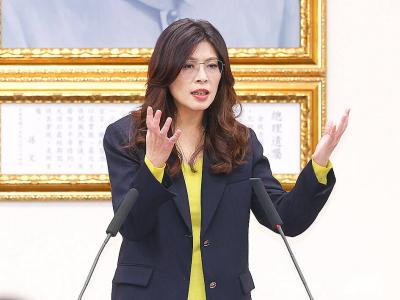
Chinese Nationalist Party (KMT) Chairwoman Cheng Li-wun (鄭麗文) today accepted an invitation from Chinese President Xi Jinping (習近平) to lead a delegation to China next month, saying she hopes to promote the peaceful development of cross-strait relations and bring stability to the Taiwan Strait. “I am grateful and happy to accept this invitation,” Cheng said in a statement from the KMT chairperson’s office. Cheng said she hopes both sides can work together to promote the peaceful development of cross-strait relations, enhance exchange and cooperation, bring stability to the Taiwan Strait and improve people’s livelihoods. At today's news conference, Cheng said any efforts to
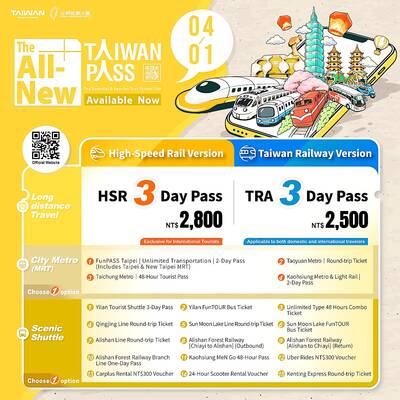
MORE POPULAR: Taiwan Pass sales increased by 59 percent during the first quarter compared with the same period last year, the Tourism Administration said The Tourism Administration yesterday said that it has streamlined the Taiwan Pass, with two versions available for purchase beginning today. The tourism agency has made the pass available to international tourists since 2024, allowing them to access the high-speed rail, Taiwan Railway Corp services, four MRT systems and four Taiwan Tourist Shuttles. Previously, five types of Taiwan Pass were available, but some tourists have said that the offerings were too complicated. The agency said only two types of Taiwan Pass would be available, starting from a three-day pass with the high-speed rail and a three-day pass with Taiwan Railway Corp. The former costs NT$2,800

The nation’s fastest supercomputer, Nano 4 (晶創26), is scheduled to be launched in the third quarter, and would be used to train large language models in finance and national defense sectors, the National Center for High-Performance Computing (NCHC) said. The supercomputer, which would operate at about 86.05 petaflops, is being tested at a new cloud computing center in the Southern Taiwan Science Park in Tainan. The exterior of the server cabinet features chip circuitry patterns overlaid with a map of Taiwan, highlighting the nation’s central position in the semiconductor industry. The center also houses Taiwania 2, Taiwania 3, Forerunner 1 and


 RSS
RSS