


In his private conference room, tucked away beside his formal midtown Manhattan office, Henry R. Kravis keeps a framed quotation: "There is nothing more difficult to take in hand, more perilous to conduct, or more uncertain in its outcome, than to take the lead in introducing a new order of things."
The line, from Niccolo Machiavelli, speaks to the image as a financial innovator that Kravis and his investment firm, Kohlberg Kravis Roberts & Co, have always cultivated. In the merger mania of the 1980s, Kohlberg Kravis did more than any other firm to popularize the leveraged buyout -- the use of huge amounts of debt, typically a mix of junk bonds, bank loans and a little cash, to buy public companies and take them private.
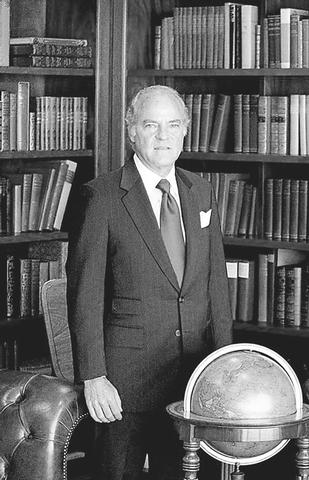
PHOTO: NY TIMES
After acquiring such companies as Safeway Stores (1986), Beatrice (1986) and Duracell (1988), KKR reached the peak of its fame in 1989, when it completed what remains the largest-ever buyout, the acquisition of RJR Nabisco for US$31 billion, including the assumption of debt. So vast was the power of KKR at the time that Barbarians at the Gate, the best-selling book by Bryan Burrough and John Helyar chronicling the battle for RJR, noted that Henry Kravis had "a war chest greater than the gross national products of Pakistan or Greece, his clout rivaling that of any in financial history."
Last month, recalling his firm's earlier days, Kravis said: "We were instrumental in getting corporate managers to think like owners. We think we had some role in changing the landscape of corporate America." Along the way, Kravis and his cousin and partner, George Roberts -- both now 57 -- made themselves and their investors, mostly public pension funds, very rich. Their annualized returns in the mid-1980s reached as high as 40 percent.
Days long gone
But those days now seem far away. Today, far from being the king of Wall Street, Kohlberg Kravis is just one of dozens of buyout firms -- and one whose vitality beyond the working lives of its founders is unclear.
Leveraged buyouts now play little role in shaping Corporate America. In the first nine months of last year, they accounted for less than 2 percent of all acquisitions, down from a high of 34 percent in 1988, according to JP Morgan Chase & Co. Even with the depressed stock prices of recent months, in theory a prime time for leveraged buyout funds, firms like Kohlberg Kravis have done little -- cramped in part because the weakening economy has made it hard for them to raise debt to finance their deals. And where once the firm got favored treatment from banks -- better terms and few conditions -- it no longer does.
Making matters worse for Kohlberg Kravis, it now has to compete with more than 100 buyout firms that manage funds with US$1 billion or more in assets, according to Thomson Venture Economics, as well as many smaller ones. And other leveraged buyout firms claim far higher returns, perhaps as much as double KKR's. Thomas Lee Partners, for example, had annualized returns of 44 percent through the end of last year on a fund started in 1996.
Kohlberg Kravis' returns have been dragged down by several investments that went sour, most notably its half-interest in the 1998 buyout of Regal Cinemas, a movie theater chain, for US$1.6 billion, and the shares that the firm has retained in long-ago buyouts that were taken public during the 1990s, but whose prices have sunk 50 percent or more from their peaks. In a cruel turn of fate, the disappointing performance of the RJR buyout, the deal that cemented the firm's reputation as the one that could tackle deals of any size, continues to hurt its track record.
"You have to credit them for being pioneers, but it's a much more competitive business now," said Richard I. Beattie, the chairman of the New York law firm Simpson Thacher & Bartlett and a close adviser to KKR.
Still, he said, "they recognize the need to evolve."
That has turned out to be harder than it sounds. On the plus side, the firm retains its strong brand name, a golden Rolodex and a loyal band of pension fund investors. It guards its image assiduously: partners rarely speak to reporters -- on the record, at least. (For this article, they also declined to be photographed.)
But the world around the firm has changed drastically.
But listen carefully to Kravis, Roberts and other partners at the firm, and even they acknowledge that the buyout business has become tougher -- leaving them in what amounts to a holding pattern.
In an earlier era, the firm boasted of its investing prowess. In an interview in 1989, one partner vowed that its returns would never fall to the 20 percent range. "I don't believe it's going to happen," the partner said, labeling the figure "unacceptable."
Roberts said that since 1996, when the firm was raising its eighth buyout fund, he and Kravis have been telling investors that such expectations are no longer realistic because market conditions have changed. "You cannot produce 30 percent-plus returns with large amounts of capital over the long term," said Perry Golkin, a partner. "We intend to give our investors 20 percent returns in good times and bad."
Kohlberg Kravis has also learned to be flexible in its investments. During the battle for RJR Nabisco, Kravis seemed desperate to buy RJR to protect KKR's "franchise," as the only buyout firm capable of large deals, according to Barbarians at the Gate and other accounts.
Kravis and his partners deny ever having used that term. Still, they acknowledge that the days of such large deals are over, partly because they are now harder to finance. "The capital just isn't there," Kravis said.
These days, the firm has been tackling smaller deals, and it no longer insists on buying 100 percent of a company, although it still tries to retain influence on management by seeking board seats. Among the deals the firm has completed over the last couple of years are the purchase of a 20 percent stake in DPL, an Ohio utility, for US$550 million, and investments in six telecommunications companies, averaging just US$100 million to US$200 million each.
Ingrained image
But Kohlberg Kravis' image as the firm that chases the largest deals is so ingrained in financial circles that, when it started raising its Millennium fund a year ago, rumors quickly circulated that the firm was seeking US$10 billion, a sum that would have created the largest buyout fund in the business, by far outpacing Thomas H. Lee, which had just raised US$6.1 billion, a record.
Kravis said it was all a fantasy. "We don't have a clue who started that rumor," he said. "We never put that number out there."
In fact, Kohlberg Kravis partners say, the US$5.1 billion that investors have pledged to the fund so far will do just fine. The firm now has close to US$9 billion in capital, including the remnants of its last fund and US$2.4 billion raised in 1999 for a KKR fund set up to invest in Europe. "We have enough capital to do what we want," Roberts said.
The firm's pitch still resonates with enough investors. The new fund includes commitments from the state pension funds of Oregon, which pledged US$1 billion, and Washington, which agreed to invest US$1.5 billion. The huge California Public Employees' Retirement System, as well as pension funds for state employees in Michigan, Wisconsin and New York, have also signed up. Several banks with long-term Kohlberg Kravis relationships, like Citigroup, J.P. Morgan Chase, and Bank of America, have signed on, too.
"Nobody's ever going to bat a thousand, but their returns over all have been solid," said Gary Moore, chairman of the US$55 billion Washington State Investment Board.
One of Moore's colleagues was more pragmatic. "There aren't many places where you can comfortably invest US$1.5 billion," said James Parker, executive director of Washington's investment board.
Now the onus is on KKR as it tries to emerge from a sleepy period for buyout firms, when the booming stock market made it expensive to do deals. "Our competition isn't so much other buyout firms as it is stock market valuations," Kravis said. "Over all, price-earnings multiples are still high."
For the first half of this year, the number of buyouts is down 31 percent, compared with the same period last year, according to S& P/Portfolio Management Data.
And these days, all leveraged buyout firms, including Kohlberg Kravis, must invest more cash up front than they once did. In the 1980s, the golden era of buyouts, these investors would acquire businesses by paying 10 percent or less in cash and financing the rest with debt. Now, getting financing from lenders requires firms to put in nearly 40 percent of the price in cash, according to Portfolio Management Data.
How much cash a buyout firm invests makes a big difference in the potential profits. Kohlberg Kravis and other buyout firms made so much money in the 1980s partly because they bought businesses cheaply and paid little up front for them. When the deals succeeded, they made many times their original investment.
When Kohlberg Kravis bought Safeway Stores in 1986, it paid US$4.8 billion, but just 3 percent of that in cash. KKR eventually sold Safeway for a US$7 billion profit, a 43 percent annualized return.
Contrast Safeway with Shoppers Drug Mart, a Canadian retailer that Kohlberg Kravis bought a year ago. It paid US$1.8 billion, more than one-third of it in cash.
Because of that difference, Kohlberg Kravis will have fewer problems if the acquired company runs into trouble: the company will have less debt to repay. But without the magic of leverage -- using other people's money -- KKR's returns are also likely to be less. "There is a lot less financial risk for us in Shoppers than there was in Safeway," said James H. Greene Jr, a KKR partner. "As a result, you have to work harder at growing the business and increasing its value."
In recent years, Kohlberg Kravis has been distracted from searching for deals because it has had to rescue several underperforming investments, though it is hardly alone in that task. With the economy in a slump, the highly leveraged companies owned by buyout funds are among the most vulnerable businesses.
Kohlberg Kravis' biggest recent embarrassment is its investment in Regal Cinemas, acquired together with the rival buyout firm Hicks, Muse, Tate & Furst. Regal was one of several theater chains acquired by buyout firms during the late 1990s. All of them proceeded to open new theaters at a time when movie attendance was shrinking, Roberts said.
"We lost all our money, but having said that, we dealt with the situation as best we could," he said. Regal's lenders -- but not the bondholders -- will be repaid in full under the proposed restructuring plan. Holders of the bank debt will wind up in control of Regal.
Avoided telecoms
Kohlberg Kravis did avoid big bets on telecommunications stocks, an area in which some of its competitors lost billions in recent months. All told, KKR invested just US$700 million in six telecom start-ups. Of these, the firm wrote down US$200 million invested in two companies and sold its interest in a third for a slight profit. But it is sticking with three others and putting in an additional US$150 million each into two of them: Birch Telecom and NewSouth Communications, both providers of phone service and Internet access to businesses.
"We weren't immune to the telecom meltdown, but we think that for the most part, the companies we invested in will succeed in the long term," said Alexander Navab Jr., a partner.
Kohlberg Kravis' bigger problem is in its portfolio of stakes in a dozen public companies, ranging from long-term holdings like Owens-Illinois, the glass and plastic container maker it acquired in 1987, to Alliance Imaging and the MedCath Corp, two health care companies that it took public last month. While most of these companies are not in danger of failing, several of their stock prices have fallen sharply.
Kohlberg Kravis views its reluctance to sell quickly as a point of pride, proving that it is a supportive partner to the management of its investments.
"We really work side by side with the management of our companies," Kravis said. "We don't just break up the business and pick the low-hanging fruit, but rather invest in companies for their long-term growth." KKR also insists that management of its companies take equity stakes.
Kohlberg Kravis did not completely sell its stake in Safeway, for example, for 13 years. And, typically, when companies it owns complete initial public offerings of stock, it does not sell its shares as part of the offering. Of the three KKR companies that went public in the last two months -- Medcath, Alliance Imaging and the Willis Group, a London-based insurance broker -- KKR sold none of its shares.
The practice that looks virtuous to Kravis looks different to some competitors and advisers in the buyout industry. "You aren't paying them fees to own a basket of public stocks," said one pension fund adviser whose clients include Kohlberg Kravis investors.
Roberts countered by bringing up the firm's success with Safeway, noting that soon after that company went public in 1990, some KKR investors tried to pressure the firm to sell out its shares. But KKR held on, to its eventual benefit. "We bought equity at the equivalent of US$0.50 a share, and some of our limited partners wanted us to sell at the equivalent of US$2.75, but we insisted there was a lot of potential," Roberts said. The firm ended up selling its holdings at prices as high as US$51 a share.
That philosophy does not always work, of course; in fact, it did not work for some high-profile deals. Last month, the firm sold its remaining stake in Gillette. The shares were acquired in 1996, when Gillette merged with Duracell, a 1988 Kohlberg Kravis buyout. KKR's investors made 11 times their original investment. But they could have earned far more: the company's stock has fallen 50 percent from its high in 1999.
Other disappointments include Owens-Illinois, whose stock peaked at US$48.625 in July 1998 but now trades at just US$5.49. Kohlberg Kravis has not sold a share.
Acquiring competitor
A spokeswoman for Kolberg Kravis said that the firm did not sell its shares in 1998 because Owens was in the middle of acquiring a competitor, and KKR did not want to depress Owens' shares by dumping its holdings.
The stock of another longtime holding, Primedia, which dates to 1989, has slumped from a high of US$33.50 in March last year to just US$5.23.
Perhaps Kohlberg Kravis' biggest albatross is a private holding: its stake in Borden, the consumer products company acquired in 1995 in a swap for its RJR shares. At the time, RJR was in the middle of a price war with Philip Morris. Since then, RJR's shares have risen several fold, after the investor Carl C. Icahn goaded that company into selling its food business. Profits at Borden, meanwhile, have declined, because a specialty chemical manufacturing division owned by the company is in a cyclical slump.
"With hindsight, we would have been better off if we'd kept the RJR stake," said Scott M. Stuart, the Kohlberg Kravis partner in charge of the investment.
In the past, the firm has taken profits on its investments by selling its companies to third parties. In 1999 alone, it sold three companies for huge profits. But with merger activity in a slump, that is hard to do, bankers said.
Some followers of the buyout world say the firm may soon become active again. "KKR is more of a value investor than a growth investor," a pension adviser said, and should flourish if the stock market reaches more reasonable levels.
The firm has indeed done well in the past by bargain-hunting in out-of-favor industries. It teamed up with the predecessor to FleetBoston Financial in 1991 to acquire the Bank of New England, which had been seized by the Federal Deposit Insurance Corp, and it acquired American Reinsurance in 1992 when the reinsurance market was ailing. Kohlberg Kravis profited -- with annualized returns of 22 percent on the bank and 50 percent on the reinsurer, when those industries revived in the mid-1990s.
Early last year, the firm acquired a 20 percent stake in DPL, the parent of the Dayton Power & Light Co in Ohio.
Kohlberg Kravis is also hunting for bargains in telecommunications and technology. In February last year, it formed an alliance with Accel Partners, a Palo Alto venture capital firm, thus combining KKR's contacts among large corporations and Accel's Internet knowledge. More recently, the two firms formed a second joint venture, which will try to acquire the assets of telecommunications companies. The ventures have attracted some big names, like Paul Hazen, former chief executive of Wells Fargo, and Arun Sarin, a former president of AirTouch Communications, the cellular phone company, who works on telecom deals.
"Henry and George have fabulous Rolodexes, but they also have unparalleled common sense," said Jim Breyer, managing partner of Accel.
And Kohlberg Kravis has tried to diversify. In the mid-1990s, it became one of the first American buyout firms to pursue European deals. In 1999, it even opened an office in London. But other firms soon followed suit, and it recently lost out to other investors in the bidding for Eircom, the Irish phone company, and for the Yell Group, the yellow-pages division of British Telecommunications. In both cases, KKR partners said, the bidding went too high for the firm's taste.
Still keen on deals
Both founders say they have not lost their taste for deals. "There's not a day I don't wake up excited about coming to work," Kravis said. Neither Kravis nor Roberts has plans to retire.
The two say they are taking steps to ensure that Kohlberg Kravis goes on after they leave.
"We are trying to get the best thinking of everyone in the firm and identify the future leaders of KKR," Roberts said. Last year, in an effort to democratize the running of the firm, they formed two committees, of five partners each, to keep track of new deals and assess the status of old ones.
Still, while they delegate more day-to-day dealmaking and monitoring, one or the other of them serves on the committees tracking every KKR deal. And when it comes to the crucial task of raising money, Kravis or Roberts meets personally with each pension fund manager. Moore of Washington State said that before investing his US$1.5 billion, he received assurances that Kravis and Roberts would be around for the life of the fund, possibly as much as 18 years.
It remains to be seen whether any of Kohlberg Kravis' younger partners have the clout and the charm of Kravis and Roberts in wooing pension funds and corporate executives, said competitors and investment bankers.
"The question is: Is this the sort of business that revolves around one great investor, like Henry or George, to keep it going, or can you train another generation?" asked Steven Rattner, a former investment banker who has started his own investment firm, the Quadrangle Group.
Perhaps a bigger question is whether the buyout business will return to its onetime glory.
"We had some small role in making corporate America more efficient," Roberts said. "That means the markets are much more transparent, and more people understand value."
Still, he said, Kohlberg Kravis will go on. "It's still a lot of fun," he said. "The harder it gets, the greater the challenge."

Japan has deployed long-range missiles in a southwestern region near China, the Japanese defense minister said yesterday, at a time when ties with Beijing are at their lowest in recent years. The missiles were installed in Kumamoto in the southern region of Kyushu, as Japan is attempting to shore up its military capacity as China steps up naval activity in the East China Sea. “Standoff defense capabilities enable us to counter the threat of enemy forces attempting to invade our country ... while ensuring the safety of our personnel,” Japanese Minister of Defense Shinjiro Koizumi said. “This is an extremely important initiative for

Chinese Nationalist Party (KMT) Chairwoman Cheng Li-wun (鄭麗文) today accepted an invitation from Chinese President Xi Jinping (習近平) to lead a delegation to China next month, saying she hopes to promote the peaceful development of cross-strait relations and bring stability to the Taiwan Strait. “I am grateful and happy to accept this invitation,” Cheng said in a statement from the KMT chairperson’s office. Cheng said she hopes both sides can work together to promote the peaceful development of cross-strait relations, enhance exchange and cooperation, bring stability to the Taiwan Strait and improve people’s livelihoods. At today's news conference, Cheng said any efforts to

MORE POPULAR: Taiwan Pass sales increased by 59 percent during the first quarter compared with the same period last year, the Tourism Administration said The Tourism Administration yesterday said that it has streamlined the Taiwan Pass, with two versions available for purchase beginning today. The tourism agency has made the pass available to international tourists since 2024, allowing them to access the high-speed rail, Taiwan Railway Corp services, four MRT systems and four Taiwan Tourist Shuttles. Previously, five types of Taiwan Pass were available, but some tourists have said that the offerings were too complicated. The agency said only two types of Taiwan Pass would be available, starting from a three-day pass with the high-speed rail and a three-day pass with Taiwan Railway Corp. The former costs NT$2,800

The nation’s fastest supercomputer, Nano 4 (晶創26), is scheduled to be launched in the third quarter, and would be used to train large language models in finance and national defense sectors, the National Center for High-Performance Computing (NCHC) said. The supercomputer, which would operate at about 86.05 petaflops, is being tested at a new cloud computing center in the Southern Taiwan Science Park in Tainan. The exterior of the server cabinet features chip circuitry patterns overlaid with a map of Taiwan, highlighting the nation’s central position in the semiconductor industry. The center also houses Taiwania 2, Taiwania 3, Forerunner 1 and


 RSS
RSS