


Behind every cup of coffee Americans drink, there is a farmer like Santiago de la Rosa laboring to produce it.
Daybreak finds him already sweat-slick and bone-weary from wielding a machete against weeds around his coffee shrubs. By 11am, he chows down beans and tortillas, the same as every meal. At nightfall, he and his family crowd into two rooms with no electricity, running water, or toilet and just three wooden chairs and rickety iron beds.
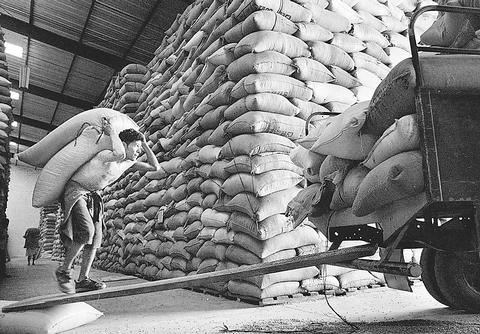
PHOTO: NY TIMES
His coffee beans, along with those of thousands of other farmers from around the world, make their way into iced lattes sipped at coffee bars and the steaming cups of "regular" coffee gulped by harried workers at home or at fast-food restaurants throughout American cities.
Americans will pay US$2 or more for a premium cup of coffee. But de la Rosa, trapped like all small farmers at the losing end of a long chain of transactions between his coffee plants and the coffee cup, sees little of it. He's lucky to live on US$2 a day.
"The problem is that coffee sells at high price there," said the sinewy, 65-year-old farmer, waving a hand toward the US. "But here we suffer."
Poverty in underdeveloped countries is a story as old as colonial plantations and clipper ships, with generations of laborers having earned pennies to sate appetites in the First World. But at the dawn of the 21st century, a simmering protest movement has been drawing attention to the inequities in international trade, which critics say provides cheap goods for wealthy consumers but little improvement in the lives of those who produce them.
A month spent tracing the route between American coffee drinkers and the farmers who grow their coffee reveals why protesters like those who disrupted the Group of Eight economic summit in Genoa have picked coffee as a target. Since 1995, labor and consumer groups have been calling on coffee companies -- particularly the popular Seattle-based Starbucks chain -- to guarantee better wages and working conditions for farmers abroad.
Coffee, the second largest world commodity traded after oil, with worldwide sales of US$55 billion, is dominated by a handful of multinational corporations that acquire beans from small producers in nearly 50 countries, all in the developing world. Most coffee companies deal only with an elite group of established brokers, even as some farmers have been trying to organize into collectives to defeat the prevailing system.
The industry is dominated by four multinational companies. Procter and Gamble Co, Philip Morris Companies Inc, the Sara Lee Corp, and Nestle account for 60 percent of US retail sales and 40 percent of worldwide sales. Likewise, just six multinational export firms control 40 percent of the world's coffee market.
Getting gouged
The Massachusetts-based Dunkin' Donuts, owned by Allied DomePLC, the world's second largest wine and spirits group, has a far smaller market share. But with 3,800 franchises nationwide -- 600 in the Boston area -- Dunkin' Donuts sells the most cups of coffee in America, two million a day.
For every pound of coffee sold in the US -- which can vary from US$2.69 for a 13-ounce can of Folgers to US$8.49 for a one-pound bag of Starbucks beans -- farmers get less than US$0.35 and coffee pickers less than US$0.14, according to industry statistics.
The disparity grows for cups of coffee sold over the counter. De la Rosa's entire crop earned him US$8,496 before costs last year. By the time the crop is turned into cups of coffee in the US, its worth is about US$750,000, based on industry calculations.
The reason lies in a complex system in which coffee beans can pass through as many as 15 hands between shrub and cup, with price increases along the way. In between the farmer and the exporter are multiple middlemen who mark up prices and pad profits. If farmers object, the middlemen simply turn elsewhere. If coffee is too expensive in one country, buyers simply turn to another.
This year, Vietnam has flooded the market with cheap, low-quality beans, driving prices to an eight-year low. From Guatemala to Tanzania, Mexico to Kenya, farmers who produce quality beans are losing money on their harvests as a result.
In 1999, high-quality or arabica coffee sold in New York for US$1.02 a pound; in June, it averaged US$0.64.
Sinking prices have been a "catastrophe" in Guatemala, says Manfredo Topke Delgado, president of Guatemala's National Coffee Association, which represents 61,500 coffee farmers. Farmers are offering beans rather than cash to pickers. Fruit from February's harvest rots on bushes. Farms lie choked with weeds or abandoned.
Farther north, the price collapse has also wreaked havoc. Among the 300,000 coffee laborers estimated to have fled the Mexican countryside this spring were 14 men found dead of exposure in the Arizona desert in May. "People are not leaving with hopes of achieving the American dream," said Mario Hernandez Cordoba, director of the Coffee Council of Veracruz, Mexico. "They are going to get money to survive."
Industry spokesmen say this is the free market at work.
"It's an excess of supply and not enough demand," said Celsius Lodder of the London-based International Coffee Organization. Even when prices are good, he added, "the farmer survives. He will not become rich, but he will not starve. His level of poverty will be acceptable."
Critics say it doesn't have to be that way. Groups like Boston-based Oxfam are calling on coffee corporations to adopt an alternative system that guarantees cooperatives of small farmers a set price -- currently US$1.26 a pound -- regardless of what coffee sells for at the world market.
Such coffee carries the "Fair Trade Certified" label and sells under a variety of brand names. Consumers end up paying about the same per pound for Fair Trade coffee as for organic or gourmet beans.
So far, Fair Trade coffee has been available only on a limited basis. Starbucks, under pressure from consumers and antiglobalization protests, offers it for purchase but not in its blends. Dunkin' Donuts does neither.
"Up to this point, fair trade has not been tied to quality," said Julie Barrett, director of Dunkin' Donuts's coffee and beverages operation. "They have a minimum price for everything. That doesn't mean, however, we won't look at them in the future."
Tangled web
The company, which said it is committed to "equitable situations" for all in the coffee business, is considering buying some coffee directly from farmers to add to its blend, although not necessarily Fair Trade coffee, Barrett said.
Here in Guatemala, the Fair Trade movement has not reached most of the country's growers, including de la Rosa, who farms about 30 miles south of Guatemala City.
The slump in coffee prices, coming after the ravages of the country's 36-year civil war, has harshened the lives of the nearly 6 million Guatemalans -- half the population -- living under the UN poverty line of US$2 a day. In the nearby city of Cuilapas, local officials report nearly a robbery per day. Among the thieves' booty: baby bottles, powdered milk, and pans of black beans.
On a humid morning last week at the Dunkin' Donuts across from the Prudential Center in Boston, consumers professed little knowledge of their beverage's origin.
"I just drink it. I need it in the morning," said Jennifer Lemire, a financial coordinator.
"I come here every morning, and I actually don't think about who grows the coffee at all," said Jim Jenney, an employee at Massachusetts Financial Services.
An effort by the Globe to follow a cup of Dunkin' Donuts coffee back to the Guatemalan farmer who produced it proved to be anything but straightforward. The coffee trade remains as secretive as it was a century ago.
Now 48 percent of Guatemala's coffee is exported to the US.
Once protected by quotas, coffee is now traded openly, with prices that swing wildly, driven by speculators and weather reports alike. For that reason, and those of competition, Dunkin' Donuts, like other big players in the industry, will not reveal what makes up its blend, which roasters it uses, or what countries it imports from.
In fact, few companies actually know which farmers produce the coffee they buy.
Long before coffee reaches an exporter, it is under the control of middlemen known as "coyotes," often loan sharks who, with knowledge of the daily world coffee price, seize the chance to price-gouge along the way. Coyotes are officially tolerated, although there have been industry efforts to halt their influence.
Interviews with industry sources and local coyotes, all of whom requested confidentiality, pointed to Guatemala's Santa Rosa region -- where the de la Rosas live -- as one source for Dunkin' Donuts blend. There, on a fertile volcanic plateau 4,000 feet above sea level, amid towering stands of laurel, oak, and cedar, farmers grow a variety of hard-bean coffee that is not too acidic.
Nearly all of the coffee here is sold to Export Cafe S.A., Guatemala's largest exporter and part of the ECOM Coffee Group, the world's third-largest coffee trader and part of privately held Esteve S.A. The beans are then shipped from the Caribbean town of Puerto Santo Tomas.
From there, coffee goes to the New York-based Atlantic (USA) Inc, also part of ECOM, before being purchased by a roaster and then sold to Dunkin' Donuts. Transportation, processing, and markups for quality add to cost along the way.
De la Rosa has never heard of Dunkin' Donuts. He has never visited one of its six branches in Guatemala. He could not imagine spending US$0.50 -- one quarter of what he lives on each day -- for a cup of coffee.
What he does know is that his coffee goes to Export Cafe. A man with a shrewd business instinct, de la Rosa once tried his hand at being a coyote. He returned to farming, however, having found the work too dangerous.
He had no choice but to return. Coffee is all de la Rosa and his family have ever known.
Rosa's father, Antonio, rousting his son from the fields. Having hiked for a half-hour through the airless, dense forest, the 85-year-old apologized for not clambering up the steep slope his son was tilling. "At my age ..." He smiled.
His apologies ended there. He is proud of the land. There are two kinds of coffee workers here: Those who own their farms, and those who work on coffee plantations. Antonio was born on a plantation, as was Santiago, who was put to work when he was 10. Neither would ever return.
Hidden behind high walls and often protected by armed guards, the country's 3,400 plantations are dominated by the country's landed class, many descended from Spanish and German settlers who once ruled the industry. Allied with the country's political and economic elite, plantation owners dominate Guatemala's vital coffee exports. Depending on its market price, coffee accounts for 25 to 35 percent of foreign exchange earnings here.
Theirs is a world removed from those they employ. Often educated in the US, they rub shoulders in fashionable restaurants and are easily spotted on the highways cruising in their Mercedes.
On plantations, workers are typically housed in barracks. By law the owner must provide education, access to health care, electricity, and water, although workers complain that is not always the case. During the harvest, plantations also hire migrant workers, usually indigenous Mayan Indians from the poorer north.
The plantations' reputations are as varied as coffee flavors, particularly when it comes to labor conditions. The first independent survey done last year -- without the industry's aid -- found that in three of the country's coffee regions, nearly half the workers were paid less than the minimum daily wage of US$2.48.
Deep in the the country's northwest hills, workers at the Nueva Florencia plantation have been fighting for minimum wage for the past five years. They were fired when they formed a union to demand their wages. Blacklisted on neighboring farms, they had no choice but to remain on the plantation in the one room each family was allotted. The plantation owner, who workers say will not negotiate, has since turned off their electricity, denied them water, prohibited their children from attending the plantation's school, and stopped access to health care.
"Our rights have been violated, not just our right to work, but our family's rights," said Arturo Mendez, 46, as rain dripped through the holes in his corrugated iron roof. "Our kids get sick, because we can't feed them the right food."
Scraping by
Escaping the plantations' incessant demands for more hours of work per day and more workers per family -- even if those workers happen to be children -- is why the de la Rosa family struggled to buy a few acres of land instead. Of the 800,000 estimated child laborers in Guatemala, some 320,000 work in coffee, the majority on plantations, said Erwin Roberto Jordan Ramirez, a consultant to the International Labor Organization here.
Land ownership, however, has not guaranteed the de la Rosas wealth. Only in good years -- like 1994, when coffee prices soared due to a frost in Brazil -- has Santiago broken free from the cycle of debt and poverty typical of small farmers.
Unable to read or write, he swiftly calculates his earnings in his head. Last year, Santiago earned enough for each of the five family members he supports -- his wife, granddaughter, grandson, daughter, and an elderly relative -- to live on just over US$2 a day.
This year, he will make no profit at all. It currently costs most Guatemalan coffee farmers about US$90 to produce a hundred pounds of coffee. One hundred pounds of coffee will sell for about US$45.
"I've been working hard for 40 years," said Santiago, "and now I owe money."
One recent morning, granddaughter Maria Elizet, 13, was shaping corn flour by hand into tortilla rounds to cook over a smoky wood fire. Her brother, 12-year-old Orlin, was lugging coffee saplings in a basket on his back to the fields to be planted. There is no money to hire extra help for the farm, much less to buy meat to eat.
One reason de la Rosa is in debt is because it takes five years for coffee bushes to produce their fruit. Another is because as a small farmer he cannot export his coffee directly. He does not have the facilities to transform coffee, plucked from the shrub in cherry form, into a more storeable bean. He produces too small a volume of coffee to sell to major exporters, who buy bulk lots of hundreds of 100-pound bags, not just a few at a time.
So he is resigned to what is a typically corrupt transaction: He sells to a coyote, who underweighs his bag and undercharges him. The coyote sells the coffee to a larger coyote, who resells it to an export house.
Facing this year's lower prices, Santiago's debt will doom him to further poverty. With no cash, he cannot buy fertilizer. With no fertilizer there will be fewer coffee cherries. With less coffee to sell, he will fall further into debt. Facing high interest rates, his debts will grow.
In May, farmers like Santiago joined forces and marched on Guatemala City demanding that Guatemala's Congress take action to create a fund to give them access to cheaper credit. The government of President Alfonso Portillo has said it will ask international lending institutions for US$150 million to allow coffee growers to refinance credit incurred to loan sharks or banks.
At Guatemala's National Coffee Association, there is a palpable sense of crisis. Even large-scale plantation owners grasp at slender hopes, such as recent Internet auctions; in May, one plantation sold coffee for a record US$11 a pound.
Otherwise, there is talk of burning unsold low-grade coffee for fuel or selling it as compost. For now, the crisis in prices, says the association's president, Topke Delgado, must take precedence over the industry's structural problems.
"As we see it, we have to compete. The name of the game is be efficient or you're out," he said. "When they ask, are you doing a terrible job vis a vis laborers, there's not much else that people can do."
That is cold comfort for Santiago or, for that matter, his nephew, Augusto de Jesus Garcia. In coffee's hierarchy, de Jesus Garcia is at rock bottom.
He is a coffee picker, hired by the family to bring in the coffee in the harvest months from December through February. This year the family cannot afford him.
He is not sure how he and his family, living in a dirt-floored, one-room wooden shack, will survive. There are quarter-inch gaps between the wooden slats that make up his home. Augusto points to the temporary repairs he has made for this rainy season. They are an exercise in futility that demonstrates the reach of the global forces to which he is subjected. Unable to buy wood, Augusto has tacked up pieces of cardboard boxes. The cardboard is stamped "Kellogg's Corn Flakes."

Japan has deployed long-range missiles in a southwestern region near China, the Japanese defense minister said yesterday, at a time when ties with Beijing are at their lowest in recent years. The missiles were installed in Kumamoto in the southern region of Kyushu, as Japan is attempting to shore up its military capacity as China steps up naval activity in the East China Sea. “Standoff defense capabilities enable us to counter the threat of enemy forces attempting to invade our country ... while ensuring the safety of our personnel,” Japanese Minister of Defense Shinjiro Koizumi said. “This is an extremely important initiative for

Chinese Nationalist Party (KMT) Chairwoman Cheng Li-wun (鄭麗文) today accepted an invitation from Chinese President Xi Jinping (習近平) to lead a delegation to China next month, saying she hopes to promote the peaceful development of cross-strait relations and bring stability to the Taiwan Strait. “I am grateful and happy to accept this invitation,” Cheng said in a statement from the KMT chairperson’s office. Cheng said she hopes both sides can work together to promote the peaceful development of cross-strait relations, enhance exchange and cooperation, bring stability to the Taiwan Strait and improve people’s livelihoods. At today's news conference, Cheng said any efforts to

MORE POPULAR: Taiwan Pass sales increased by 59 percent during the first quarter compared with the same period last year, the Tourism Administration said The Tourism Administration yesterday said that it has streamlined the Taiwan Pass, with two versions available for purchase beginning today. The tourism agency has made the pass available to international tourists since 2024, allowing them to access the high-speed rail, Taiwan Railway Corp services, four MRT systems and four Taiwan Tourist Shuttles. Previously, five types of Taiwan Pass were available, but some tourists have said that the offerings were too complicated. The agency said only two types of Taiwan Pass would be available, starting from a three-day pass with the high-speed rail and a three-day pass with Taiwan Railway Corp. The former costs NT$2,800

The nation’s fastest supercomputer, Nano 4 (晶創26), is scheduled to be launched in the third quarter, and would be used to train large language models in finance and national defense sectors, the National Center for High-Performance Computing (NCHC) said. The supercomputer, which would operate at about 86.05 petaflops, is being tested at a new cloud computing center in the Southern Taiwan Science Park in Tainan. The exterior of the server cabinet features chip circuitry patterns overlaid with a map of Taiwan, highlighting the nation’s central position in the semiconductor industry. The center also houses Taiwania 2, Taiwania 3, Forerunner 1 and


 RSS
RSS