


Placing a Pizza Hut pizza on an airport baggage trolley to be taken to a plane, Eagle Boys Pizza founder Tom Potter has a message for TV viewers.
"I reckon there's one really important thing all Aussies should look for in a pizza.
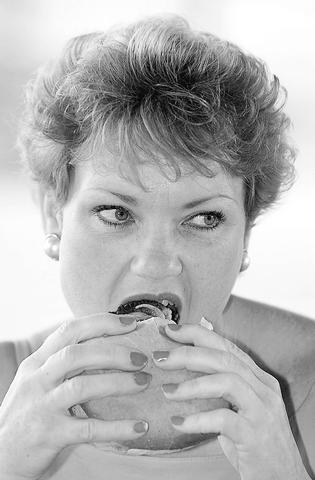
PHOTO: AFP
"Is it a 100 percent Australian-owned company? Because if it's not, your money is being delivered overseas."
Wrapped in the Australian flag and flinging barbs at foreign companies, Australian corporate nationalists are fighting back against a deep fear that Australia may become nothing but a "branch office economy," run by multinationals from abroad.
From "Big Kev's" household cleansers to Potter's pizzas and Dick Smith's peanut butter, "Australian Made" is no longer good enough. "Australian Owned" is the new battle cry.
"If Australian business was as patriotic and as sincere about their business as what they are about their sport we'd be the best in the world," says Potter, whose pizza delivery business turns over A$60 million (US$30.6 million) a year.
The message is simple. Unless Australians support local companies, living standards will plunge as corporate profits are sucked overseas, say the champions of Australian Owned.
Australia's 19 million people will be at the mercy of distant and uncaring executives in New York, London or Tokyo, who will lay off staff, close down factories and jack up prices on a whim.
On the face of it, corporate jingoism appears to sell.
Opinion polls show that more than 80 percent of Australians feel it is important to support local firms as more and more top Australian companies list abroad in search of deeper capital markets or merge with global rivals to gain clout.
Choice magazine, published by the independent Australian Consumers' Association, found the "Buy Australian" issue was the single most important topic for its subscribers.
Potter says pizza sales in his 123-store franchise chain were up 10-12 percent nationally after three months of running the provocative advertising campaign.
"It has worked," he said in a telephone interview.
Dick Smith, who set up the successful Dick Smith Electronics chain in 1968 and sold it to Australian-owned Woolworths Ltd in 1982, founded a food company in 1999 that packages locally made products in the Aussie flag and markets them to big chains.
He says Dick Smith Foods has already ratcheted up A$101 million in annual sales.
And Dick Smith's peanut butter grabbed an 18 percent market share in its first month after he told TV audiences that top-selling rival brands Kraft and Eta were actually owned by a foreign cigarette company, Philip Morris Companies Inc.
Smith says foreign investment were good when multinationals invested in a country's future but that now foreign giants buy cheap, cut staff and then take the profits out with them.
"I believe we should be looking for a balance. Foreign investment has given us some great advantages in the past, however that does not mean that all future foreign investment is good," he says in a mission statement on his Web page.
Kevin "Big Kev" McQuay, a rotund Queenslander who lounges around a pool side barbecue in his adverts, also appears to be making a success of playing the nationalist card.
His firm is expected to make its Australian Stock Exchange debut in August, with a projected market value of A$19 million.
Perhaps the clearest sign that jingoism sells is that the foreigners have tried to fight back through the courts.
Pizza Hut, through local subsidiary Tricon Restaurants Australia Pty Ltd, sought an injunction against Potter's airport advertisements. It has since dropped the case.
"Wholly Australian owned" family firm Herron Pharmaceuticals irritated SmithKline Beecham Pharmaceuticals by saying in an ad that Australia's number-one painkiller, Panadol, owned by the US heavyweight, was not Australian at all.
SmithKline Beecham went to court but Herron won.
Herron chief executive Euan Murdoch said the company's market share in painkillers climbed to 32 percent from 25 percent before the ads, and public support was "huge."
But the nationalists are not simply irking the foreigners.
Dick Smith has had run-ins with former deputy prime minister Tim Fischer, ambassador of the "Australian Made Campaign," a body set up by national and state chambers of commerce to promote locally manufactured products and not just pure Australian firms.
"It's fortress Australia, it's ultimately devastating to the longer-term future of Australia," Fischer said back in March, criticizing Smith's "xenophobic" twist.
The campaign's executive director, Jenny Da Rin, says there is no proof that foreign investment is bad for the economy. The latest government study found that 97 cents of every dollar invested by foreign firms remained in Australia, she says.
Da Rin says she is not against promoting ownership. But ownership does not always mean a firm's products are made in Australia.
Ultimately, consumers should make decisions based on price and quality, and not just nationalism, she says.
The Consumers' Association is careful not to take sides in the Australian-made or Australian-owned debate, but on that point it agrees.
"Don't let the desire to buy Australian get in the way of normal shopping best practice," it says.
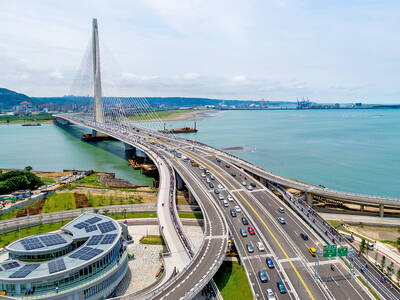
The Ministry of Transportation and Communications yesterday inaugurated the Danjiang Bridge across the Tamsui River in New Taipei City, saying that the structure would be an architectural icon and traffic artery for Taiwan. Feted as a major engineering achievement, the Danjiang Bridge is 920m long, 211m tall at the top of its pylon, and is the longest single-pylon asymmetric cable-stayed bridge in the world, the government’s Web site for the structure said. It was designed by late Iraqi-British architect Zaha Hadid. The structure, with a maximum deck of 70m, accommodates road and light rail traffic, and affords a 200m navigation channel for boats,
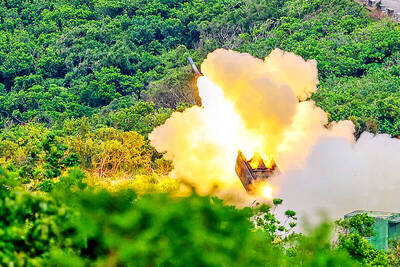
PRECISION STRIKES: The most significant reason to deploy HIMARS to outlying islands is to establish a ‘dead zone’ that the PLA would not dare enter, a source said A High Mobility Artillery Rocket System (HIMARS) would be deployed to Penghu County and Dongyin Island (東引) in Lienchiang County (Matsu) to force the Chinese military to retreat at least 100km from the coastline, a military source said yesterday. Taiwan has been procuring HIMARS and Army Tactical Missile Systems (ATACMS) from the US in batches. Once all batches have been delivered, Taiwan would possess 111 HIMARS units and 504 ATACMS, which have a range of 300km. Considering that “offense is the best defense,” the military plans to forward-deploy the systems to outlying islands such as Penghu and Dongyin so that
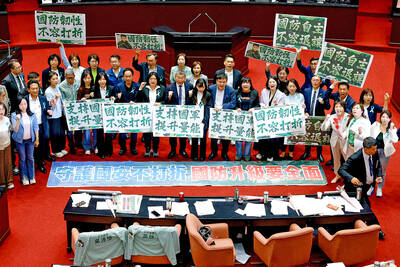
WHAT WAS ALL THAT FOR? Jaw Shaw-kong said that Cheng Li-wen had pushed for more drastic cuts and attacked him, just for the outcome to be nearly identical to his bill The legislature yesterday passed a supplementary budget bill to fund the purchase of separate packages of US military equipment, with the combined amount of spending capped at NT$780 billion (US$24.8 billion). The Chinese Nationalist Party (KMT) and Taiwan People’s Party (TPP) used their legislative majority to pass the bill, which runs until 2033 and has two main funding provisions. One was for NT$300 billion of arms sales already approved by the US for Taiwan on Dec. 17 last year, the other was for NT$480 billion for another arms package expected to be announced by Washington. The bill, which fell short of the NT$1.25
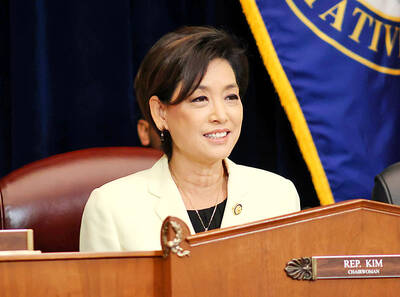
‘CLEAR MESSAGE’: The bill would set up an interagency ‘tiger team’ to review sanctions tools and other economic options to help deter any Chinese aggression toward Taiwan US Representative Young Kim has introduced a bill to deter Chinese aggression against Taiwan, calling for an interagency “tiger team” to preplan coordinated sanctions and economic measures in response to possible Chinese military or political action against Taiwan. “[Chinese President] Xi Jinping [習近平] has directed the People’s Liberation Army to be ready to invade Taiwan by 2027. China has a plan. America should have one too,” Kim said in a news release on Thursday last week. She introduced the “Deter PRC [People’s Republic of China] aggression against Taiwan act” to “ensure the US has a coordinated sanctions strategy ready should


 RSS
RSS