


Several years ago, Carl Jaskolski and a few employees he supervised at a Milwaukee social services agency put a quarter into a "cussing jar" every time they swore. His weekly contribution averaged US$3.
But today, Jaskolski, a specialist in human resources at the Concordia University business school in Mequon, Wisconsin, has become a self-described anti-swearing zealot.
Jaskolski, 46, views the increasing use of vulgar language in the workplace as the ugly side of the casual movement that has freed workers from suits and ties. In his view, swearing is often a form of workplace harassment. "And it's just plain bad manners," said Jaskolski, who also teaches employment law at the Milwaukee Area Technical College.

PHOTO: NY TIMES
To fight the trend, he has drafted a language policy and is distributing it free to human resource practitioners across the country. "Vulgar and offensive language can cause real harm, crosses the boundary of appropriate conduct and even disrupts the entire work force," the policy states. "Disgusting language infringes upon equal respect in working relationships and can cause serious harm to productivity, efficiency and stability."
His initiative has captured the interest of several companies, and that could spell trouble for workers with a weakness for four-letter words.
Susan Nattrass, an employment lawyer in California, read about his policy on the bulletin board of the Society for Human Resource Management in Alexandria, Virginia. She now recommends it as an insert to employee handbooks and estimates about 40 percent of her clients have adopted it.
"People seem to be swearing more today and companies want to take action," she said. Curtailing offensive workplace behavior, including swearing, could limit a company's liability against harassment claims, she added.
Of course, cracking down can spell pain for the offenders. Consider Susanna Seaman, who was fired from her job as a customer service representative for Verizon Communications Inc in Sarasota, Florida, in April for using a crude expletive.
Seaman, 36, says she was under disciplinary scrutiny at the time for marching up to a manager's desk in March after a phone argument and angrily telling her, "Don't you ever hang up on me again."
In April, she says, she was called into her boss' office for a disciplinary review of the encounter, but mistakenly thought she was going to be reprimanded again and muttered a phrase containing the offending word. A week later, after more than five years with the company, she was fired.
"It slipped," she said. "I was distraught and upset. I understand that people can get offended by swearing. I was brought up in a Christian home. But they went overboard firing me."
Robert Elek, Verizon spokesman, declined to comment on Seaman's case because it was going through grievance procedures. The company does not allow profanity in the workplace if it offends, intimidates or harasses co-workers, managers or contractors, he said.
OK, but what about blue-collar workers who consider four-letter words just part of their world? "We call it shop talk," said Richard Montero, 41, an assembly-line worker at the General Motors Saturn factory in Wilmington, Delaware, which has no air-conditioning. What with the heat and the monotony of the job, he said, "you can turn into a walking time bomb if you hold it in."
Few do. "When the supervisor comes down the line an hour before we're supposed to be getting out and tells us we're working overtime," Montero said, a majority of the workers call out "bull," and the expletives do not stop there. "There are a few people on the line who read their Bibles and ignore us. Most supervisors laugh it off."
Even so, he added, the younger supervisors he has encountered recently are more likely to ask workers to tone down the dirty jokes and swearing.
Alice Petitt, the plant spokeswoman, says GM does not tolerate profanity in any form, though she added that managers do not go out of their way to listen to every word workers utter.
While companies try to restrain foul language, banning it could be a losing battle, some specialists say. Timothy Jay, professor of psychology at the Massachusetts College of Liberal Arts and the author of Why We Curse, says an occasional outburst of swearing may actually have a therapeutic effect on workers under stress.
It must be devoid of any threatening undertones toward co-workers or bosses, of course, but Jay says his research has found that people feel better when they release some anger and frustration through words. "It's built into many of us, like a horn in a car," he said.
"It's a fine academic exercise," said John Rapoport, an employment lawyer in White Plains, New York. "The problem is the workplace is anything but an academic place."
A cursing ban could create a legal nightmare for employers, he says. Supervisors would have their hands full investigating every off-color remark, and companies would open themselves up to lawsuits if they did not mete out identical punishments for every offender. For example, he says, a woman or black employee fired for swearing could claim discrimination if a white male were not terminated for a similar indiscretion.
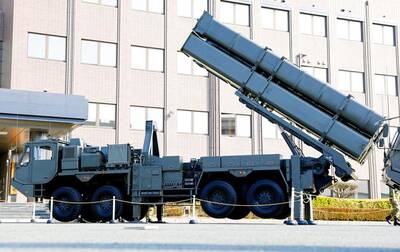
Japan has deployed long-range missiles in a southwestern region near China, the Japanese defense minister said yesterday, at a time when ties with Beijing are at their lowest in recent years. The missiles were installed in Kumamoto in the southern region of Kyushu, as Japan is attempting to shore up its military capacity as China steps up naval activity in the East China Sea. “Standoff defense capabilities enable us to counter the threat of enemy forces attempting to invade our country ... while ensuring the safety of our personnel,” Japanese Minister of Defense Shinjiro Koizumi said. “This is an extremely important initiative for

Chinese Nationalist Party (KMT) Chairwoman Cheng Li-wun (鄭麗文) today accepted an invitation from Chinese President Xi Jinping (習近平) to lead a delegation to China next month, saying she hopes to promote the peaceful development of cross-strait relations and bring stability to the Taiwan Strait. “I am grateful and happy to accept this invitation,” Cheng said in a statement from the KMT chairperson’s office. Cheng said she hopes both sides can work together to promote the peaceful development of cross-strait relations, enhance exchange and cooperation, bring stability to the Taiwan Strait and improve people’s livelihoods. At today's news conference, Cheng said any efforts to

MORE POPULAR: Taiwan Pass sales increased by 59 percent during the first quarter compared with the same period last year, the Tourism Administration said The Tourism Administration yesterday said that it has streamlined the Taiwan Pass, with two versions available for purchase beginning today. The tourism agency has made the pass available to international tourists since 2024, allowing them to access the high-speed rail, Taiwan Railway Corp services, four MRT systems and four Taiwan Tourist Shuttles. Previously, five types of Taiwan Pass were available, but some tourists have said that the offerings were too complicated. The agency said only two types of Taiwan Pass would be available, starting from a three-day pass with the high-speed rail and a three-day pass with Taiwan Railway Corp. The former costs NT$2,800

The nation’s fastest supercomputer, Nano 4 (晶創26), is scheduled to be launched in the third quarter, and would be used to train large language models in finance and national defense sectors, the National Center for High-Performance Computing (NCHC) said. The supercomputer, which would operate at about 86.05 petaflops, is being tested at a new cloud computing center in the Southern Taiwan Science Park in Tainan. The exterior of the server cabinet features chip circuitry patterns overlaid with a map of Taiwan, highlighting the nation’s central position in the semiconductor industry. The center also houses Taiwania 2, Taiwania 3, Forerunner 1 and


 RSS
RSS