


There is a fine line between news and entertainment on a new Web site that translates hundreds of the world's newspapers into English. Consider this headline translated from The Beijing Daily: "Sells which roast the dried bean curd girl." From The Okinawa Times comes this gripping lead: "The light where the body of the strong so stainless steel material is sluggish is shot."
Those are samples of "gist level" translations by Newstran. com (www.newstran.com). The three-month-old site, created by Rick Perez, links to AltaVista's free translation service, named Babel Fish. Babel Fish, which uses dictionary software from Systran, was the first such online translation service when it appeared in late 1997; today it supports 19 language pairs.
As a result, Newstran.com can translate newspapers into English from German, French, Italian, Spanish, Portuguese, Japanese, Chinese and Korean. (It also can translate English-language newspapers into any of these languages.) Whether or not readers will understand the result is another matter. At the very least it takes some patience to muddle through the babble.
"Sure, it stumbles on slang and idioms, but you can get the gist of most things," said Perez, who runs an advertising and public relations. "I wouldn't base any major business or life decisions on what you read here."
To be fair, Asian languages are the most difficult for computers to translate into English. French and Spanish newspapers tend to be the most readable; a few attempts at German-into-English were laughable and resulted in Spiegel Online headlines like "Single dumps from the telex."
While Newstran.com may not be perfect, it can still be useful. The ability to translate Web sites (news or otherwise) is increasingly important in a world where an estimated 400 million people are communicating and conducting business online of which 53 percent speak something other than English as their native language.
Perez say his main goal is to open the world's media to all readers -- especially those without access to a free press. "It's more of a crusade than a business project," said Perez, who finances the site through his nonprofit organization Humanitas International. "I'm going to put every dime I have into this to make it successful."
Perez may be headed for some legal trouble, however, because of the way his site works. When a user calls up a newspaper for translating, the newspaper site is contained within a frame and is surrounded by Newstran advertisements.
The New York Times Co, for one, has sent a "cease and desist" letter to Perez. The Times Co's legal department "will follow up if the illegal framing and unauthorized use of The New York Times' content is not stopped," a company spokeswoman said.
Perez said he was not trying to steal any traffic from newspapers. He doesn't want to take The New York Times on the Web off the site, but isn't sure what he will do. "According to my attorneys, I'm not violating any laws," he said. "We're a nonprofit organization providing a service."
Aside from any legal problems, professional translators say that Newstran may be spreading itself too thin by trying to translate so many newspapers between so many languages.
"The problem with a general-purpose site is that there's no such thing as a general-purpose language," said Rose Lockwood, director of research at Berlitz GlobalNET, a subsidiary of Berlitz International.
Systran, the company that provides the dictionary software for Babel Fish and, by extension, Newstran.com, is a pioneer in the realm of machine translation, but its system works best when customized. As ragged as the newspaper translations are, they will only improve as Babel Fish expands its vocabulary. Unknown words are added to the dictionaries, so the longer it is used, the better it gets.
"We're only in our infancy," Perez said. "As computers get faster and smarter, the translations will get more precise."


Taiwan has arranged for about 8 million barrels of crude oil, or about one-third of its monthly needs, to be shipped from the Red Sea this month to bypass the Strait of Hormuz and ease domestic supply pressures, CPC Corp, Taiwan (CPC, 台灣中油) said yesterday. The state-run oil company has worked with Middle Eastern suppliers to secure routes other than the Strait of Hormuz, through which about 20 percent of the world’s oil and liquefied natural gas typically passes, CPC chairman Fang Jeng-zen (方振仁) said at a meeting of the legislature’s Economics Committee in Taipei. Suppliers in Saudi Arabia have indicated they
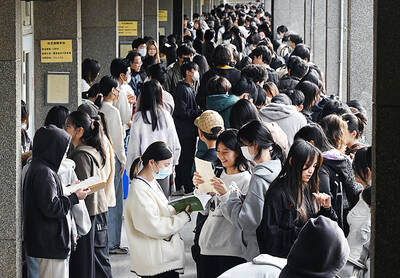
A global survey showed that 60 percent of Taiwanese had attained higher education, second only to Canada, the Ministry of the Interior said. Taiwan easily surpassed the global average of 43 percent and ranked ahead of major economies, including Japan, South Korea and the US, data from the Organisation for Economic Co-operation and Development (OECD) for 2024 showed. Taiwan has a high literacy rate, data released by the ministry showed. As of the end of last year, Taiwan had 20.617 million people aged 15 or older, accounting for 88.5 percent of the total population, with a literacy rate of 99.4 percent, the data

CCP ‘PAWN’? Beijing could use the KMT chairwoman’s visit to signal to the world that many people in Taiwan support the ‘one China’ principle, an academic said Chinese Nationalist Party (KMT) Chairwoman Cheng Li-wun (鄭麗文) yesterday arrived in China for a “peace” mission and potential meeting with Chinese President Xi Jinping (習近平), while a Taiwanese minister detailed the number of Chinese warships currently deployed around the nation. Cheng is visiting at a time of increased Chinese military pressure on Taiwan, as the opposition-dominated Legislative Yuan stalls a government plan for US$40 billion in extra defense spending. Speaking to reporters before going to the airport, Cheng said she was going on a “historic journey for peace,” but added that some people felt uneasy about her trip. “If you truly love Taiwan,

NEW LOW: The council in 2024 based predictions on a pessimistic estimate for the nation’s total fertility rate of 0.84, but last year that rate was 0.69, 17 percent lower An expected National Development Council (NDC) report expects the nation’s population to drop below 12 million by 2065, with the old-age dependency ratio to top 100 percent sooner than 2070, sources said yesterday. The council is slated to release its latest population projections in August, using an ultra-low fertility model, the sources said. The previous report projected that Taiwan’s population would fall to 14.37 million by 2070, but based on a new estimate of the total fertility rate (TFR) — the average number of children born to a woman over her lifetime — the population is expected to reach 12 million by


 RSS
RSS