


What would a Taiwanese prospect for a public offering on the NASDAQ or Hong Kong's GEM be without a "greater China" development plan? Not much, seems to be the rhetorical answer provided by a quick look at the prospectus of any Taiwanese company with an eye on e-commerce riches.
This is hardly surprising of course. Given the appeal of access to a potential market of 1.3 billion, China's rapid growth of Internet usage and the advantage of close linguistic and cultural links with China, the real question is, which Taiwanese company will be the most successful in this economic environment?
Yam.com thinks it can be.
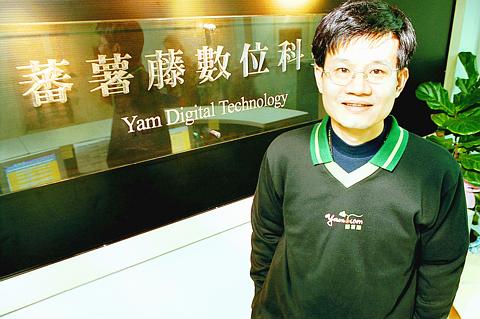
PHOTO: CHEN CHENG-CHANG
The way, it believes, lies in having a strong local base of users.
Having served more than 220 million customers so far in Taiwan, says Yam.com CEO Chen Jen-ran (
Not that NASDAQ wouldn't be nice. Indeed, the Taiwan-based Web portal and e-commerce company is ready in technical terms for an overseas listing. "We are just waiting for the board to give us the green light," Chen said.
No easy task
To be sure, challenges abound in convincing Wall Street investors that Yam.com has a bright future in a burgeoning market, regardless of last week's turbulence in American markets.
Most importantly, Chen is acutely aware that conducting e-commerce in China is fundamentally different from the US.
For a start, the two countries' distribution systems and after-sale service networks are decades apart in terms of development. Transportation between provinces (sometimes even between cities and counties) is unreliable and overcrowded, retail and wholesale operations are difficult to meld, and the concept of service as an industry is still in its infancy in many areas.
So does this daunt Yam.com? Listening to Chen, it doesn't sound like it.
"That's why we have set up a physical presence in metropolitan areas such as Beijing and Shanghai," Chen says. "Real-world displays that demonstrate products such as IBM or iMac computers which we sell online are exceptionally important in the immediate context, and in the long run."
So far, the strategy seems to be working well. "Our e-commerce business in China will get aggressive in the third quarter," Chen says.
Moreover, Yam.com is not only going it alone, having teamed up with European publishing giant Bertelsmann, which will offer content through the main Yam.com home page.
But this is just the start of it according to Chen, who is keen to stress the multi-focused nature of his company. "The Web portal is just an end-product," he says. To be more specific, he says it is the end-product of an Internet-enabled "Info-communication Service Company" which promotes the "5C" concept (content, community, communication, commerce and China).
Maturing focus
"Yam.com itself is an Internet-based application service provider," which has matured in its provision of content and community services over the years, Chen says. "This year we are going to focus on e-commerce," he says, adding that the company's revenue target for the year is roughly NT$360 million.
In order to achieve that goal, Yam.com is prepared to spend big. "We expect to lay out 20 percent of our estimated year 2000 budget -- NT$300 million -- on R&D," Chen says. This makes for a 25 percent increase over the previous year's R&D spending.
But it is in personnel where the biggest changes will be seen, as the current staffing level of 160 will leap to between 400 and 450. This does not include an additional 60 people who will be brought into the company's China operations by the second quarter. And China appears to be Yam.com's oyster.
With abundant capital, and a strategic e-commerce partnership sealed with Bertelsmann, Microsoft , Acer, and the Eslite Corp, it is hardly surprising that the Swiss Banking Corp has rated it as an Internet market leader in China, with an estimated potential market value of US$254 million.
Just over a year ago, however, Yam.com was not even a profit-oriented business.
The company's founders introduced the world's first Chinese-language search engine in 1995, when they were a group of volunteers in their 20s and early 30s working at the Frontier Foundation, a non-profit organization.
It was only in November, 1998, that the Web site with the domain name www.yam.org.tw went commercial, corporatized under the name Yam Digital Technology Co Ltd.
This lack of a commercial background has not been a hindrance, according to the company's management. In fact, it has been beneficial in many ways.
"Our technological history has given Yam.com a cutting-edge advantage in the marketplace," says Chen. "People trust us and our products -- and that is something money can't buy."
Yet it even has a monetary value, as Chen explains. Whereas most commercial enterprises have to set aside a part of their advertising budget to promote themselves among public-interest groups, Yam doesn't need to, due to its reputation. "Non-profit organizations usually come to us first with their advertisements," Chen said.
This is not just fancy talk, however. Yam.com still runs a site devoted to the devastating 921 earthquake, which continues to garner widespread media attention. "We are probably the only Web portal that still provides a communication channel between the quake-hit areas and the outside world," Chen says.
Yam also launched a site at www.disable.yam.com in December last year as part of its efforts to help disadvantaged groups in society.
"In the near future, even the blind will be able to use our sites," Chen says, adding that Yam's research team is currently working on the project.
The company's non-profit experience extends, ironically, to the bottom line, too. "We know how to make the most out of a penny," Chen says with a shy smile, while admitting that the company's management style has certainly grown more sophisticated.
"Before, each person had to shoulder far more and diverse responsibilities. Now, the division of labor has become more subtle in its distinctions."
Wireless Applications
Chen will not be drawn further on specifics, but it is clear that Yam sees great potential in phone-based services.
"We are cooperating with Far EasTone and GigaMedia to allow cell-phone users to get online," Chen admits. "However, the cell phone is just a carrier in the current stage of development; other devices will evolve for getting online."
As Chen sees it, people will still want to see pictures, graphics and conduct non-linear operations (which require a type of browser) online. Cell phone services are currently limited by their simple text-mode and linear operation. This is set to change soon, with the advent of Wireless Application Protocol in the middle of the year, and the eventual move to third generation mobile technology. And it's clear that Yam wants to stay ahead of the curve.
"Our lab has successfully developed technology that can be used with wireless devices," says Chen.

LEVERAGE: China did not ‘need to fire a shot’ to deny Taiwan airspace over Africa when it owns ‘half the continent’s debt,’ a US official said, calling it economic warfare The EU has raised concerns about overflight rights following the delay of President William Lai’s (賴清德) planned state visit to the Kingdom of Eswatini after three African nations denied overflight clearance for his charter at the last minute. Taiwanese allies Paraguay and Saint Kitts and Nevis, as well as several US lawmakers and the Inter-Parliamentary Alliance on China (IPAC) condemned China for allegedly pressuring the countries. Lai was scheduled to fly directly to Taiwan’s only African ally from yesterday to Sunday to celebrate the 40th anniversary of King Mswati III’s accession and his 58th birthday, but Seychelles, Mauritius and Madagascar suddenly revoked
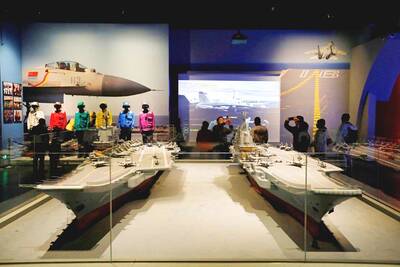
China on Wednesday teased in a video an aircraft carrier that could be its fourth, and the first using nuclear power, while making an allusion to Taiwan and vowing to further build up its islands, as it looks to boost maritime power, secure resources and bolster territorial claims. The video, issued on the eve of the 77th founding anniversary of the Chinese People’s Liberation Army Navy, featured fictional officers with names that are homophones of three commissioned aircraft carriers, the Liaoning (遼寧), Shandong (山東) and Fujian (福建). Titled Into the Deep, it showed a 19-year-old named “Hejian” (何劍) joining the group, sparking
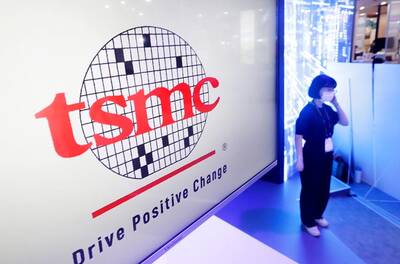
BIG YEAR: The company said it would also release its A12 chip the same year to keep a ‘reliable stream of new silicon technologies’ flowing to its customers Taiwan Semiconductor Manufacturing Co (TSMC, 台積電) yesterday said its newest A13 chip is to enter volume production in 2029 as the chipmaker seeks to hold onto its tech leadership and demand for next-generation chips used in artificial intelligence (AI), high-performance-computing (HPC) and mobile applications. TSMC, the world’s biggest contract chipmaker, also unveiled its A12 chip at its annual technology symposium in Santa Clara, California. The A12 chip, which features TSMC’s super-power-rail technology to provide backside power delivery for AI and HPC applications, is also to enter volume production in 2029, a year after the scheduled release of the A14 chip. The technology moves

The final batch of 28 M1A2T Abrams tanks purchased from the US arrived at Taipei Port last night and were transported to the Armor Training Command in Hsinchu County’s Hukou Township (湖口), completing the military’s multi-year procurement of 108 of the tanks. Starting at 12:10am today, reporters observed more than a dozen civilian flatbed trailers departing from Taipei Port, each carrying an M1A2T tank covered with black waterproof tarps. Escorted by military vehicles, the convoy traveled via the West Coast Expressway to the Armor Training Command, with police implementing traffic control. The army operates about 1,000 tanks, including CM-11 Brave Tiger


 RSS
RSS