


In stock market parlance, Joseph O' Konek is bullish about Taiwan's wireless telecom industry. As the president of a leading company in the world's fastest-growing mobile phone market, he has many reasons to be.
Launched in 1998 as a joint venture between Taiwan's Far Eastern Group and US telecom giant AT&T, Far EasTone has been quick to make a name for itself.
The company's credentials are strong, which would explain why it was the only challenger to Chunghwa Telecom (中華電信), the government monopoly, to be given both a 900Mhz and the superior 1800Mhz GSM licenses. That alone put it in a strong position to lead the pack.

PHOTO: CHEN CHENG-CHANG, TAIPEI TIMES
But the number one position has not (yet) fallen Far EasTone's way, whether measured by market share, revenue or profit.
When the race started back in 1998, Far EasTone missed the gun somewhat, the company admits that many had doubts about whether it could catch up to its competitors. Having launched earlier, Taiwan GSM (台灣大哥大), also known as Pacific Cellular, managed to grab 24 percent of the market to Far EasTone's 18 percent by the end of 1998.
But Far EasTone's commitment to marketing and improved service has helped it to recapture that lost ground. Today, the two firms hold a market share of around 25 percent each.
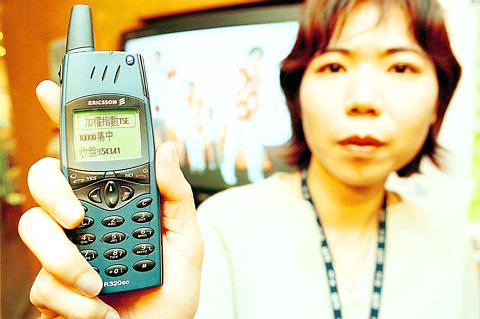
PHOTO: CHEN CHENG-CHANG
Far EasTone's balance sheet has likewise lagged Taiwan GSM's. By the end of its first calendar year, Far EasTone posted a respectable NT$1.15 billion loss, but well short of Taiwan GSM's astounding NT$3.8 billion net profit, which made it one of the fastest profit-makers in wireless history.
Despite the early setback, Far EasTone's rise has proven to be a textbook case of "new economy" management. As dotcom mania sweeps the world and new technology wows consumers, the key question new (and old) companies face is how to make themselves stand out from the crowd.
Despite the hype about new inventions and unexplored frontiers, success in the new economy is not about having the latest and greatest technology; it's about using it right and marketing it properly.
O' Konek uses the word "innovation."
Innovation, he explained, is not just about technology. "It's a management approach, it's about continually keeping ourselves fresh," he says. "We have to be responsive to people, our customers and staff, and not just be responsive to technology."
Early days
Far EasTone's background helps to explain this approach. When it was announced that mobile phone licenses would be released to end the monopoly of state-run Chunghwa, nearly all of Taiwan's biggest conglomerates rushed in, forming consortiums to vie for the licenses. As Taiwan's second-largest conglomerate, the Far Eastern Group was keen to find an entry point into the new, high-tech economy.
The vision was to develop Far EasTone as an incubator to bring Far Eastern Textiles into the 21st century, by bringing in professional management. "And innovation," says O' Konek.
When the company launched in January 1998 it established a vision with somewhat broad parameters: Anytime, anywhere communications to enrich people's lives.
No mention of wireless communications. No mention of profits or market share.
Yet while such a vision seems quite touchy-feely, it reflects the company's open-minded approach.
"We don't know where the company will be in the future, or what technology will be around," O' Konek says, "but we know that our products and service must relate to all aspects of each person. Business, and private."
It's this attitude that is the key to success in the new economy. After all, what are companies in the new economy doing but providing a service? Information on your desktop, books delivered to your door, a greater variety of entertainment, quick and easy communications. And it's not just about price.
From the outset, Far EasTone has not concerned itself with fighting a price war. "It was clear back then that everyone was going to say `we're a lot better than Chunghwa, and we're cheaper," O' Konek explains. "We came out and said, `we're going to provide the best value.'"
Among Far EasTone's early innovations was dual-band coverage and per-second billing, rather than in six-second increments.
All this comes at a price, of course. Far EasTone charges around 10 percent more than its competitors -- a fact which O' Konek is unapologetic about. "We provide better service," he boasts, eagerly showing off figures from recent customer satisfactions surveys.
But to say that customer service has been the key to Far EasTone's success may well be stretching the truth. Like other big winners in the service industry worldwide, Far EasTone has also worked hard to establish a brand image.
"Every market in the world has a segment that wants to be with the leading brand," O' Konek says.
Fortunately for some, the Taiwan market identifies leading brands as being international. Those names that have won the trust and respect of Taiwanese consumers are, with few exceptions, foreign multinationals, a point Far EasTone has played on.
"When we looked at Taiwan back in 1997, and asked consumers what the big brands were, none were Taiwanese," O' Konek says. "Not Acer, not EVA Airways, but 7-Eleven and McDonald's."
Going global at home
It was from this realization that Far EasTone started to position itself in the image of a foreign multinational. Not a bad trick, considering only 20 percent of its shareholding is in foreign hands.
Indeed, despite being a local firm with localized products, Far EasTone worked hard to project itself as a big name company.
"We had to position Far EasTone in such as way as to make the customer feel they are getting the same quality as they would from a multinational," O' Konek says.
So it is in this image that Far EasTone could afford to be more expensive.
To help build the image, Far EasTone has cemented alliances with multinational brand partners including the NBA, Microsoft, the Body Shop, AMEX and Swatch.
"There's clearly a big segment of the Taiwan market that is very brand-aware and is willing to pay a slight premium for the brand and the quality that goes along with being a foreign multinational," O' Konek says.
He admits that the tactic has been to get upscale brands that are less price sensitive. A service company that provides a homogenous product, such as wireless airtime, can ill afford to engage in a price war. Not even Amazon.com claims to be the cheapest; it instead uses the claim of having "Earth's biggest selection," emphasizing, "fast, easy and enjoyable shopping."
So, are Far EasTone's customers just rich, image-conscious yuppies? On the contrary, it would seem.
Like all good service companies, Far EasTone undertakes twice-yearly customer satisfaction surveys that help it work out where it stands, and more importantly where it's heading. "The bar is constantly rising," O' Konek says. "What satisfied a customer back then is not enough now."
Word of mouth seemed to be the best advertising the company could have asked for, the surveys showed, as customers were most impressed with its service.
And although price has proven to be Far EasTone's biggest stumbling block, as confirmed by the surveys, it was ironically price-sensitive customers that helped the company leapfrog Taiwan GSM last year.
Its vehicle for growth was the rechargable pre-paid "IF" card. While other companies were launching their pre-paid cards as separate products from the main company, Far EasTone deliberately promoted IF as an extension of the Far EasTone family. It also launched a highly successful marketing campaign to go with it. The now famous "Call Me Dance" was the brainchild of international agency Ogilvy & Mather.
IF's main customers have proven to be those that were seen as Far EasTone's greatest weakness: price-sensitive under-30s.
"Not only are IF customers more price-sensitive, but our research has shown them to be more satisfied with us than the post-paid customers," O' Konek notes.
To the future
Since that burst of energy last year, Far EasTone hasn't been sitting on its hands. New technology has indeed been a driving force behind the company's innovation and promises to be factor in future performance.
In wireless telephony the current catch phrase is WAP, Wireless Application Protocol, which enables scaled-down versions of the Internet to be viewed on a handset. Put simply, a WAP-enabled phone is like having "Netscape on your Nokia."
In order to make a play for the still-young WAP market, Far EasTone launched its WAP Web site on Dec. 1 last year. Rather than attempt to provide all of the content to users, Far EasTone has hooked up with strategic partners to provide a wide range of content. Items available include traffic information, ticket reservations, email and stock market updates.
A fortnight after launching its WAP site, Far EasTone jumped into the Internet Service Provider (ISP) business. At first glance the two moves seem unrelated. It certainly seems a strange move for a wireless company to get into the fixed-line Internet business. But for a company that's looking to keep up with technology, the move is entirely logical.
"We saw the convergence coming," O' Konek says. "So what's a better way to understand the future than to look at people's usage on fixed Internet and how they use wireless, then anticipate the next move?"
For most new entrants, tackling Taiwan's already crowded ISP market would be more than a daunting prospect. But the way O' Konek explains it, the move appears natural.
The country's two leading ISPs, Hinet and Seednet, are virtually unassailable, but grabbing third spot, or around 100,000 subscribers, is an achievable target. With a subscriber base of 2 million, the logic goes, Far EasTone needs to get only 5 percent of its wireless customers to turn to its ISP service and it can chalk-up 100,000 customers.
To get there, Far EasTone has created a seamless link between its ISP and wireless products. Every minute of wireless airtime gives a customer one minute of ISP time; the charges appear on one bill, and they work with the same customer service team.
"We're leveraging the relationship with just shy of two million customers," O' Konek enthuses. The company predicts it can jump into third spot on the ISP market by the end of the year.
As for WAP, well, that's another matter. While the future is bright, the hype maybe overdone. According to research company IDC, this year is not destined to see the long-awaited wireless Internet boom. As IDC analyst Frank Gens said in one report: "There is little pent-up demand for 14.4 or 28.8 bits per second Yahoo! on a cell phone."
O' Konek is a little more optimistic. "WAP is the next hot new thing. It's very, very important to the industry," he says.
The problem however, is the lack of WAP-enabled handsets. From Europe to Australia, wireless service providers are facing a severe shortage of handsets over which they can provide WAP services.
"Handsets are the big issue, as they are for any new wireless technology. It's easier to get the technology into a network than it is to get it into a handset," O' Konek explains.
Far EasTone has only managed to get 1,000 WAP handsets onto the market since December, although at around NT$17,000 each that's not bad going.
Far EasTone is expected to have wireless broadband available at 56K by year-end and 115K some time next year.
O' Konek also talks up the prospects for the industry's new General Packet Radio Service (GPRS), which Far EasTone will be testing from next month.
While WAP is a protocol for presenting data, GPRS is a new method by which that data is sent. Rather than using a continuous connection, as is the traditional dial-up method, GPRS sends and receives data only on demand. This means that idle time, such as when reading an email, does not use network resources. The technology is more akin to the current short message service (SMS) that is used to notify cellphone users of a new voicemail message.
This, O' Konek says, is a more efficient way of managing data.
But the wow factor of all this new technology may still be overplayed, a fact O' Konek is conscious of.
Before consumers are willing to embrace the new technology, they're going to have to be convinced that it actually applies to them.
"There are thousands of WAP-enabled sites around the world, O' Konek says. "But, are they the killer applications that will make people switch?
There will be new applications that we don't even know about that will make wireless Internet more attractive, O' Konek predicts.
Until then however, the wireless Internet will stay more of a concept than a reality. Part of the problem is that existing customers are not using current services such as SMS and voicemail to their full extent, O' Konek says.
Among this hive of technological activity, the company is not standing still.
To tap into the growing business-to-business market and help companies integrate all of their communication needs, Far EasTone this year set up its Enterprise Solutions division. The new division will target the top 1,000 companies in Taiwan using consultative-selling to provide services from from Virtual Private Networks (VPN) to supply chain management systems.
Add to the list unified messaging, which integrates voicemail, SMS and fax, and you get a company that's not only pushing a brand, but constant innovation.
So what about the competition, what are their strengths and what do they do better? "We don't think they do anything better than us," O' Konek says matter of factly.
Information
A Jumble of Jargon
As the telecoms industry changes at rapid speed, so does the terminology
GSM
Global System for Mobiles. A digital phone standard that has become the major standard through most of Europe and Asia, and is now catching on in the US.
CDMA
Code Division Multiple Access. The leading standard in the US.
SMS
Short Message Service. Originally designed using the 'service' channels of the wireless band to deliver voicemail notification, it has taken off as a two-way messaging system.
WAP
Wireless Application Protocol. A protocol that allows browsing via a handset. "Netscape on your Nokia." Requires WAP-enabled handset
GPRS
General Packet Radio Service. A system of sending and receiving data that doesn't require dial-up connection, but instead is 'always on.' Works in a similar fashion to SMS.
The Generation GAP
1 - Analog system providing basic voice service
2 - Digital system with speeds up to 9.6k providing advanced voice and SMS services (Current GSM)
2.5 - Digital System with speeds of 56k, and as high as 384k, providing SMS and Internet (GPRS)
3 - Digital System providing speeds as high as 2Mbps providing Video, Internet, and Multimedia (Still a dream)

‘NO SECURITY RISK’: The Railway Bureau reassured the public that the technicians’ activities were limited to technical guidance and did not involve sensitive systems The Railway Bureau yesterday said it had invited eight Chinese technicians to assist with an airport MRT construction project. The bureau issued the confirmation after an Internet user said Chinese nationals had entered the construction zone of Taiwan Taoyuan International Airport’s Terminal 3 project. They asked why “individuals from an enemy state” were allowed access to such a major national infrastructure project, which raised serious concerns over Taiwan’s industrial safety, sensitive systems and information security. The bureau’s Northern Region Engineering Branch Office said subcontractor Taiwan Handle Industrial Co (台灣手把工業) of the Taoyuan airport MRT’s “Contract No. CU05 Project A14 Station Civil, MEP &

The National Chungshan Institute of Science and Technology yesterday showcased its locally developed variants of the Vision 60 robotic patrol dog, which it plans to deploy on the nation’s outlying territories in the South China Sea. The variants were produced under the Joint Lab project — created by the institute and domestic companies — and assembled with domestically produced motors, lenses and artificial intelligence (AI) systems alongside licensed tech from the US, Missile and Rocket Systems Research Division deputy director Jen Kuo-kang (任國光) told the media event at a military base in Taipei’s Dazhi (大直) area. Taiwan has built up its strengths

NOT IMMEDIATE: Taiwan has a chance to appeal the proposed 10 percent tariff before it starts, while other countries face a 12.5 percent tariff from the trade office Taiwan is among 60 economies determined by the US to have failed to impose or enforce a ban on the importation of goods produced with forced labor, according to a notice released on Tuesday by the Office of the US Trade Representative (USTR), which proposed imposing an additional 10 percent or more tariff on them. The USTR in a statement said that following an investigation, it had determined under Section 301 of the Trade Act of 1974 that the failure of the 60 economies to impose and effectively enforce a prohibition on the importation of goods produced with forced labor is

RIGHT DIRECTION: Taiwan’s efforts to prevent forced labor include a proposal to ‘fully prohibit’ employers from withholding workers’ documents, an official said Taiwan is to establish a mechanism to restrict imports of goods linked to forced labor, the Executive Yuan said yesterday, after the US proposed imposing additional tariffs on Taiwanese goods over labor concerns. “The Ministry of Labor and the Ministry of Economic Affairs are to establish an interministerial review procedure,” Executive Yuan spokesperson Michelle Lee (李慧芝) said at a news briefing in Taipei. “The government is to use the Foreign Trade Act [貿易法] as the legal basis to restrict imports of goods produced with forced labor” and bring its supply chain governance more in line with international standards on human rights, resilience


 RSS
RSS