

South Korea’s exports nearly doubled last month, the sharpest jump in more than 50 years, as robust global demand for artificial intelligence (AI) investment boosted shipments of the country’s chips, government data showed yesterday.
Exports from Asia’s fourth-largest economy, a bellwether for global trade, rose 93.7 percent from the same month last year to US$115.28 billion, slightly higher than a median 93.2 percent rise forecast in a Reuters poll of economists.
The surge, boosted by having more working days than a year earlier due to the timing difference in the Chuseok holidays, exceeded September’s 83.7 percent gain and was the strongest since January 1974.
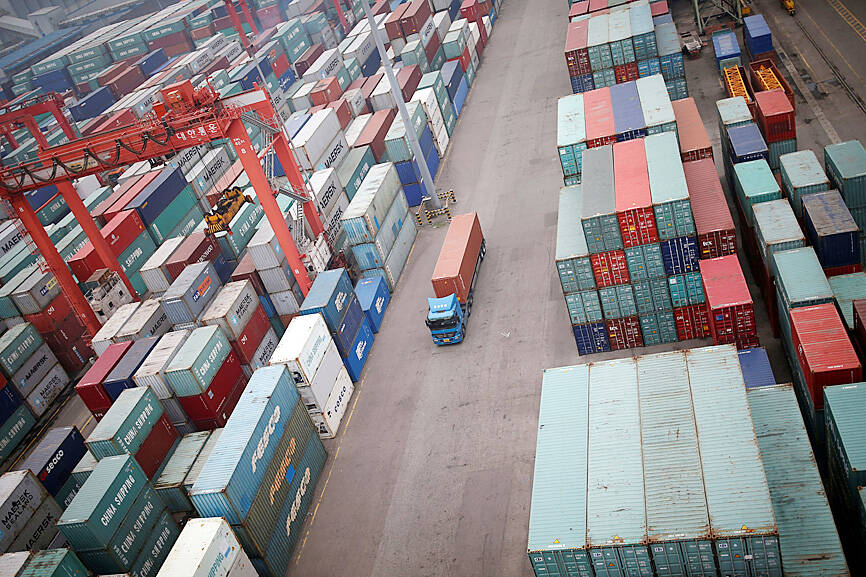
Photo: Reuters
Riding the global boom in AI investment, South Korea’s economy grew faster than expected in the third quarter on strong semiconductor exports and investments, with chipmakers Samsung Electronics Co and SK Hynix Inc posting surging profits.
“With exports continuing solid growth of more than US$110 billion in October, it is becoming certain that annual exports of US$1 trillion will be reached within November,” South Korean Minister of Trade, Industry and Resources Kim Jung-kwan said.
South Korea’s exports for the January-October period totaled US$930 billion. Annual exports of more than US$1 trillion would make South Korea the fourth country in the world to reach the milestone, after the US, China and Germany.
Overseas sales of semiconductors jumped 259.4 percent last month to US$56.44 billion, as prices and volume remained high on continued facility investment by global big tech firms in the competition for AI industry leadership, the trade ministry said.
Computer sales spiked 496.6 percent on increasing server demand for AI services.
Shipments to China rose 133.6 percent, while those to the US grew by 185.8 percent, to Europe by 56.4 percent and to Southeast Asia by 128.0 percent.
South Korea’s imports rose 36.0 percent to US$72.78 billion, after rising 26.0 percent in September, to post the biggest annual increase since January 2022 on higher crude oil prices, as well as demand for semiconductor manufacturing equipment and cars.
The nation posted a monthly trade surplus of US$42.50 billion, narrower than a record US$49.97 billion surplus in the previous month.
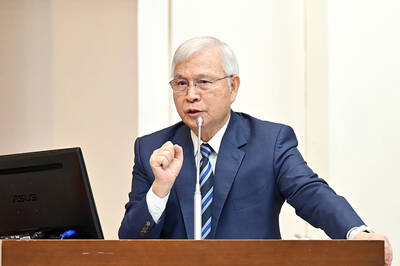
RESERVES ADEQUATE: The central bank governor rejected claims that Taiwan was facing a cash shortage, saying that its financial system had ample savings The New Taiwan dollar’s 3 percent fall this year despite record exports and a widening trade surplus stems from foreign investors cashing in on the local stock market’s technology-driven rally and moving funds overseas, central bank Governor Yang Chin-long (楊金龍) told lawmakers yesterday. The NT dollar has become one of Asia’s weakest-performing major currencies this year. Foreign investors have reaped substantial gains from Taiwan’s surging stock market, prompting them to sell shares and rebalance their portfolios, Yang told a meeting of the legislature’s Finance Committee in Taipei. Their withdrawals have added to downward pressure on the NT dollar, offsetting support

The artificial intelligence (AI) supercycle should last for more than two decades, former Intel Corp chief executive officer Pat Gelsinger told an event in Taipei yesterday, dismissing fears of an AI bubble amid mounting skepticism over massive infrastructure investments. “We do see that there will be periods of disruption, correction, etc. So, we do not think of it as an AI bubble,” Gelsinger, who is a general partner at Playground Global LLC, said at the US venture capital firm’s second annual Taiwan Deep Tech Summit. However, “we’ll have some speed bumps as different areas and different technology disruptions occur along it,” Gelsinger

Chinese automakers outsold Japanese rivals in Europe for the first time over a full quarter, underscoring how quickly brands like BYD Co (比亞迪) and Chery Automobile Co (奇瑞汽車) are gaining ground in the region. Registrations of Chinese-branded cars roughly doubled from a year earlier in the three months through September to make up 12.7 percent of total sales across the region, led by hybrids, according to market researcher Dataforce. That has put them ahead of Japanese manufacturers, including Toyota Motor Corp, at 11.9 percent. The advance accelerated at the end of the quarter. Chinese brands’ European share jumped to a record 14.5

A US cruise ship on an around-the-world voyage that touted its cabins as floating homes suspended its three-year journey in Cambodia due to fuel costs, forcing hundreds of passengers to disembark. The MV Odyssey set sail two years ago on a voyage to the seven continents marketed as combining long-term living at sea with global travel. Its operator had offered to “make the Odyssey your permanent home,” with the purchase price of a suite for the lifetime of the vessel starting at about US$230,000. For now, it is docked at the Cambodian port of Sihanoukville on the Gulf of Thailand, with no


 RSS