

Taiwan’s machinery exports rose again last month, driven mainly by shipments of electronic equipment amid strong demand for artificial intelligence (AI) applications and semiconductors, the Taiwan Association of Machinery Industry said yesterday.
Outbound shipments of machinery products increased 29.9 percent from a year earlier to US$3.437 billion, the 20th consecutive monthly increase, the association said in a report.
Last month’s strong performance led third-quarter machinery exports to grow 22.14 percent year-on-year to US$10.184 billion, data from the association showed. In the first three quarters, overall exports reached US$27.98 billion, up 20.3 percent from a year earlier, the data showed.
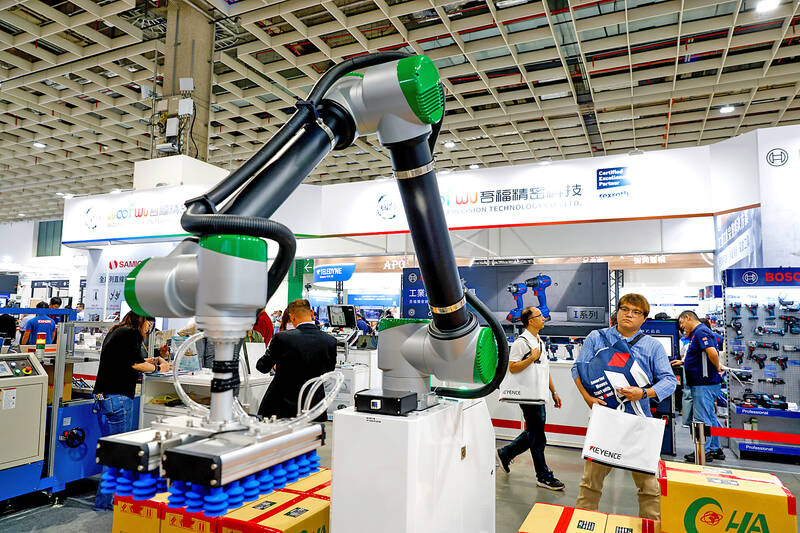
Photo: EPA
Driven by strong orders the industry has received, shipments in the fourth quarter are expected to continue showing positive growth, the association said. In addition, full-year exports and output value are forecast to hit record levels, it said.
Taiwan’s machinery products comprise mainly electronic equipment, inspection and testing equipment, power transmission components and machine tools.
Shipments of electronic equipment saw the largest growth, rising 61 percent to US$700.57 million last month and increasing 46.1 percent to US$5.55 billion in the first three quarters, association data showed.
Machine tool exports were relatively low compared with other product categories, down 1.8 percent to US$167 million last month and down 1.9 percent to US$1.492 billion in the first three quarters, the data showed.
The association attributed the decline to an unfavorable New Taiwan dollar exchange rate compared with the Japanese yen and South Korean won, undercutting Taiwanese competitiveness.
The US remained the largest buyer of Taiwanese machinery products in the first three quarters, with purchases worth US$7.287 billion, accounting for 26 percent of exports, association data showed.
China ranked second, with purchases of US$5.895 billion for a 21.1 percent share of exports. Singapore followed with purchases of US$2.122 billion and accounting for 7.6 percent of the total, the data showed.
The association said the local machinery industry should be able to maintain steady growth ahead, thanks to strong demand for semiconductors and AI servers boosting shipments of electronic equipment and inspection and testing equipment.
However, geopolitical conflicts and export control policies of some countries, such as those concerning high-tech and rare earths, could impact global supply chains. If the availability of key components becomes an issue, it might affect Taiwanese manufacturers’ order visibility and export outlook going forward, it said.
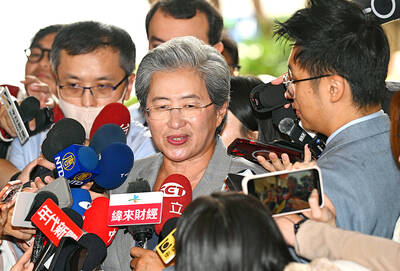
SILICON ISLAND: When asked about geopolitical tensions, Lisa Su said that ‘Taiwan is absolutely critical to the semiconductor supply chain, and very, very critical for AMD’ Advanced Micro Devices Inc (AMD) CEO Lisa Su (蘇姿丰) yesterday said the company plans to “substantially” increase manufacturing capacity next year through its Taiwanese supply chain, particularly with Taiwan Semiconductor Manufacturing Co (TSMC, 台積電), as surging demand for artificial intelligence (AI)-related processors continues to outstrip supply. “It is a very exciting time right now for all kinds of compute, and especially on the CPU [central processing unit] side,” Su said during a visit to Taiwan. “The overall market has increased a lot in 2026, and so we have also increased our own supply and capacity in 2026, but I can

INFRINGEMENT: The investigation comes after a complaint from Vicor Corp, with the company seeking a limited exclusion order as well as cease-and-desist orders, the ITA said The US International Trade Commission (USITC) has launched a Section 337 investigation naming Taiwanese technology companies, including Hon Hai Precision Industry Co (鴻海), Delta Electronics Inc (台達電) and Quanta Computer Inc (廣達), as respondents. The Ministry of Economic Affairs (MOEA) pledged assistance if needed. The USITC said on Friday in a statement that it had voted to institute an investigation under Section 337 of the US Tariff Act of 1930 into certain vertical power delivery systems, related components and computing devices incorporating such systems. The investigation covers 20 companies from Taiwan, China, Germany and the US, the commission said, adding that it
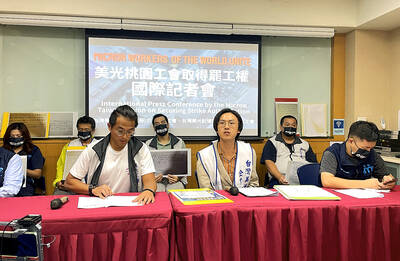
INDUSTRY STANDARD: Most global semiconductor companies have tied employee bonuses directly to corporate profits, the union said, urging Micron to do the same Micron Memory Taiwan Co’s (台灣美光) Taoyuan union secured strike authorization yesterday after a six-day vote, ramping up pressure on management to build a reasonable profit-sharing mechanism. Before the strike, the Taoyuan union “encourages” members to join a protest in Taipei on Oct. 19, union chairman Jerry Lin (林哲瑞) told a news conference in Taipei. The union did not rule out staging a snap strike, Lin said. The union has 2,258 registered members, with 88.3 percent backing the strike, he said. The vote comes as Micron’s board of directors is meeting today and tomorrow in the US. The union expects the board to respond

Elon Musk said his business empire would build and operate Terafab independently, quashing speculation about industry leader Taiwan Semiconductor Manufacturing Co (TSMC, 台積電) swooping in to run his ambitious chipmaking venture. Based in Texas, the Terafab project is Musk’s effort to break into the business of fabricating chips, in service of his companies Tesla Inc and SpaceXAI. While Musk had said that he was in discussions with TSMC, the trillionaire clarified in an X post yesterday that the only matter under consideration is for TSMC potentially leasing some part of the planned site and would not involve any operational role. “Maybe TSMC


 RSS
RSS