

Largan Precision Co (大立光), a key iPhone lens supplier, yesterday reported that gross margin slid to 42.21 percent in the third quarter — the lowest in 13 years — from 49.41 percent in the previous quarter and 47.24 percent a year earlier.
The decline was mainly due to lower yields for new smartphone camera lens products and higher green energy costs, Largan chairman Adam Lin (林恩平) told an earnings conference.
As green energy costs are structural and unlikely to ease in the near term, this quarter’s margin outlook would depend largely on improving yields for new lens products, Lin said.
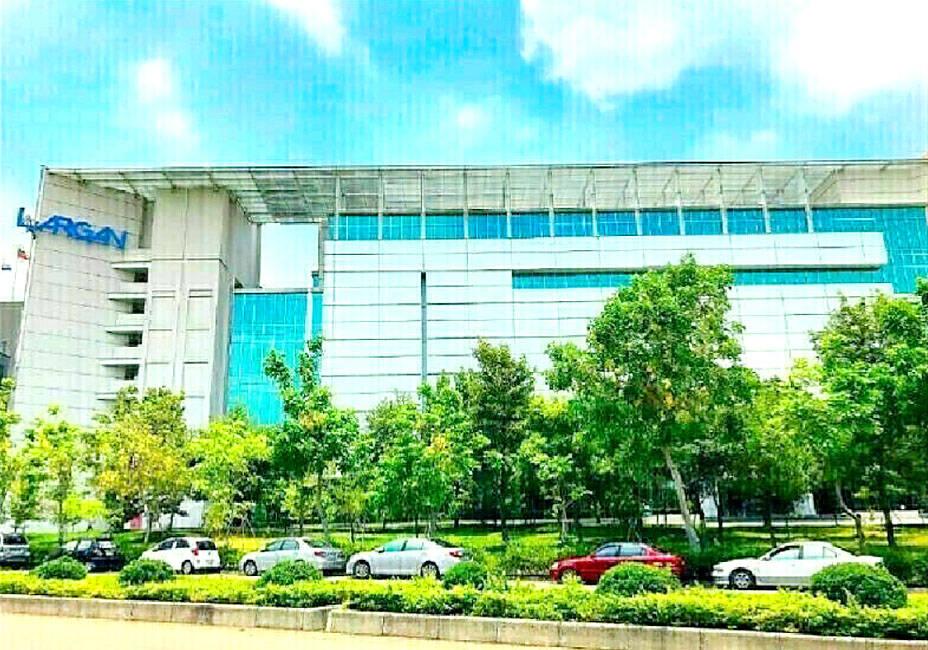
Photo: Chen Mei-ying, Taipei Times
During the July-to-September period, Largan’s revenue fell 11.47 percent year-on-year to NT$15.65 billion (US$490.98 million), while net profit declined 27.65 percent to NT$5.18 billion.
Earnings per share were NT$39.62, down from NT$53.05 a year earlier, company data showed.
This month’s revenue is expected to remain flat from last month’s NT$5.78 billion before declining next month after smartphone customers began cutting orders last month, he said.
Apple Inc last quarter launched the iPhone 18 series with variable aperture lenses, for which Largan has an exclusive supply share.
Yields for variable aperture lenses are currently “rather OK,” Lin said.
However, shipment momentum is weakening as the peak season has passed, he said.
Factory utilization for smartphone lenses is expected to remain at full capacity this quarter, Lin said.
Customers are testing samples of upgraded camera lens modules for next year’s models, he said, adding that new periscope lenses are entering trial production.
As the company pushes into the copackaged optics business to supply fiber arrays (FAs), Largan has completed a trial automated production line for FAs after gaining customer certification last month, Lin said.
The company also plans to complete its first fiber array unit (FAU) production line by the middle of next year and begin volume shipment in the second half of next year, he said.
Largan aims to begin mass production of FAU products for one customer in the second half of next year, with sample deliveries slated for this month, he said.
The company integrates FAs with prism microlens arrays it sources externally to make FAUs, Lin said.
The FAU solution next year is expected to use grating couplers, while Largan is also working with customers on edge-coupling technology, he said.
Largan is also discussing next-generation FAU products with other customers, with timelines broadly pointing to 2028, he said.
Capital expenditure totaled NT$8.18 billion last quarter, mainly for land and factory purchases in Taichung, he said.
The purchases are to support the expansion of its FAU-related business, Lin said.
Construction is expected to begin next year and be completed by 2030, he added.

Bankers in Hong Kong skipped the summer break as an artificial intelligence (AI)-fueled rush for capital sent share sales to a record, defying a bruising selloff in the city’s stocks. Initial public offerings (IPOs), placements and block trades raised US$47.5 billion in July to last month, the biggest haul ever for the period, data compiled by Bloomberg showed. That pushed fundraising this year above US$92 billion and within reach of the US$112.5 billion record set in 2021. AI has been at the heart of Hong Kong’s deal revival, but this summer brought a new level of intensity. Chinese companies raised ever-larger sums

SILICON ISLAND: When asked about geopolitical tensions, Lisa Su said that ‘Taiwan is absolutely critical to the semiconductor supply chain, and very, very critical for AMD’ Advanced Micro Devices Inc (AMD) CEO Lisa Su (蘇姿丰) yesterday said the company plans to “substantially” increase manufacturing capacity next year through its Taiwanese supply chain, particularly with Taiwan Semiconductor Manufacturing Co (TSMC, 台積電), as surging demand for artificial intelligence (AI)-related processors continues to outstrip supply. “It is a very exciting time right now for all kinds of compute, and especially on the CPU [central processing unit] side,” Su said during a visit to Taiwan. “The overall market has increased a lot in 2026, and so we have also increased our own supply and capacity in 2026, but I can
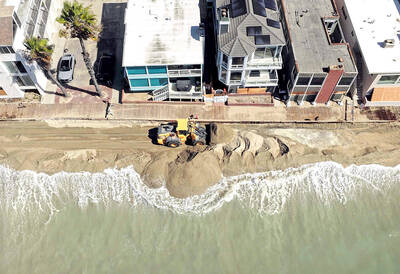
Sea levels in California are set to rise by as much as a foot (30cm) in the coming days as an enormous wave washes up the US West Coast. The huge surge of energy, known as a “coastal trapped wave” or a “Kelvin wave,” is part of El Nino, a months-long phenomenon in the Pacific Ocean that scientists say could generate powerful storms and floods in some parts of the world, while leaving others in drought. The Kelvin wave is not anything like a tsunami; nor does it crash on beaches. Rather it is a sustained bulge of excess water up to
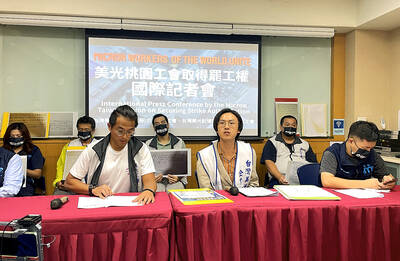
INDUSTRY STANDARD: Most global semiconductor companies have tied employee bonuses directly to corporate profits, the union said, urging Micron to do the same Micron Memory Taiwan Co’s (台灣美光) Taoyuan union secured strike authorization yesterday after a six-day vote, ramping up pressure on management to build a reasonable profit-sharing mechanism. Before the strike, the Taoyuan union “encourages” members to join a protest in Taipei on Oct. 19, union chairman Jerry Lin (林哲瑞) told a news conference in Taipei. The union did not rule out staging a snap strike, Lin said. The union has 2,258 registered members, with 88.3 percent backing the strike, he said. The vote comes as Micron’s board of directors is meeting today and tomorrow in the US. The union expects the board to respond


 RSS
RSS