

Sea levels in California are set to rise by as much as a foot (30cm) in the coming days as an enormous wave washes up the US West Coast.
The huge surge of energy, known as a “coastal trapped wave” or a “Kelvin wave,” is part of El Nino, a months-long phenomenon in the Pacific Ocean that scientists say could generate powerful storms and floods in some parts of the world, while leaving others in drought.
The Kelvin wave is not anything like a tsunami; nor does it crash on beaches. Rather it is a sustained bulge of excess water up to 30km wide that should hug the coastline as it travels all the way up to Alaska.
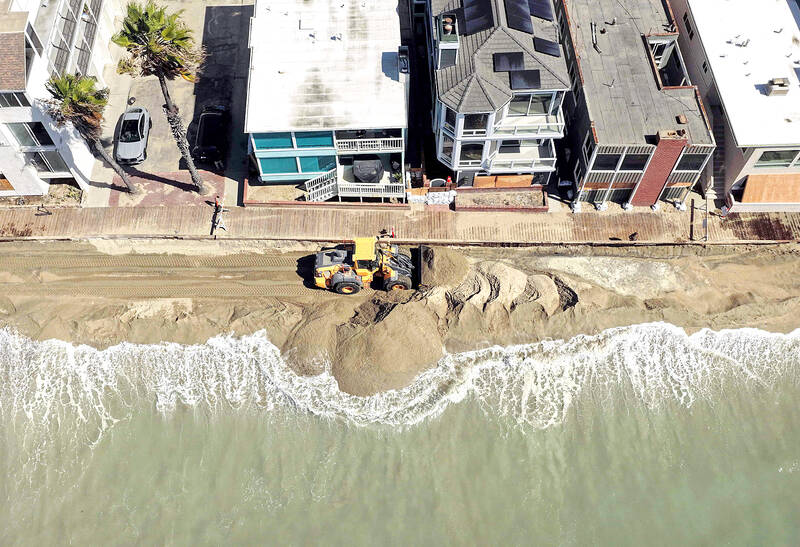
Photo: AFP
Dillon Amaya, an oceanographer at North Carolina State University, said the elevated sea levels could combine with other natural phenomena to create problems for coastal communities.
“What this wave is doing is it’s raising sea states, and then when... you combine this wave with things like storm surge from passing weather, large swells, or things like astronomically high tide... [you] elevate your risk for things like flooding and also beach erosion,” Amaya said in a phone interview.
“The general rule of thumb is that every two to four inches [5-10cm] of sea level rise that we see in that background state essentially doubles your flood risk,” he said. “So it doesn’t sound like a lot, but because it’s over a huge volume of water, and it’s combined with these other factors, you start to get the flood risk.”
In the past few weeks parts of southern California have been hit by storm surges that have eaten away at beaches or damaged properties.
In Dana Point and Laguna Beach, south of Los Angeles, several houses have been rendered uninhabitable, and at least one has completely collapsed.
In Malibu, an enormous sinkhole formed in the driveway of a house belonging to actor Nicolas Cage when pounding waves from a hurricane eroded the coastline.
The Kelvin wave is both a cause and a symptom of El Nino, said Amaya, adding that it originates in waters near Indonesia when trade winds die down.
“Those trade winds hold up a ton of really warm water in the Western Equatorial Pacific because they’re pushing on the surface waters as they blow. “If they weaken for too long... water is then able to effectively slosh back along the equatorial strip from Indonesia all the way to South America.”
As this wave makes its way across the Pacific, it suppresses the cold water that usually comes up from the deep ocean, making the surface temperature higher.
It is this ocean warming that we call El Nino.
“So these Kelvin waves are, in many ways, the driving force of El Nino. They help El Nino grow and mature over the course of several months,” said Amaya.
As the equatorial Kelvin wave hits South America, the energy converts into a coastal Kelvin wave, and heads both north and south along the continents.
The wave going toward the US is somewhere north of Cabo, Mexico, and travelling about 6mph (10kph), said Amaya, who expects it to reach San Diego within the next week.
While Kelvin waves are common — there are five or six during every El Nino — this one arrives at a delicate time, said Amaya, with sea temperatures already elevated.
“When it gets really warm, that water expands... which causes sea levels to rise just because the water is warm, so you get an additional additive increase in sea level,” he said. “Southern California... just got battered by offshore tropical cyclones, which led to flooding events already and beach erosion, so there’s lots of anxiety about extra flood risk coming from El Nino and these waves.”
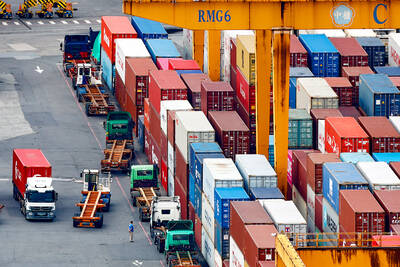
LOPSIDED DEVELOPMENT: While AI firms are riding the wave as far it can take them, traditional industries and their workers are not floated by the same flood While Taiwan is benefiting from a global artificial intelligence (AI) boom, many traditional industries have seen little of the benefit, widening the country’s “K-shaped” economic divide, an economist said. A “K-shaped” economy is one in which some sectors expand rapidly while others struggle, head of the commerce development and strategy research division at the Commerce Development Research Institute Ju Haw (朱浩) said in an interview. In Taiwan’s case, high-tech and AI-related industries have continued to grow while traditional industries have come under increasing pressure, he said. AI development has created crowding-out effects, as large high-tech firms generating strong profits are better able

Artificial intelligence (AI) requires safeguards that go beyond self-regulation, Microsoft Corp cofounder Bill Gates said in an interview that aired on Sunday, calling for legislation to be passed in US Congress. “You need law enforcement and the politicians to get into the discussion about what safeguards and monitoring look like,” Gates said in a taped interview on NBC’s Meet the Press program. “And that has to be a required thing.” A sudden groundswell has risen in favor of federal intervention after OpenAI in July said that an autonomous AI agent went rogue during a security test and hacked into another company, subverting

BOOMING BUSINESS: Memory supply constraints would be even more severe in 2027 and 2028, prompting customers to sign long-term supply agreements, Micron said Micron Memory Taiwan Co (台灣美光) yesterday said it is accelerating memorychip capacity expansion amid growing artificial intelligence (AI)-driven demand, with its accumulated investment in Taiwan reaching NT$1.6 trillion (US$50.2 billion) as of June. The company’s investment in Taiwan has surged over the past four years, with recent spending equaling the total invested over the past 25 years, Micron Taiwan chairman Donghui Lu (盧東暉) told a media briefing in Taipei. “The launch of ChatGPT and the outbreak of COVID triggered increasing demand for memory chips. Since then, demand has gathered pace rapidly, with only a brief pause in 2023 when a major downturn”

Apple Inc is set to sell about 6 million units of the iPhone Duo this year, Counterpoint Research said, offering the first estimate for how the company’s inaugural foldable device would fare. The figure, more typical of the niche foldable segment than Apple’s usual smartphone sales, is contingent on how well the company ramps up production of the new hardware, Counterpoint senior analyst Ivan Lam (林科宇) said. Priced at US$1,999 and set for a release this month, the iPhone Duo sits atop the Apple lineup and carries industry wide hopes for stoking greater interest and sales of foldables. Market researcher IDC Corp


 RSS
RSS