

Engineer Rinzin Galley stands on a platform overlooking a former military shooting range on the edge of Bhutan’s capital, Thimphu, now home to a field of solar panels.
With abundant waterways, Bhutan has long relied on hydroelectric power to meet its electricity needs and stay carbon negative.
However, demand is growing, and in winter, when rivers run low before the mountain melt arrives, Bhutan already relies on imported Indian electricity.
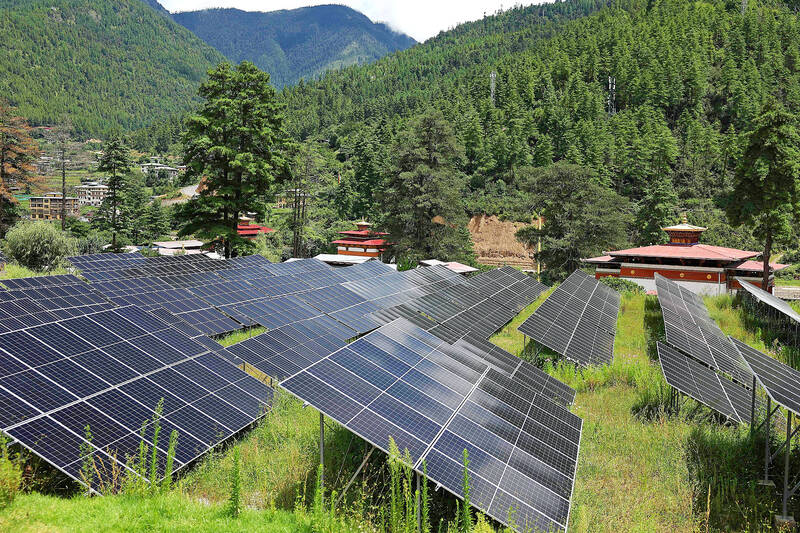
Photo: AFP
“Solar projects are booming,” said Rinzin, senior engineer at Norion Renewable Energy.
The company’s biggest project to date is the Dechencholing solar farm on former military land, with an installed capacity of 4.45 megawatts (MW).
Dechencholing is one of several solar fields developed in recent years, including the country’s first mega project — Sephu, with capacity of more than 22MW.
That is relatively modest, especially compared with the vast solar fields installed in neighboring China, but it represents a new direction for Bhutan, where hydropower exports account for up to 15 percent of GDP, according to the World Bank.
“Our plans are to develop about 5,000 megawatts,” said Chhewang Rinzin, managing director of Druk Green Power Corp, the country’s generation utility.
Bhutan can generate about 3,700MW from hydro, but that capacity falls by about 80 percent during the winter, he said.
Winter demand has increased to 1,500MW from 400MW, creating a significant shortfall being met by electricity imports from India.
Officials attribute part of the growing demand to a construction boom, but Bhutan has also bet on bitcoin mining to boost revenue. A planned special economic zone known as the Gelephu Mindfulness City is expected to host energy-hungry data centers.
The problem was already clear in 2008, when a goal of generating 10,000MW from hydropower by 2020 was agreed.
However, the plan ran into a series of obstacles, including financing.
“When you’re looking at constructing 10,000 megawatts in hydropower capacity and each megawatt probably costs you about [US]$1.5 million ... for a small economy like ourselves, that’s quite difficult,” Chhewang said.
Solutions have included liberalizing foreign investment rules and increasing solar targets in the energy mix.
The country now aims for 25,000MW by 2040, with solar accounting for one-fifth of that.
Finding sufficient space for projects is challenging given Bhutan’s largely mountainous terrain.
“When we do solar projects on the ground mount, it takes a huge amount of area to get certain capacity,” Rinzin said.
The country’s high altitudes, circuitous routes and roads frequently damaged by landslides pose further problems.
Part of the push has involved training up a corps of solar engineers, including through the De-suung royal skilling initiative.
Norion has trained about 450 De-suung volunteers “to build in-house capacity in the country,” Rinzin said.
Several dozen work at Norion, which has a goal of installing 30MW of solar by next year, much of it on rooftops.
Rooftop solar is now a common sight in Thimphu on government buildings and businesses, but the incentives for individual consumers are still slim.
Electricity is comparatively cheap in Bhutan and installing solar remains expensive.
Om Pradhan, a former minister and ambassador, had long advocated for solar in Bhutan and was keen to install panels at home.
“I thought that firstly it would benefit me personally, in the sense that my electricity bills would go down,” the 79-year-old former minister for trade and industries told reporters. “The second thing is that I’ve always been an advocate for solar power.”
However, the 600,000 ngultrums (US$6,300) it cost him to install the system remains far out of reach for most Bhutanese.
“Many people calculate that if you put that money in the bank, the interest would pay your electricity bills,” he said.
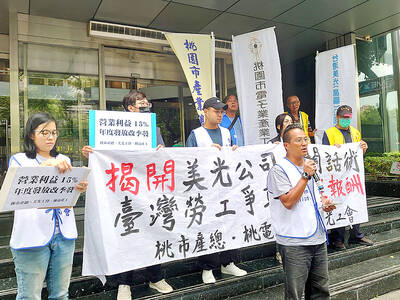
UNION DETERMINATION: Rejecting an offer for a one-time payout as an attempt to influence opinion, the union said a strike at the memory chip manufacturer is possible The Micron Taiwan workers’ union yesterday rejected a one-time payout unveiled by US-based Micron Technology Inc last week, saying it wants a long-term mechanism under which employees would share 15 percent of the company’s operating profits. While the union and the company are still in talks over the dispute, the reward package was proposed unilaterally by the employer without reaching an agreement with the union, union head Jerry Lin (林哲瑞) told reporters. Lin said he suspected the company was seeking to influence public opinion with the move. On Friday last week, Micron announced a reward package under which employees in Taiwan would receive
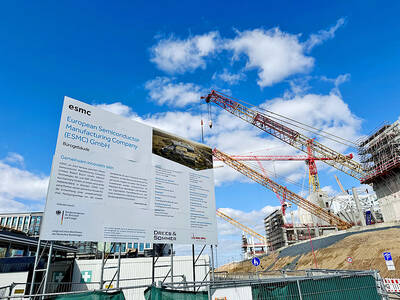
BUILDER’s RITES: The topping out ceremony is held when a project being built has its highest point laid out, a sure sign that TSMC’s European project is making solid progress A “topping out” ceremony was held on Monday at a plant under construction in Germany by Taiwan Semiconductor Manufacturing Co (TSMC, 台積電), indicating that the fab is progressing as planned and within budget, the head of a joint-venture company in charge of the project said. A topping out ceremony is the construction milestone of laying the final beam or structural piece at the highest point of a building, and it honors the construction crew, architects and engineers. European Semiconductor Manufacturing Co (ESMC) president Christian Koitzsch said that about 2,000 workers from 106 countries are working around the clock at the site in

SOME CUSHION: Taiwan’s GDP is forecast to grow more than 11 percent this year, so the economy should be able to absorb the impact of a rate hike, an expert said With domestic inflation topping the 2 percent alert level for a fourth consecutive month last month and several major central banks around the world raising their key interest rates, Taiwan’s central bank is facing growing pressure to raise rates at its quarterly policymaking meeting on Thursday, economists said. At its June meeting, the central bank left interest rates unchanged for the ninth consecutive quarter, with the discount rate at 2 percent. Central Bank Governor Yang Chin-long (楊金龍) had said that the bank maintained a somewhat hawkish stance, with two board directors voicing support for a rate hike at the meeting. Cathay United

APPEAL: Any agreement to produce advanced memory such as HBM or DRAM could run into opposition from Seoul as those technologies are sensitive, sources said South Korea’s SK Hynix Inc is in talks with Intel Corp about a deal that would see it manufacture memory chips on US soil for the first time, three people familiar with the discussions said. Under one potential scenario, SK Hynix would lease part of Intel’s long-planned chipmaking facility in Ohio, they said. Under another scenario, it could form a venture with Intel and major cloud firms that are keen to lock in memory supplies, two of the people said. A deal would relieve pressure on Intel, which has been struggling, and mark a big win for US President Donald


 RSS
RSS