

Micron Technology Inc’s labor unions in Taiwan said yesterday that they were moving toward possible strike action unless the US memory maker overhauls its bonus system and shares more of its profits with employees.
The unions, representing Micron workers in Taoyuan and Taichung, said in a written response to Reuters that they had nearly 10,000 members among Micron’s roughly 15,000 employees in the two cities.
More than 80 percent of members who took part in an internal online survey last month backed strike action, they said.
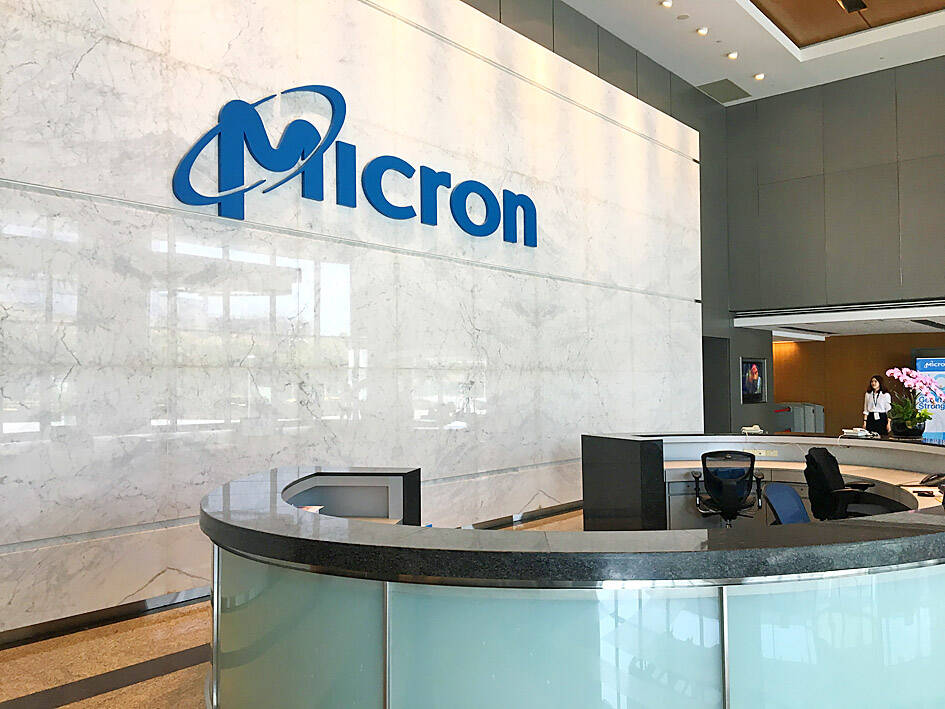
Photo: CNA
Micron’s Taiwan office said in response to a request for comment that this year’s performance-bonus payout would be the highest in the company’s history.
It said it would continue to engage with employees through existing channels while respecting applicable legal processes.
The strike threat comes as booming demand for memory chips used in artificial intelligence (AI) hardware has tightened global supply and lifted profits across the sector.
Micron, the world’s third-largest memory maker, reported record revenue of US$41.46 billion and net income of US$28.24 billion for its fiscal third quarter ended on May 28, as demand for its products surged. The company’s market value was about US$1.10 trillion yesterday.
A strike at Micron would be highly disruptive because Taiwan is the company’s largest manufacturing base, according to authorities in Taipei. They say Micron has invested NT$1.4 trillion (US$43.9 billion) in the island and produces DRAM and high-bandwidth memory chips there.
The government-run Central Taiwan Science Park (中部科學園區)administration said last month it was closely monitoring the dispute and had assigned staff to help facilitate contacts between Micron and the unions.
It said a strike could affect workers’ livelihoods, Micron’s operations and potentially Taiwan’s semiconductor supply chain and wider economy, adding that it could launch labor-management negotiations or mediation if needed.
The dispute echoes a showdown at Samsung Electronics Co in South Korea, where a planned 18-day strike involving as many as 48,000 union members was called off in May after last-minute negotiations.
That deal created a special bonus pool worth 10.5 percent of the chip division’s operating profit, subject to profitability targets.
Micron’s Taiwanese unions said profit-sharing arrangements at Samsung and SK Hynix Inc had widened the gap between Micron workers and their South Korean counterparts.
For this fiscal year, the unions are seeking an additional one-off bonus payment, arguing that Micron’s existing Incentive Pay Plan (IPP) does not adequately reflect the company’s profitability.
The unions said their proposal would amount to about 83 months’ salary for each Taiwan-based employee.
From next fiscal year, they want the IPP replaced with a system that allocates 15 percent of operating profit to bonuses and distributes payments quarterly rather than annually.
Micron’s IPP determines annual bonuses using company and individual performance measures. The unions said the company had not fully explained how its company-performance metric was calculated and argued that it appeared to track revenue growth more closely than profit.
The unions said Micron had indicated it would keep the existing IPP for this year’s bonus payments while delaying negotiations.
Micron said its compensation structure differs from the profit-sharing model sought by the unions. According to the company, employee pay packages include base salary, annual performance incentives, operational bonuses and equity programs, including stock-purchase and restricted-stock plans.

Silicon photonics would play a dominant role next year and make chip-level co-packaged optics (CPO) packaging possible, Taiwan Semiconductor Manufacturing Co (TSMC, 台積電) said yesterday. “For years, critics questioned the reliability of CPO. The doubts are being thoroughly dismantled by real-world data and market validation,” TSMC vice president of advanced packaging technology development K.C. Hsu (徐國晉) said at a SEMI forum in Taipei. The company is on track to enter production of CPO later this year, Hsu said in another forum arranged by Imec in Taipei yesterday, about four months after TSMC announced its progress in CPO development in May.
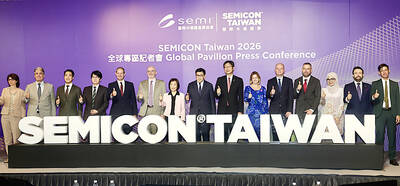
EXPANDING: Firms are accelerating commercialization of the technologies as the industry moves beyond chip-level speeds to upgrading rack-to-rack links, SEMI said Silicon photonics and copackaged optics (CPO), technologies seen as critical to meeting the surging bandwidth demands of artificial intelligence (AI) infrastructure, would be among the main themes at the Semicon Taiwan trade show, which opens on Wednesday, event organizer SEMI said yesterday. The forum runs until Friday at the Taipei Nangang Exhibition Center, with technical forums beginning today. The event is expected to set a record in terms of the number of participants, SEMI said, projecting more than 1,300 exhibitors from 65 countries across 4,300 booths and more than 100,000 attendees. Optical interconnects underpinning AI infrastructure would be one of the highlights, with

In China’s hilly Guizhou Province, a cluster of European-style buildings complete with clock tower and multi-arched bridge emits a low, permanent hum — a clue to its unexpected identity as tech giant Huawei’s largest data center. The town-like complex is unique in design, but not in its placement. Dozens of data centers have been constructed in the southwestern province in the past few years. They are part of a government strategy that has seen much of the digital infrastructure for breakneck artificial intelligence (AI) development across China’s eastern seaboard established in the country’s less populated, rural west. The build-out is ongoing. China
Taiwan Semiconductor Manufacturing Co (TSMC, 台積電) has increased its second-quarter employee bonuses by more than 50 percent from a year earlier, as the world’s largest contract chipmaker posted record earnings in the three-month period. TSMC distributed its second-quarter bonuses to employees on Friday. Employee bonuses for the April-to-June period totaled NT$36 billion (US$1.14 billion), the chipmaker’s financial data showed. During the period, TSMC posted NT$706.56 billion in net profit, up 77.4 percent from a year earlier and 23.4 percent from a quarter earlier. Second-quarter earnings per share (EPS) rose to NT$27.25, compared with NT$15.36 a year earlier and NT$22.08 in the first


 RSS
RSS