

In China’s hilly Guizhou Province, a cluster of European-style buildings complete with clock tower and multi-arched bridge emits a low, permanent hum — a clue to its unexpected identity as tech giant Huawei’s largest data center.
The town-like complex is unique in design, but not in its placement. Dozens of data centers have been constructed in the southwestern province in the past few years.
They are part of a government strategy that has seen much of the digital infrastructure for breakneck artificial intelligence (AI) development across China’s eastern seaboard established in the country’s less populated, rural west.
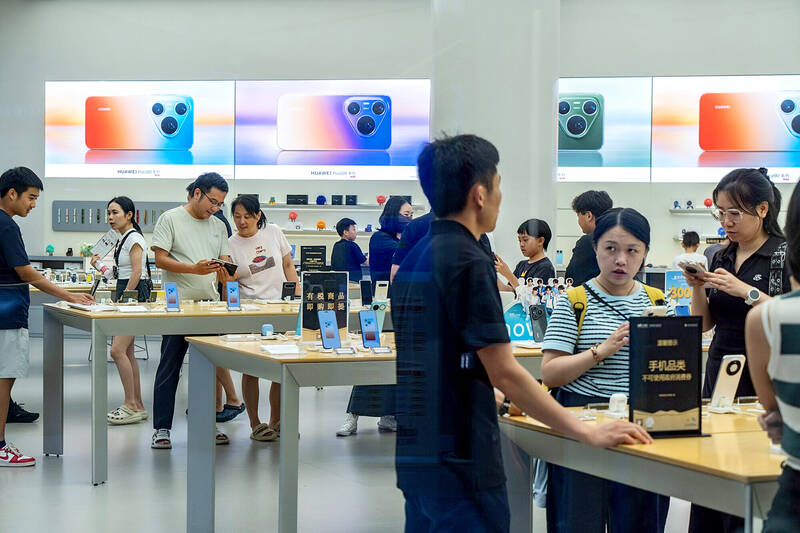
Photo: Bloomberg
The build-out is ongoing. China is on course to nearly double its data center capacity within the next five years, as a tech race with the US intensifies and countries everywhere try to swerve a computing crunch that could stymie AI expansion.
The projects have transformed some places — such as Guian New Area, where the Huawei data center and others are located.
“It used to be a barren mountain, but since the area has developed, transportation has become more convenient, trade has picked up, business opportunities have emerged,” local shopkeeper Shu Peihua said.
When AFP visited last month, street vendors were catering to data center workers on their lunch break near a roadside banner calling for “promoting high-quality development,” a government tech policy catchphrase.
In Europe and the US, data center construction has often been met with resistance from local communities citing concerns around energy prices, as well as environmental issues such as water usage and noise.
However, dissent in China is tightly controlled, especially around central government policy.
Still, Guian residents who spoke to AFP were positive about the changes to their area.
A vendor selling savory pancakes, who did not give his name, said two universities had been established since the facilities were built.
Another local, Li Xixiu, said that the main road had been developed because of the centers, which in general had “really boosted the economy of this entire area.”
“All the villagers in our neighborhood now find jobs nearby, unlike before, when they had to go to other places,” Li said.
In 2021, the government gave its strategy a name: Eastern Data Western Computing.
The logic of construction in Guizhou, with its cooler climate, abundant renewable energy and empty space, is multifaceted. AI processing is extremely energy intensive, and China has demanded that data centers draw 80 percent of their power from renewable sources by the end of this decade.
That makes regions such as Guizhou and Inner Mongolia, which have massively expanded renewable capacity such as solar and wind, ideal for operators looking to meet those commitments, Rystad Energy senior analyst Simeng Deng said.
Energy-guzzling server farms could also help solve renewables’ issue of curtailment, or the over-production of energy.
The data centers “can be an engine to digest or absorb the surplus of renewable power generation,” Deng said.
Developing previously neglected parts of the countryside is another potential benefit.
Despite the enthusiasm of the locals, some researchers question the overall economic gains to host regions.
Data centers do not necessarily create a “huge spillover effect” on local jobs, said Andrew Stokols from Singapore Management University.
“The hope is that you can use data centers as an engine for broader digital development... bringing in industries that will come in around data centers,” he said.
However, in China and elsewhere, “immediate benefits have been elusive.”
Guizhou has averaged an annual GDP growth rate of 7.4 percent over the past decade, but its wage growth over the same period was second to last nationwide, the Taiwan-based Research Institute for Democracy, Society and Emerging Technology (DSET) said.
“This contrast suggests that while data centers drive heavy investment in land and equipment, their impact on boosting local per capita income remains limited,” DSET researchers Cartus Bo-Xiang You and Angela Glowacki said.
Massive investment in infrastructure, coupled with policy incentives to attract data center builders, have earned Guizhou one of the highest debt burdens in the country.
In 2024, Guizhou ranked 30th among Chinese provinces for its debt-to-revenue ratio, a DSET report showed, and 27th for its debt-to-GDP ratio.
However, the demand for data processing capacity as countries scramble for technological supremacy means the building would continue.
Even before ChatGPT heralded the beginning of the AI boom, Chinese policy documents were “talking about the idea that computing power is correlated with national power,” Stokols said.
“It’s essential for national competitiveness in the age of digital technology... the AI competition has accelerated that,” he added.

HAND-IN-HAND: Nvidia’s inability to hold the line on prices reflects how much leverage memorychip makers have amid the surge in demand for AI infrastructure Some of Nvidia Corp’s biggest customers have been told that the prices of servers containing its artificial intelligence (AI) chips are going up more than 15 percent in many cases with memory costs soaring. The price hikes would go into effect on systems shipped early next year and impact systems including those with the flagship Vera Rubin and Grace Blackwell chips, people familiar with the process said on condition of anonymity. The increases would depend on the generation of Nvidia chips and the memory configurations, they said. Companies who build the servers under contract for large data center operators such as Microsoft
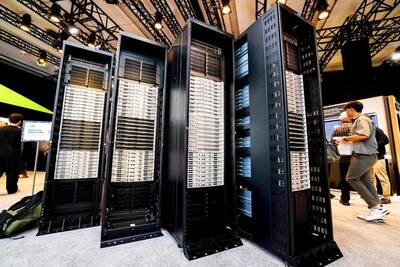
AM Intelligence, an Indian artificial intelligence (AI) infrastructure company, has ordered 9,000 Nvidia Corp Vera Rubin systems, seeking to become one of the first adopters of the advanced computing platform in Asia. Servers equipped with the rack-scale systems are slated to come online next year in southern India, the Hyderabad-based company said in a statement yesterday. Customers include major cloud service providers, AI labs and organizations aiming to develop homegrown Indian AI models, it said. Supplies of high-end Nvidia compute clusters remain tight. Demand from data centers and companies such as Microsoft Corp, Alphabet Inc’s Google and Amazon.com Inc to train AI models

The market debut of artificial intelligence (AI) start-up Anthropic PBC, a chief rival to OpenAI, could break the record set by Space Exploration Technologies Corp (SpaceX), US media have reported. Businessman Elon Musk’s SpaceX went public in June at a value of US$1.77 trillion and raised US$85.7 billion in its blockbuster initial public offering (IPO), the largest in history. Anthropic, maker of the Claude AI models, “expects to match or beat the size” of SpaceX’s deal, Bloomberg reported. The company’s bankers have told potential investors it could seek to raise “more than US$100 billion” in its IPO, which could put the company’s

Xiaomi Corp (小米) has launched a mobile processor for its marquee devices, putting pressure on Qualcomm Inc and MediaTek Inc (聯發科), which for years supplied the key component to the Chinese company. The Xring O3 system-on-a-chip advances Xiaomi’s in-house semiconductor design efforts with more power-efficient image processing and better artificial intelligence capabilities, the Beijing-based company said in a post on Sina Weibo yesterday. The company’s new silicon is made using a 3-nanometer fabrication process, Xiaomi founder Lei Jun (雷軍) said in a WeChat post . That is closer to the node used for Apple Inc’s most recent A19 Pro chips and well ahead


 RSS
RSS