

Some of Nvidia Corp’s biggest customers have been told that the prices of servers containing its artificial intelligence (AI) chips are going up more than 15 percent in many cases with memory costs soaring.
The price hikes would go into effect on systems shipped early next year and impact systems including those with the flagship Vera Rubin and Grace Blackwell chips, people familiar with the process said on condition of anonymity.
The increases would depend on the generation of Nvidia chips and the memory configurations, they said.
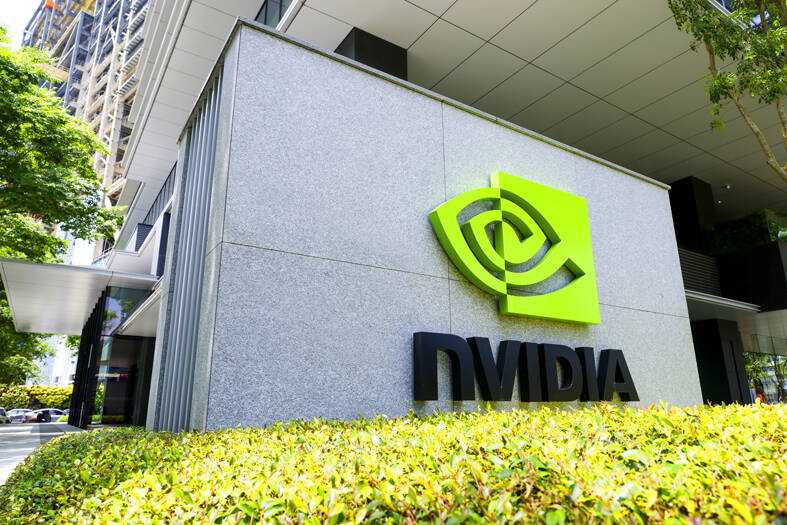
Photo: Ritchie B. Tongo, EPA
Companies who build the servers under contract for large data center operators such as Microsoft Corp, Alphabet Inc’s Google and Oracle Corp have notified their customers of the forthcoming increases, the people said.
The inability of the industry’s most dominant company to hold the line on prices or absorb rising costs shows how much leverage makers of memory chips — Samsung Electronics Co, SK Hynix Inc and Micron Technology Inc — have amid a surge in demand for AI infrastructure.
Major technology companies including Apple Inc and Qualcomm Inc have said they have been forced to charge more for their products because of chip shortages.
Nvidia’s accelerator processors are the heart of computers that create and run AI software. Their effectiveness depends on how much DRAM they are paired with. The two South Korean companies and Micron account for most of the world’s production of that type of chip. While they have been increasing output, they still have not caught up with surging demand.
Nvidia is one of the most profitable companies in semiconductors. It is able to charge tens of thousands of dollars per chip because supply — from contract manufacturer Taiwan Semiconductor Manufacturing Co (台積電) — still cannot meet runaway demand.
Nvidia has also raised prices for its gaming-oriented PC graphics cards, Tom’s Hardware reported earlier this month.
How Nvidia’s customers react to the move and whether it would create an opening for its competitors would likely depend on whether they are able to secure enough memory themselves.
Major customers such as Amazon, Microsoft, Google and Meta are all pursuing their own in-house chip programs, but are still dependent on purchases from Nvidia for their data center build-outs. Their ability to push forward with greater independence would also depend on their access to supply from Samsung, SK Hynix and Micron.
The price increases are also likely to add complexity to the industry’s massive AI data center build-out ambitions. Project delays, labor shortages, tightening capital markets and community resistance to developments have already complicated many plans.
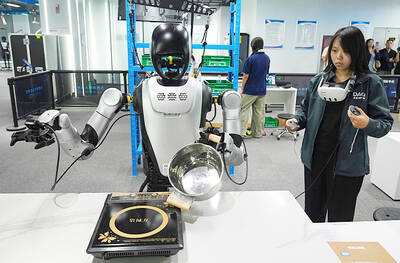
Taiwan and other technology democracies have a "golden but narrowing" three-to-five-year window to lay the foundations for an advanced robotics supply chain outside China, particularly for humanoid robots, a Taiwan-based researcher said yesterday. A report released on Monday by the Research Institute for Democracy, Society and Emerging Technology (DSET) examines China-West competition in physical artificial intelligence (AI) and Taiwan’s potential role in developing alternatives to Chinese robot supply chains. Humanoid robots remain unproven, meaning China’s lead in shipments currently has a limited impact on the real economy, Nathanael Cheng (鄭秉信), a policy analyst in the DSET Economic Security Program, said in a
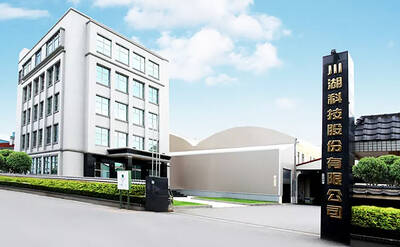
Shares in King Slide Works Co (川湖科技), a supplier of rail kits used in servers, rose by the 10 percent daily limit to close at a record high of NT$13,750 yesterday, making the company’s founder and chairman Lin Tsung-chi (林聰吉) Taiwan’s richest person for the time being. According to Forbes’ real-time billionaires list, Lin’s net worth increased by US$1.8 billion to US$19.5 billion yesterday, surpassing Yageo Corp (國巨) founder and chairman Pierre Chen (陳泰銘), who has a net worth of US$17.4 billion, to become the richest person in Taiwan and rank 140th globally. The stock’s rally came as the company on Friday
Outbound investments approved by Taiwan’s government surged more than 200 percent from the year before during the January to July period largely due to Taiwan Semiconductor Manufacturing Co (TSMC, 台積電) spending heavily overseas, the Ministry of Economic Affairs reported on Monday. The Department of Investment Review approved US$61.26 billion of outbound investment in 395 applications during the first seven months of this year, up 208.43 percent from a year earlier, the ministry said in a statement. Significant growth came after TSMC, the world’s largest contract chipmaker, secured approval to raise capital investments by US$20 billion in its US subsidiary TSMC Arizona Corp,

PROFITABLE TIMES: The savings, which were at NT$4 trillion just two years ago, are now projected to crack NT$11 trillion next year as the AI boom drives meteoric growth Taiwan’s excess savings are expected to reach a record NT$11 trillion (US$345 billion) next year, as the artificial intelligence (AI) boom boosts the country’s exports and current account surplus, the Directorate General of Budget, Accounting and Statistics (DGBAS) said. With excess savings expected to reach a record high, the excess savings rate is forecast to rise to a new high of 29.49 percent next year, up from an estimated 25.13 percent for this year, DGBAS data showed. Excess savings refers to the difference between a country’s gross domestic savings and gross domestic investments and largely serves as an indicator of idle funds. From


 RSS
RSS