

Artificial intelligence (AI) is reshaping workplaces rather than simply eliminating jobs, with companies across the Asia-Pacific region expecting their workforces to grow even as they struggle to find skilled workers needed to drive AI adoption, Jones Lang LaSalle said in a report.
About 61 percent of senior executives in the region expect employee numbers to continue rising, despite concerns that AI would trigger widespread job losses, the property consultancy said.
Companies at the forefront of the technology shift are instead increasing investment in physical workplaces to support higher-value work, collaboration and productivity, Jones Lang LaSalle Taiwan managing director Kevin Hou (侯文信) said.
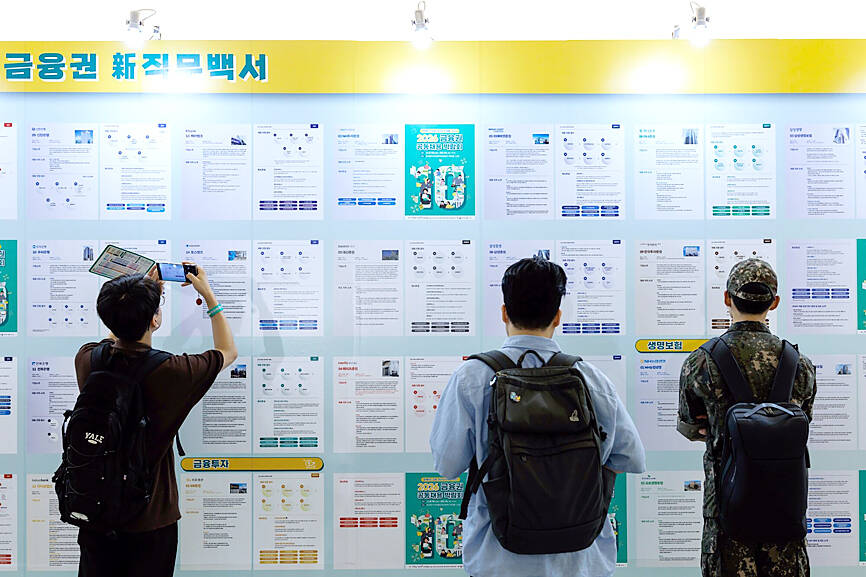
Photo: Bloomberg
“AI will not necessarily reduce demand for physical office space,” Hou said. “Companies leading the AI transition are upgrading workplaces as technology shifts employees toward tasks requiring deeper thinking, concentration and interaction.”
The findings are from Jones Lang LaSalle’s global survey on workplace trends, which polled more than 2,200 senior executives and corporate real-estate leaders across 21 countries.
About 78 percent of respondents expected AI to significantly change their corporate real-estate strategies, but only 31 percent have begun planning workplaces designed for human-machine collaboration, the survey showed.
Just 15 percent have reached an advanced stage of AI adoption, it showed.
The gap between expectations and implementation is emerging as a key challenge as companies balance technology investment against talent shortages, budgets and organizational change, Jones Lang LaSalle said.
For the first time in the survey’s history, talent and skills shortages have overtaken budget constraints as the biggest obstacle to AI transformation.
Globally, 36 percent of respondents cited a lack of skills in AI, data analytics and emerging technologies as a major barrier, the survey said.
The problem is more acute in the Asia-Pacific region, where 42 percent identified AI skills shortages as their biggest constraint, the highest share among regions, it said.
Almost half of companies in the region expect AI-driven demand for employee retraining to further worsen talent shortages over the next three to five years, it said.
The skills crunch is particularly significant as firms in the Asia-Pacific area lead globally in applying AI to corporate real-estate strategy, property-portfolio optimization and technology management, Jones Lang LaSalle said.
AI is also creating new challenges for office managers. As companies increase technology investment to boost productivity, 46 percent of respondents now rank employee productivity as their most important corporate real-estate performance measure, ahead of traditional cost control, the survey said.
Technology-related risks are mounting. Information security and data governance were cited by 47 percent of respondents as a major risk, followed by disruption from AI and emerging technologies at 41 percent, and uncertainty over future office-space demand at 40 percent, it said.
In the Asia-Pacific region, 44 percent viewed technology and AI as a major risk, the highest share globally.
Rather than trying to predict exactly how AI will change headcounts and office demand, companies are being pushed to build flexibility into real-estate strategies through flexible leases, multiple locations and adaptable workspaces, it said.
The shift suggests the office is not disappearing in the AI era, it said.
Instead, its role is evolving as companies seek environments where employees can work more effectively alongside increasingly capable machines, it added.

RIVAL BLOCS: Kazakhstan has signed on to the US’ and China’s AI frameworks; a US official said it was difficult to see how a country can be trusted while in a competing pact The US is preparing to tell dozens of countries they must pick sides in the artificial intelligence (AI) race with China, warning they would be excluded from a US-led AI coalition if they also sign up for Beijing’s competing framework, according to a US official and an internal draft reviewed by Reuters. Washington last year launched the Pax Silica initiative aimed at securing supply chains for AI models, semiconductors and critical minerals, amid a fierce technology rivalry with Beijing. About two dozen countries have joined, including Kazakhstan, a key potential source of critical minerals that has also joined China’s coalition,
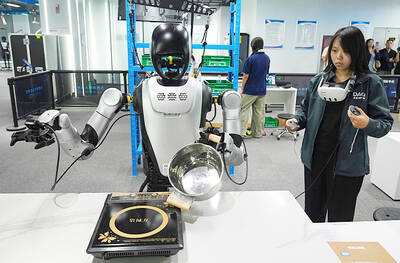
Taiwan and other technology democracies have a "golden but narrowing" three-to-five-year window to lay the foundations for an advanced robotics supply chain outside China, particularly for humanoid robots, a Taiwan-based researcher said yesterday. A report released on Monday by the Research Institute for Democracy, Society and Emerging Technology (DSET) examines China-West competition in physical artificial intelligence (AI) and Taiwan’s potential role in developing alternatives to Chinese robot supply chains. Humanoid robots remain unproven, meaning China’s lead in shipments currently has a limited impact on the real economy, Nathanael Cheng (鄭秉信), a policy analyst in the DSET Economic Security Program, said in a
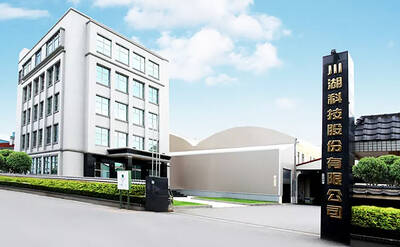
Shares in King Slide Works Co (川湖科技), a supplier of rail kits used in servers, rose by the 10 percent daily limit to close at a record high of NT$13,750 yesterday, making the company’s founder and chairman Lin Tsung-chi (林聰吉) Taiwan’s richest person for the time being. According to Forbes’ real-time billionaires list, Lin’s net worth increased by US$1.8 billion to US$19.5 billion yesterday, surpassing Yageo Corp (國巨) founder and chairman Pierre Chen (陳泰銘), who has a net worth of US$17.4 billion, to become the richest person in Taiwan and rank 140th globally. The stock’s rally came as the company on Friday
Outbound investments approved by Taiwan’s government surged more than 200 percent from the year before during the January to July period largely due to Taiwan Semiconductor Manufacturing Co (TSMC, 台積電) spending heavily overseas, the Ministry of Economic Affairs reported on Monday. The Department of Investment Review approved US$61.26 billion of outbound investment in 395 applications during the first seven months of this year, up 208.43 percent from a year earlier, the ministry said in a statement. Significant growth came after TSMC, the world’s largest contract chipmaker, secured approval to raise capital investments by US$20 billion in its US subsidiary TSMC Arizona Corp,


 RSS
RSS