

US Secretary of the Treasury Scott Bessent on Thursday said that he might further increase the US government’s repurchases of Treasuries, attempting to jawbone a government debt market that was beginning to balk after the previous day’s surprise plan to double buybacks.
Bessent, a former hedge fund manager with extensive experience in sovereign debt and currency markets, said the recent upswing in long-dated Treasury yields to near two-decade highs was unwarranted against the vibrancy of the US economy.
He also pointed to the plans of US President Donald Trump’s administration to curtail government spending that has driven the collective US IOU to the world north of US$40 trillion.
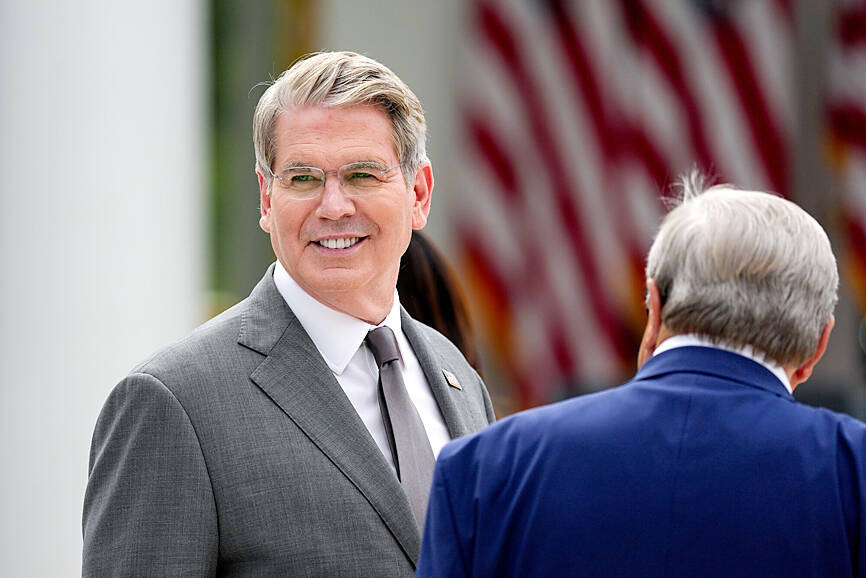
Photo: Bloomberg
In the latest of Bessent’s maneuvers, the Treasury on Wednesday announced that it would double the size of buybacks on longer-dated securities over the next quarter to at least US$4 billion per operation, a move that for one day at least brought the administration some relief from the high bond yields that are rapidly driving up federal debt service costs.
“We’re going to increase the size of the buyback,” Bessent said in a CNBC interview. “I would note that it could be more than the [US]$4 billion per issue.”
The 30-year yield dropped on Wednesday by the most in a day since October last year after Bessent’s tactic caught the market by surprise amid thin late-summer trading and liquidity conditions.
However, by Thursday half of that move was retraced and a brief lurch lower in yields on his comments to CNBC held only for a few moments.
The 30-year yield last traded at 5.24 percent, only about 10 basis points from its high point on Tuesday, when it struck the highest since June 2007.
Bessent, who earlier this month executed the first joint intervention in the Japanese yen in 15 years, told CNBC that his objective was to support liquidity in an area of the market that is thinly traded, especially in August, while having to compete with a large volume of corporate issuance at higher yields, including for artificial intelligence infrastructure.
“Part of it is signaling here, and to show that we believe that the yields don’t reflect the underlying fundamentals. This Iran conflict, we will get on the other side of this, we don’t know when,” Bessent said.
A day after total US public debt outstanding crossed the symbolic US$40 trillion threshold, Bessent said that he and White House budget director Russell Vought would be embarking on a new fiscal consolidation effort directed by Trump, and that combined with efforts to cut waste, fraud and abuse, savings of several hundred billion dollars could be found.
There was “nothing magic about the [US]$40 trillion figure” and the US would grow its way out of the debt, he said.
The deficit this year has been pushed up by refunds of Trump’s tariffs, which were declared illegal by the US Supreme Court — a phenomenon that would not be repeated next year, as new tariffs are being implemented under other trade laws that have withstood court challenges, he said.
Tariff revenues this year are expected to match those of last year, he said, without specifying whether he was referring to calendar or fiscal years.
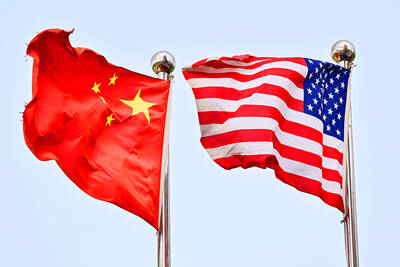
RIVAL BLOCS: Kazakhstan has signed on to the US’ and China’s AI frameworks; a US official said it was difficult to see how a country can be trusted while in a competing pact The US is preparing to tell dozens of countries they must pick sides in the artificial intelligence (AI) race with China, warning they would be excluded from a US-led AI coalition if they also sign up for Beijing’s competing framework, according to a US official and an internal draft reviewed by Reuters. Washington last year launched the Pax Silica initiative aimed at securing supply chains for AI models, semiconductors and critical minerals, amid a fierce technology rivalry with Beijing. About two dozen countries have joined, including Kazakhstan, a key potential source of critical minerals that has also joined China’s coalition,
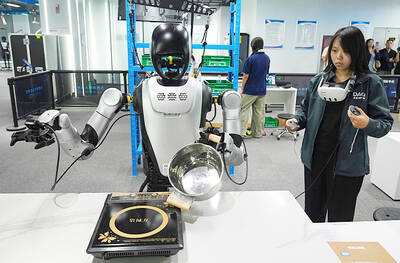
Taiwan and other technology democracies have a "golden but narrowing" three-to-five-year window to lay the foundations for an advanced robotics supply chain outside China, particularly for humanoid robots, a Taiwan-based researcher said yesterday. A report released on Monday by the Research Institute for Democracy, Society and Emerging Technology (DSET) examines China-West competition in physical artificial intelligence (AI) and Taiwan’s potential role in developing alternatives to Chinese robot supply chains. Humanoid robots remain unproven, meaning China’s lead in shipments currently has a limited impact on the real economy, Nathanael Cheng (鄭秉信), a policy analyst in the DSET Economic Security Program, said in a

Shares in King Slide Works Co (川湖科技), a supplier of rail kits used in servers, rose by the 10 percent daily limit to close at a record high of NT$13,750 yesterday, making the company’s founder and chairman Lin Tsung-chi (林聰吉) Taiwan’s richest person for the time being. According to Forbes’ real-time billionaires list, Lin’s net worth increased by US$1.8 billion to US$19.5 billion yesterday, surpassing Yageo Corp (國巨) founder and chairman Pierre Chen (陳泰銘), who has a net worth of US$17.4 billion, to become the richest person in Taiwan and rank 140th globally. The stock’s rally came as the company on Friday
Outbound investments approved by Taiwan’s government surged more than 200 percent from the year before during the January to July period largely due to Taiwan Semiconductor Manufacturing Co (TSMC, 台積電) spending heavily overseas, the Ministry of Economic Affairs reported on Monday. The Department of Investment Review approved US$61.26 billion of outbound investment in 395 applications during the first seven months of this year, up 208.43 percent from a year earlier, the ministry said in a statement. Significant growth came after TSMC, the world’s largest contract chipmaker, secured approval to raise capital investments by US$20 billion in its US subsidiary TSMC Arizona Corp,


 RSS
RSS