

Uninterruptible power supply (UPS) maker CyberPower Systems Inc (碩天科技) yesterday said that third-quarter revenue and profit are expected to surpass its second-quarter results and be the strongest quarter this year.
Growth would be driven by seasonal demand, including for UPS systems and data center power management products, particularly in the US market, CyberPower chairman Michael Ho (何濂洵) told an earnings conference in Taipei.
Revenue rose 13.9 percent in the second quarter to NT$3.34 billion (US$104.87 million) from the first quarter, while net profit surged 69.2 percent to NT$672.8 million, CyberPower said.

Photo: Meryl Kao, Taipei Times
While North America is expected to remain CyberPower’s largest revenue contributor this year, growth in Europe is accelerating, particularly in Italy, Denmark, Sweden, Norway and Finland, as the company’s expanded sales channels gradually bear fruit, Ho said.
The US, Canada and Mexico remained CyberPower’s largest market in the first half of this year, accounting for about 75 percent of its NT$6.27 billion in revenue in the first six months.
UPS systems accounted for 55 percent of CyberPower’s first-half revenue, followed by data center power management products at 37 percent, power protection and management devices at 6 percent and others at 2 percent, company data showed.
Its data center products are mainly single-phase and three-phase UPS systems, modular UPS systems, power distribution units, automatic transfer switches and battery management systems, Ho said.
The company also supplies standalone products, including single-phase and enterprise-grade UPS systems, he said.
As data center UPS products typically have higher specifications and margins, the company has stepped up investment in the segment and shifted its focus from standalone UPS products to total solutions, he said.
CyberPower sells its products mainly through distributors rather than signing large supply contracts directly with data center operators, Ho said.
Its distributors handle logistics and payments as they integrate CyberPower’s UPS products with servers, racks and other equipment to build complete solutions for end customers, he said.
Recent increases in component prices have prompted the company to raise prices in some markets, but the increases have yet to fully offset higher material costs, he said.
CyberPower has responded by securing components earlier, and seeking alternative suppliers and brands to avoid shipment disruptions, he said.
The company in January purchased a new plant and land in Cavite, the Philippines, with the new facility expected to be 2.5 to three times the size of its existing plant there, Ho said.
The new facility would provide additional capacity, with expansion plans focused there as well, he said.
About 30 to 40 percent of CyberPower’s products are made in China, with the remainder produced in the Philippines, Taiwan and Vietnam.
Net profit totaled NT$1.05 billion in the first half, up 142.4 percent year-on-year, or NT$11.12 per share, up from NT$4.59 a year earlier.
Gross margin rose to 58.67 percent last quarter from 53.53 percent a year earlier, supported by a NT$226 million refund of tariffs imposed by US legislation, Ho said.
Gross margin is expected to stay at about 56 percent this year, he said.
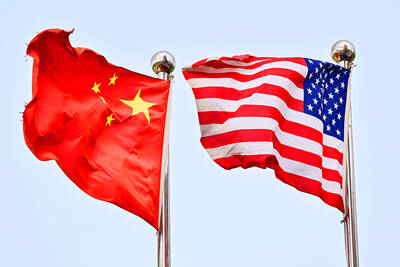
RIVAL BLOCS: Kazakhstan has signed on to the US’ and China’s AI frameworks; a US official said it was difficult to see how a country can be trusted while in a competing pact The US is preparing to tell dozens of countries they must pick sides in the artificial intelligence (AI) race with China, warning they would be excluded from a US-led AI coalition if they also sign up for Beijing’s competing framework, according to a US official and an internal draft reviewed by Reuters. Washington last year launched the Pax Silica initiative aimed at securing supply chains for AI models, semiconductors and critical minerals, amid a fierce technology rivalry with Beijing. About two dozen countries have joined, including Kazakhstan, a key potential source of critical minerals that has also joined China’s coalition,
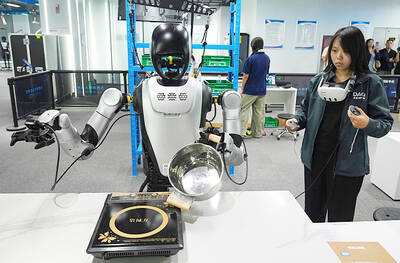
Taiwan and other technology democracies have a "golden but narrowing" three-to-five-year window to lay the foundations for an advanced robotics supply chain outside China, particularly for humanoid robots, a Taiwan-based researcher said yesterday. A report released on Monday by the Research Institute for Democracy, Society and Emerging Technology (DSET) examines China-West competition in physical artificial intelligence (AI) and Taiwan’s potential role in developing alternatives to Chinese robot supply chains. Humanoid robots remain unproven, meaning China’s lead in shipments currently has a limited impact on the real economy, Nathanael Cheng (鄭秉信), a policy analyst in the DSET Economic Security Program, said in a

Shares in King Slide Works Co (川湖科技), a supplier of rail kits used in servers, rose by the 10 percent daily limit to close at a record high of NT$13,750 yesterday, making the company’s founder and chairman Lin Tsung-chi (林聰吉) Taiwan’s richest person for the time being. According to Forbes’ real-time billionaires list, Lin’s net worth increased by US$1.8 billion to US$19.5 billion yesterday, surpassing Yageo Corp (國巨) founder and chairman Pierre Chen (陳泰銘), who has a net worth of US$17.4 billion, to become the richest person in Taiwan and rank 140th globally. The stock’s rally came as the company on Friday
Outbound investments approved by Taiwan’s government surged more than 200 percent from the year before during the January to July period largely due to Taiwan Semiconductor Manufacturing Co (TSMC, 台積電) spending heavily overseas, the Ministry of Economic Affairs reported on Monday. The Department of Investment Review approved US$61.26 billion of outbound investment in 395 applications during the first seven months of this year, up 208.43 percent from a year earlier, the ministry said in a statement. Significant growth came after TSMC, the world’s largest contract chipmaker, secured approval to raise capital investments by US$20 billion in its US subsidiary TSMC Arizona Corp,


 RSS
RSS