

Burgers are having a moment in China, with budget-conscious diners and smaller households turning the sandwich into one of the country’s hottest fast-food battlegrounds, drawing in everyone from global restaurant chains to hotpot operators and coffee brands.
Yum China Holdings Inc’s (百勝中國) Pizza Hut Burger Bar format, in which a burger counter operates alongside a Pizza Hut restaurant, expanded to more than 200 outlets in six months, the company said last month. It plans to grow the format to 500 to 600 outlets by the end of the year, affecting about 10 percent of its Pizza Hut store network.
The rush into burgers reflects broader shifts in China’s consumption habits. As households get smaller and economic uncertainty keeps spending in check, diners are favoring lower-cost, portable meals that offer convenience.
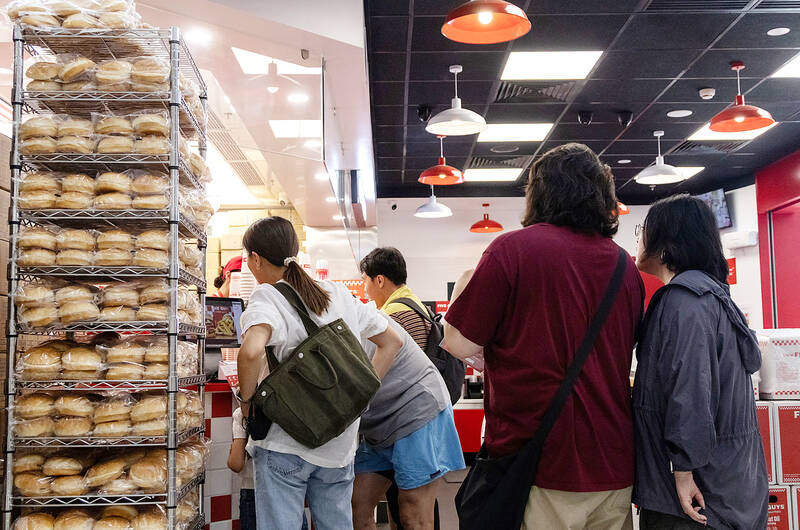
Photo: Maxim Shemetov, Reuters
That is turning burgers from a niche Western import, dominated by McDonald’s Corp, Yum China’s KFC and Burger King Co, into one of the most hotly contested arenas of China’s restaurant market as new brands race to cash in.
Last month, hotpot chain operator Haidilao International Holding Ltd (海底撈) entered the segment with Huanxianbao, or “Fresh Burger,” a chain selling burgers, as well as pizza, pasta and fried chicken. Shanghai Aiqia Catering Management Co’s (上海艾恰餐飲管理) coffee chain M Stand has opened burger-focused outlets in some cities.
China’s Western fast-food market was valued at 499.65 billion yuan (US$74.1 billion) last year and is expected to reach 587.09 billion yuan by next year, according to data provider iiMedia Research Group, despite some high-profile challenges for many global brands.
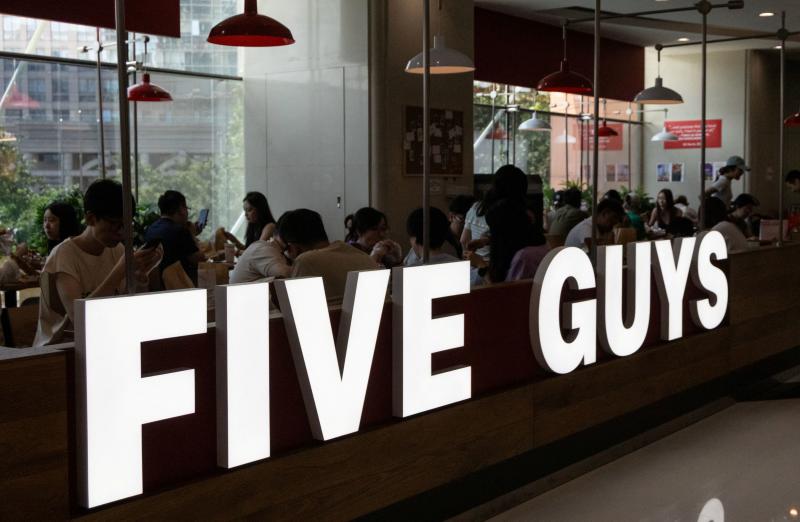
Photo: Maxim Shemetov, Reuters
Burgers topped consumer preferences, with 55 percent of respondents selecting them. While still a relatively small segment of China’s fast-food market, the burger category was worth US$18.4 billion last year and is projected to grow 8.7 percent annually through 2035, according to Emergen Research. Part of the appeal is economics.
As consumer spending remains cautious, burgers offer a lower-cost alternative to full-service restaurant meals while still serving as a substantial meal option, said Zhu Danpeng (朱丹蓬), a China food industry analyst. “It’s a good value-for-money choice,” Zhu said.
Wang Fang, a university student in Beijing, said burgers have become a go-to lunch option for her and her classmates because they are cheaper than ordering multiple dishes at a restaurant.
"With meat, vegetables and butter, it makes a very affordable balanced meal," she said.
The category aligns with changing demographics. Rising numbers of one-person households, smaller families and young urban workers have fueled demand for convenient individual meals, a trend Yum China says is creating opportunities across its brands.
Pizza Hut added burgers to its menu in 2024. By last year, burgers accounted for a mid-single-digit percentage of Pizza Hut sales, the company said, adding that it expects the category to generate more than 1 billion yuan in sales this year, or 5 percent to 6 percent of the brand’s revenue.
The company said burgers appeal to takeaway and delivery customers in China, where 43 percent of consumers order delivery at least once a week, compared with a global average of 23 percent, according to Euromonitor International.
The growing appetite is drawing players from across the industry. Domestic chains such as Fuzhou Tastien Catering Management Co’s (福州塔斯汀餐飲管理) Tasiting are competing with McDonald’s, KFC and Shake Shack Inc.
International brands are eager to grab a seat at the table.
When US fast-food chain operator Five Guys Enterprises LLC opened stores in Beijing this month, consumers waited more than two hours to be served. Wendy’s Co said in May it plans to enter China and open up to 1,000 franchised restaurants over the next decade.

E.Sun Financial Holding Co (玉山金控) is to formally merge with Mercuries Life Insurance Co (三商美邦人壽) on Sept. 1, creating Taiwan’s fifth-largest listed financial holding company by assets and paving the way for capital injections totaling NT$22 billion (US$683.91 million) to shore up the insurer’s finances, top executives said yesterday. “The first priority after the merger will be to bring the insurer back to health through capital injections,” E.Sun Financial chairman Joseph Huang (黃男州) told a news conference in Taipei ahead of a company earnings call. E.Sun would inject NT$16 billion into Mercuries Life next month, followed by another NT$6 billion next year,
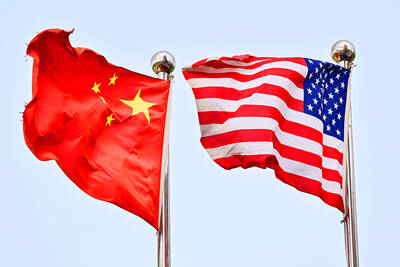
RIVAL BLOCS: Kazakhstan has signed on to the US’ and China’s AI frameworks; a US official said it was difficult to see how a country can be trusted while in a competing pact The US is preparing to tell dozens of countries they must pick sides in the artificial intelligence (AI) race with China, warning they would be excluded from a US-led AI coalition if they also sign up for Beijing’s competing framework, according to a US official and an internal draft reviewed by Reuters. Washington last year launched the Pax Silica initiative aimed at securing supply chains for AI models, semiconductors and critical minerals, amid a fierce technology rivalry with Beijing. About two dozen countries have joined, including Kazakhstan, a key potential source of critical minerals that has also joined China’s coalition,
Taiwan Semiconductor Manufacturing Co (TSMC, 台積電) yesterday said its board of directors has approved investment of ¥282 billion (US$1.77 billion) to form a joint venture with Sony Semiconductor Solutions Corp to develop and manufacture next-generation image sensors for smartphones in Japan. The joint venture, Advanced Vision Semiconductor Manufacturing Corp, would be sited in Koshi City, Kumamoto Prefecture, TSMC said in a statement. It should commence volume production in 2029, TSMC said. Sony Semiconductor would invest ¥465 billion in the joint venture through a combination of cash and assets, the statement said. These capital contributions are expected to be made in phases based
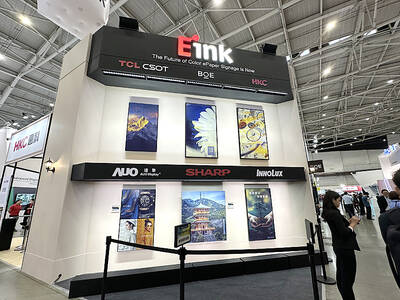
E-PAPER TRANSITION: Increasing memory prices have caused customers to postpone new product launches, with the firm expecting a later peak season this year E Ink Holdings Inc (元太科技), the world’s biggest e-paper display supplier, yesterday revised downward its revenue growth forecast for this year to between 10 and 15 percent, from the 20 to 25 percent it previously estimated, as surging memory prices are hurting demand for its e-readers and e-notes. The company had expected a transition from monochrome color e-paper displays to color displays used in e-readers and e-notes to continue this year. However, rapidly increasing memory prices have caused customers to postpone new product launches, while demand for models from previous generations has also dwindled due to higher prices, E Ink said. That created


 RSS
RSS