

Taiwan Power Co (Taipower, 台電) yesterday said it would support plans by local governments to establish artificial intelligence (AI) data center zones near power plants in northern Taiwan.
If local governments propose such plans, Taipower would work with them to develop the projects, but the state-run utility must assess whether the proposed sites could put too much pressure on local grids and substations, Taipower chairman Tseng Wen-sheng (曾文生) said ahead of a meeting of the legislature’s Economics Committee.
Taipower in September 2023 suspended new applications for data centers with electricity demand exceeding 5 megawatts (MW) north of Taoyuan following a surge in applications, fearing a severe power transmission bottleneck in northern Taiwan.
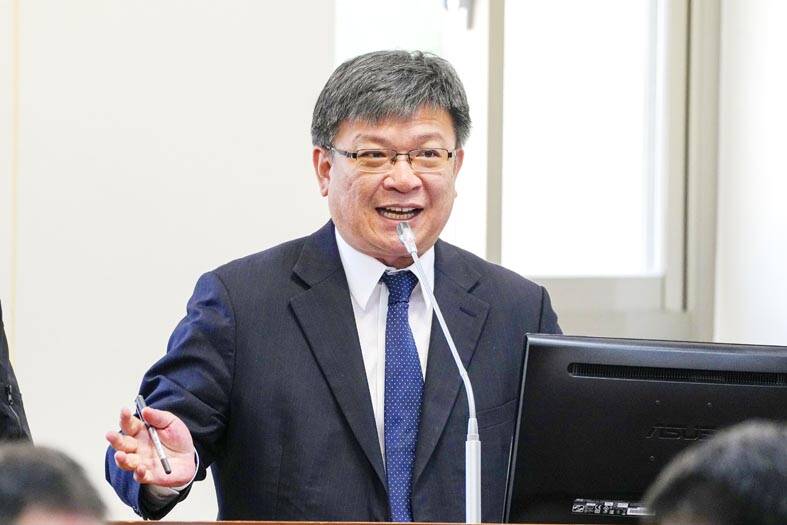
Photo: CNA
A 5MW data center draws as much electricity as the Shin Kong Life Tower near Taipei Railway Station, while Taipower’s headquarters uses only about 4MW, illustrating the scale of the power demand, Tseng said.
Governments globally usually require large-scale data centers to be near power plants and in some cases force them to generate their own electricity, he said.
Tseng’s remarks came amid reports that the Taoyuan City Government is planning a northern AI computing center near the Datan Power Plant (大潭電廠) in Guanyin District (觀音) to meet demand from businesses, which would require the removal of the 5MW ban.
On Monday, Minister of Economic Affairs Kung Ming-hsin (龔明鑫) inspected power infrastructure in Taoyuan.
The central government is willing to relax the ban, Kung said, but added that new data centers should, where possible, be near power plants.
The ministry would further discuss potential sites and power supply arrangements with Taipower, he said.
The outlook for power supply in northern Taiwan was uncertain in 2023, when three gas-fired generating units at the Datan Power Plant were still under construction and a redevelopment project at the Concord Power Plant (Hsieh-ho Power Plant, 協和電廠) in Keelung’s Zhongshan District (中山) had yet to clear its environmental impact assessment, Tseng said.
However, the power supply outlook has become clearer — with the additional units at Datan going online, while the Concord project cleared its environmental review and construction is set to begin — so Taipower has discussed the issue with the Taoyuan City Government, he said.
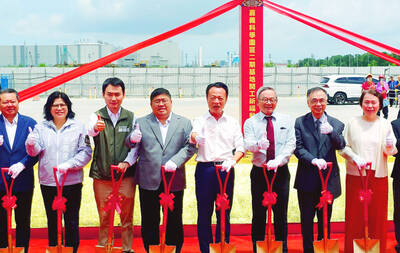
TECH CORRIDOR: The new Phase II site is expected to work with other facilities in the region and nation as TSMC looks to shape the future with its manufacturing Taiwan Semiconductor Manufacturing Co (TSMC, 台積電) would build three additional advanced packaging facilities in Phase II of the Chiayi Science Park (嘉義科學園區), National Science and Technology Council (NSTC) Minister Wu Cheng-wen (吳誠文) said yesterday. Speaking at the groundbreaking ceremony for the Phase II, Wu said the roughly 90-hectare site would be developed into an advanced packaging industry cluster led by TSMC. Two advanced packaging facilities at Phase I began mass production last month. Wu said that the Phase II development of the Chiayi Science Park would strengthen the resilience of the regional economy and help transform Chiayi County into a global production
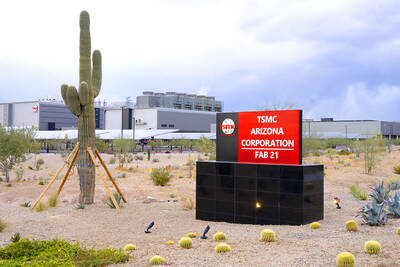
A growing nationwide shortage of high-skilled workers threatens to delay construction of billions of dollars in new semiconductor plants across the US and constrain future chip production unless the industry pools resources and the government keeps up funding, a new report said. The deficit is expected to be most acute in states such as Texas, California, Arizona, New York and Ohio, where many of the new facilities are being planned, according to new analysis including a survey of employers from McKinsey & Co, the chip industry group SEMI and the National Science Foundation. Altogether, the skilled labor deficit is projected to

Chinese authorities have held meetings with top tech firms over the past month about potentially restricting overseas access to China’s most advanced AI models, including those yet to be released, three people familiar with the discussions said. The talks follow a number of steps by Beijing to keep homegrown AI technology in the country and underscore how China, like the US, is now treating cutting-edge artificial intelligence as a critical national asset that needs controls. Companies present at the talks included tech giants Alibaba Group Holding Ltd (阿里巴巴) and ByteDance Ltd (字節跳動), as well as start-up Z.ai, formerly known as Zhipu AI
MOMENTUM: Second-quarter revenue reached NT$1.27 trillion as the June turnover surged, while TSMC’s 2nm process spending and US expansion remain focus points Taiwan Semiconductor Manufacturing Co (TSMC, 台積電) yesterday reported its highest quarterly sales amid strong global demand for artificial intelligence (AI) applications. The world’s largest contract chipmaker posted NT$1.27 trillion (US$39.5 billion) in consolidated revenue for the second quarter of this year, up 36 percent year-on-year and nearly 12 percent from a quarter earlier. The quarterly figure was bolstered by a very strong performance last month, when TSMC’s revenue was up 67.9 percent from a year earlier and rose 6.2 percent from a month earlier to NT$442.68 billion, a new monthly high, TSMC said in a statement. At its earnings conference in April, TSMC


 RSS
RSS