


The Ministry of Economic Affairs yesterday said it expects to help more than 20,000 companies adopt artificial intelligence (AI) technology by 2028, up from its previous target of 14,000 set in October last year when an industrial competitiveness task force was launched.
The ministry has helped 9,249 companies adopt AI since October last year, 93 percent of which are small or medium-sized enterprises, Industrial Development Administration Director-General Chiou Chyou-huey (邱求慧) told a news conference in Taipei.
Service-sector firms accounted for 60 percent of the total, led by the wholesale, retail and food service segments, while manufacturers made up the remaining 40 percent, mainly in the metal products and machinery sectors, Chiou said.
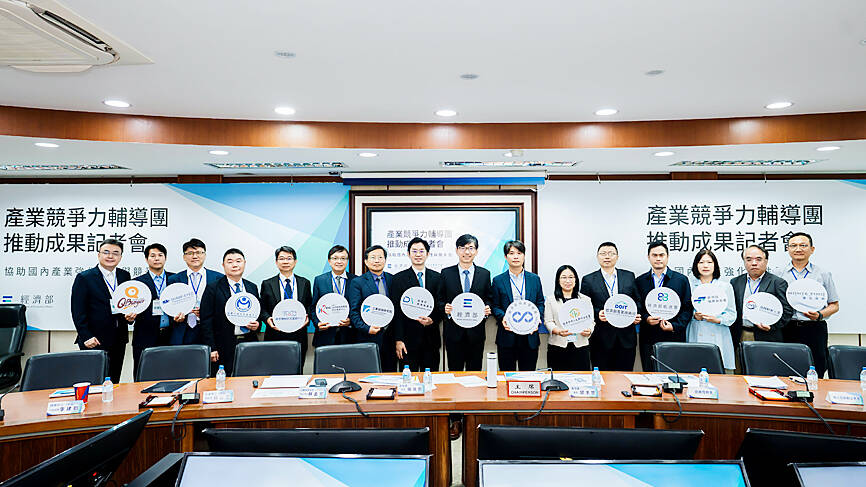
Photo courtesy of the Industrial Development Administration
Many small and medium-sized enterprises and traditional industries have struggled to adopt AI due to high costs and technical barriers, he said.
The ministry’s program helps firms undergo the AI transformation through a three-stage process, Chiou said.
The first stage provides diagnostic consulting to assess companies’ operational needs, with the government subsidizing NT$190,000 (US$5,904) of the cost and participating companies contributing NT$10,000, he said.
The second stage provides a grant of NT$100,000 for AI hardware and software deployment, along with NT$120,000 in training vouchers, he said.
The third stage offers research-and-development grants of up to NT$5 million per project, or NT$40 million for consortium projects, to help companies deepen AI adoption, he added.
Companies participating in the program have so far generated about NT$32.3 billion in output value by improving production processes, reducing defect rates and enhancing research and development efficiency, Chiou said.
A survey conducted by the Artificial Intelligence Foundation found that the overall AI adoption rate among the nation’s manufacturers and retailers has risen to 38.5 percent. The ministry aims to increase that figure to more than 50 percent and generate NT$50 billion in output value by 2028, he said.
Asked whether AI adoption could lead to massive layoffs, Chiou said the experience of participating companies suggests otherwise, as many traditional industries continue facing labor shortages.
AI is mainly being used to replace repetitive tasks, and those positions are difficult to fill, rather than replacing workers, he said, adding that companies adopting AI with the expectation of cutting jobs would “regret it.”
The government encourages businesses to use AI to boost productivity, preserve experienced workers’ knowledge and increase employees’ value, rather than reduce headcounts, he added.
For yacht builder Kha Shing Enterprise Co (嘉信遊艇), the retirement of veteran workers has made knowledge transfer a key challenge for the 50-year-old company, but the adoption of AI enables young workers to quickly access information for design, materials management and pricing, while reducing rework and quotation errors, company president Howard Gung (龔俊豪) said.
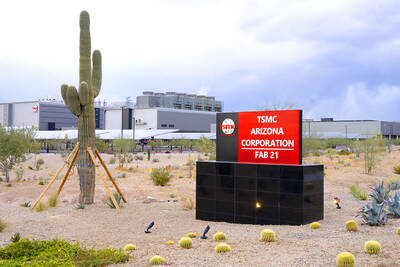
A growing nationwide shortage of high-skilled workers threatens to delay construction of billions of dollars in new semiconductor plants across the US and constrain future chip production unless the industry pools resources and the government keeps up funding, a new report said. The deficit is expected to be most acute in states such as Texas, California, Arizona, New York and Ohio, where many of the new facilities are being planned, according to new analysis including a survey of employers from McKinsey & Co, the chip industry group SEMI and the National Science Foundation. Altogether, the skilled labor deficit is projected to

Chinese start-up DeepSeek (深度求索) is developing its own artificial intelligence (AI) chip, according to three people familiar with the matter, a push that could reduce its reliance on Nvidia Corp and Huawei Technologies Co (華為) chips, which it has depended on to train and run its globally popular models. The chip is designed for inference — the stage of AI computing in which a trained model generates responses for users — rather than for training new models, the sources said. If successful, DeepSeek’s expansion into semiconductor development would mark a major strategic shift for a company widely hailed in China as the
STATUS: A delay to the system does not imply weak capital expenditure, but means the next-gen AI system architecture would take longer, an analyst said Asian technology stocks slumped after a report that Nvidia Corp’s next-generation artificial intelligence (AI) server rack system has been delayed by more than a year due to manufacturing difficulties. Research firm SemiAnalysis said in a social media post that Nvidia’s Kyber NVL144 hit setbacks in the construction of printed circuit boards (PCBs) for the platform. “Our road map is intact,” an Nvidia spokesperson said in an e-mailed statement. The report landed as AI stock investors are growing increasingly jittery, with even the smallest setback sparking outsized reactions after the yearslong rally. Last week, global tech stocks whipsawed on headlines hinting at

Chang Kuo-hua (張國華), a board director at Taiwanese shipping giant Evergreen Marine Corp (長榮海運), was early today released on NT$120 million (US$3.74 million) bail after prosecutors questioned him over allegations of insider trading involving the company's shares. The Taipei District Prosecutors’ Office barred Chang from leaving Taiwan, traveling by sea or changing his residence, and required him to wear an electronic monitoring device. Chang, who is in his early 70s, was among nine people accused by lawyer Lin Wen-peng (林文鵬) in April 2024 of insider trading involving Evergreen Marine shares in 2023. The group included members of Chang's immediate family, his brother,


 RSS
RSS