


Handset camera lens maker Largan Precision Co (大立光) yesterday reported weaker-than-expected revenue for the second quarter, after sales last month reached the lowest level in 13 months as clients entered a product transition period and the company experienced delivery schedule issues.
Revenue for the April-to-June period was NT$13.66 billion (US$427.81 million), down 12.09 percent from the same period last year, but increasing 17.07 percent year-on-year, the company said in a statement.
It came after revenue last month decreased 19.18 percent quarterly and was down 10.46 percent annually to NT$3.71 billion, the lowest since May last year when revenue was NT$3.24 billion.
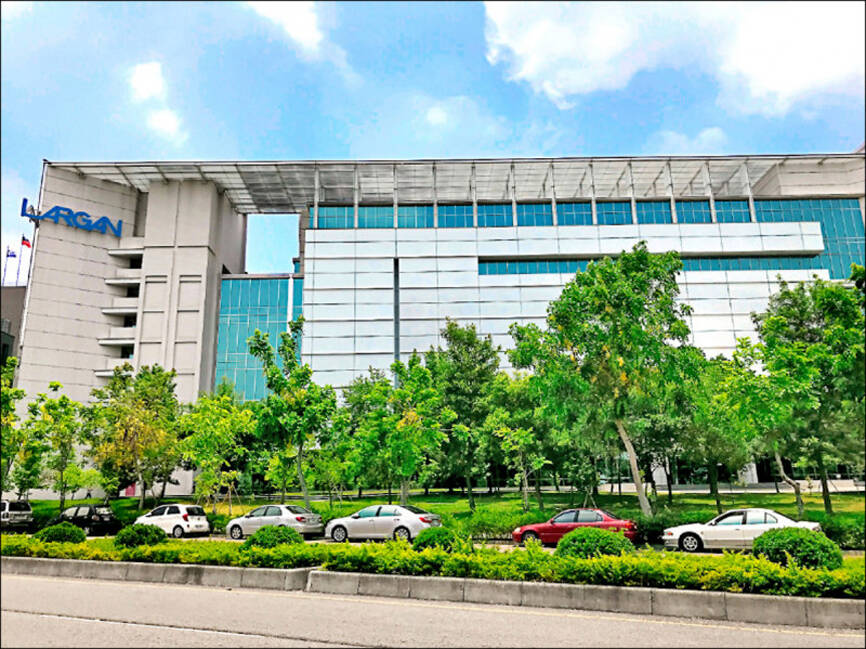
Photo: Chen Mei-ying, Taipei Times
Yuanta Securities Investment Consulting Co (元大投顧), which had expected Largan’s second-quarter revenue to reach NT$1.4 billion, forecast that third-quarter revenue would grow 39 percent sequentially to NT$19.5 billion as the handset industry enters a peak season, it said in a note on Wednesday last week.
“Apple is set to launch iPhone 18 with variable aperture lenses in the third quarter, which will support Largan’s product average selling price, as it has an exclusive supply share,” Yuanta said.
Largan’s revenue for the first half of the year rose 11.26 percent to NT$29.21 billion, compared with NT$26.25 billion a year ago, company data showed.
The Taichung-based company is the world’s largest handset camera lens producer, supplying high-end products for Apple Inc and Android phone vendors, such as Samsung Electronics, Xiaomi Corp (小米) and Huawei Technologies Co (華為).
Largan is to release its second-quarter financial results and factory utilization at an earnings conference on Thursday, and give sales guidance for this quarter.
Investors would learn about the company’s gross margin results, after it fell to 49.4 percent in the first quarter from 54.63 percent a year earlier due to low yields on some products, higher fixed asset investments and increased electricity costs.
Investors are also expected to hear from the company about its progress in the copackaged optics (CPO) business, as Largan is focused on the key component for CPO — fiber array unit (FAU) — which is crucial for optical interconnects at artificial intelligence servers.
Largan has spent eight months in research and development on optical communication applications, leveraging its expertise in precision alignment.
The company can manufacture precision alignment equipment in-house which can control process accuracy for coupling photonic component to optical fibers better than industry standards, Yuanta said.
While the company plans to establish pilot lines using semi-automated production and prepares to send its FAU samples to customers for testing, meaningful FAU sales contribution would not come until 2028 at the earliest, following equipment installation and mass production, Yuanta added.

Their metallic frames covered in supple, lifelike skin, a posse of new Chinese robots meant for companionship can offer users artificial intelligence (AI)-generated conversation or a hand to hold, complete with manicured nails. The company UBTech says its U1 robot — equipped with eye cameras, chest sensors and listening microphones — is the world’s first full-sized, ultra-realistic humanoid designed for mass production. Touted as an antidote to loneliness, the robots are priced at 119,800 yuan (US$17,600) for the most basic type and 990,000 yuan (US$145,700) for an “ultra” version with more advanced features. “Our bionic robots can accompany you for a lifetime,” Michael
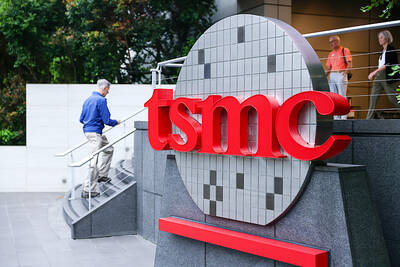
ARIZONA INVESTMENT: The Taiwanese semiconductor firm has gained approval for a US$20 billion capital injection into its its wholly owned US subsidiary The US is unlikely to match Taiwan Semiconductor Manufacturing Co’s (TSMC, 台積電) production capacity in Taiwan despite the chipmaker’s expansion in Arizona, Minister of Economic Affairs Kung Ming-hsin (龔明鑫) said yesterday. TSMC has already announced plans for a total of 16 fabrication plants and advanced chip-on-wafer-on-substrate packaging facilities in Taiwan, Kung said before a ministry meeting yesterday afternoon. “No matter how many fabs the US builds in the future, it won’t be that many,” Kung said. His remarks came after US President Donald Trump reportedly said on Wednesday that Taiwan was doubling the size of the chip plants under construction in Arizona and
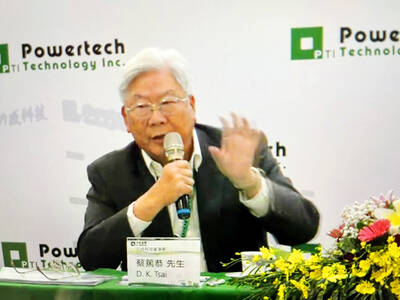
REGIONAL GAMBIT: Powertech’s subsidiary plans to acquire ON Semiconductor’s local operation for US$45m, adding Southeast Asian testing and packaging capacity Powertech Technology Inc (力成科技), the world’s largest memorychip testing and packaging service provider, yesterday said it plans to acquire the entire Philippine unit of ON Semiconductor Japan Holdings Ltd for US$45 million as part of efforts to navigate global supply chain realignment amid escalating geopolitical risks. The transaction will be conducted by its subsidiary Greatek Electronics Inc (超豐), a provider of logic chip packaging and testing services. Powertech holds a 43 percent stake in Greatek. “This move is a core component of the company’s mid-to-long-term growth strategy and directly aligns with major customers’ “Taiwan Plus One” approach to diversify their sourcing in
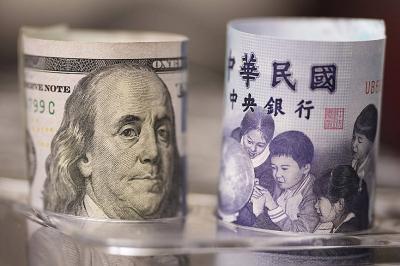
The New Taiwan dollar, which is on track for its first quarterly gain in a year, may face renewed pressure as the US currency strengthens and local companies boost dividend payouts to a record. Domestic firms are set to pay out more than NT$2.5 trillion (US$78.5 billion) in cash dividends this year, according to data from the Taiwan Stock Exchange, the largest amount ever in Bloomberg-compiled data going back to 1990. Foreign-exchange conversions by overseas investors repatriating the funds are expected to add to near-term volatility in the local currency. “The Taiwan dollar could hit a rough patch in the coming weeks,


 RSS
RSS