


China has imposed export controls against two US rare earth producers that are part of Washington’s effort to reduce its dependence on Beijing by establishing an alternative supply chain for the critical minerals.
MP Materials Corp and USA Rare Earth Inc have been added to China’s export control list to “safeguard national security and interests,” the Chinese Ministry of Commerce said in a statement Monday.
The decision ends a months-long lull in China’s use of such restrictions against US companies following last October’s summit between US President Donald Trump and Chinese President Xi Jinping (習近平). In a separate statement, the Commerce Ministry said the move was in response to the Pentagon’s decision this month to add some of China’s biggest companies to a roster of firms it accuses of supporting the Chinese military.
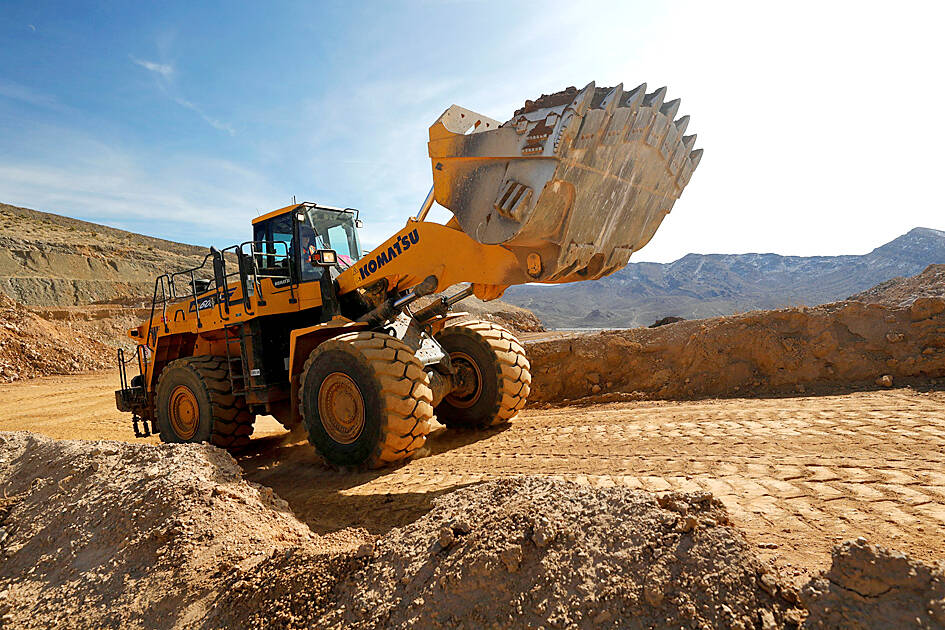
Photo: Reuters
Effective immediately, China’s designation prohibits these US companies from access to items that can be used for both commercial and military purposes.
The order bans organizations and individuals around the world from transferring or providing them with dual-use items originating in China, effectively extending the scope of export controls beyond Chinese borders.
The ministry announced eight other US companies, including drone makers and robotics and aerospace firms, were added to the export control list.
MP Materials operates the only major rare earths mine in America. It is the linchpin of the Trump administration’s push to build a domestic supply chain for rare earths and magnets, which are crucial to advanced manufacturing and defense. Last year, the company got a US$400 million equity investment from the US Department of Defense.
USA Rare Earth is an emerging producer of rare earths, having earlier this month confirmed US$1.6 billion in funding from the US Department of Commerce. It has agreed to buy Brazil’s Serra Verde Group for access to its mines.
Both companies have been building up their capacity over the past year, as the US races to boost production of rare earths and magnets on US soil following a trade standoff with China.
Beijing used its control of rare earth supplies to retaliate against Trump’s tariffs by restricting exports, highlighting supply vulnerabilities and disrupting production from the US to Europe.
The impact would likely be limited this time. The companies said they have largely cut off supplies of equipment and materials from China.
China accounts for about 60 percent of global mined production of rare earths used in permanent magnets that are critical to making everything from mobile phones and electric vehicles to fighter aircraft and missiles, according to the International Energy Agency. Its dominance is even more clear cut in midstream and downstream segments, accounting for above 90 percent of the refining process and almost 95 percent of permanent magnet production, the agency said.

Poland is betting on a flood of investments and technology transfers from Taiwanese companies to reengineer its US$1 trillion economy. Polish Prime Minister Donald Tusk said yesterday that Poland will no longer be “just an assembly hub” as it pursues further investments from the likes of Foxconn Technology Group (富士康). The firm, whose full name is Hon Hai Precision Industry Co (鴻海精密), last month agreed to build electric vehicles (EVs) in the European Union nation and now could be a partner in a semiconductor venture, he said. The government’s aim is to boost manufacturing and the country’s high-tech chops in an era

Google DeepMind vice president John Jumper, who won the 2024 Nobel Prize in chemistry for his work on artificial intelligence (AI), is leaving the company to join Anthropic PBC. Jumper has been a key member of Google’s AI coding development team and his departure strains the tech giant’s efforts to beat Anthropic, OpenAI and SpaceX in the race to build the most powerful AI models. Google has struggled to sell AI coding tools to businesses, according to former employees. Employees and executives at DeepMind have raised concerns in the past few months that the company does not have a clear solution for

RESTRICTION BREACH: ASML said that it denies ‘unfounded rumors regarding non-compliance with export controls concerning China,’ and enforces controls strictly US Secretary of Commerce Howard Lutnick in a series of recent meetings outlined concerns to Dutch chip-equipment giant ASML Holding NV’s senior leaders that one of its top-of-the-line machines might have made its way into China, in violation of US-led export restrictions. In the meetings, Lutnick expressed concern to ASML executives over the company’s extreme ultraviolet lithography (EUV) machines, people familiar with the talks said. EUV systems are used by firms such as Taiwan Semiconductor Manufacturing Co (台積電) to manufacture processors for the likes of Nvidia Corp and Apple Inc. ASML has never been allowed to ship them to China because of curbs

PROMISING SIGNS: The indications of a peace deal, or at least a ceasefire, between the US and Iran have global prices easing down slightly after months of shooting State-owned oil supplier CPC Corp, Taiwan (CPC, 台灣中油) announced on Saturday that it would cut domestic gasoline and diesel prices by NT$1.0 (US$0.03) and NT$0.7 per liter respectively this week, reflecting reduced upward pressure on international energy prices. The announcement marked an end to the company’s 11-week streak of leaving its retail fuel prices unchanged amid military conflicts in the Middle East. CPC said in a statement that international crude prices fell last week after the US and Iran announced plans to sign a memorandum of understanding to extend their ceasefire for 60 days and open the Strait of Hormuz, the choke


 RSS